
Nasdaq Inc. Expands FinTech and Index Leadership with Strong Q2 Momentum
Nasdaq delivers robust second-quarter performance driven by recurring revenue growth, index inflows, and strategic acquisitions.
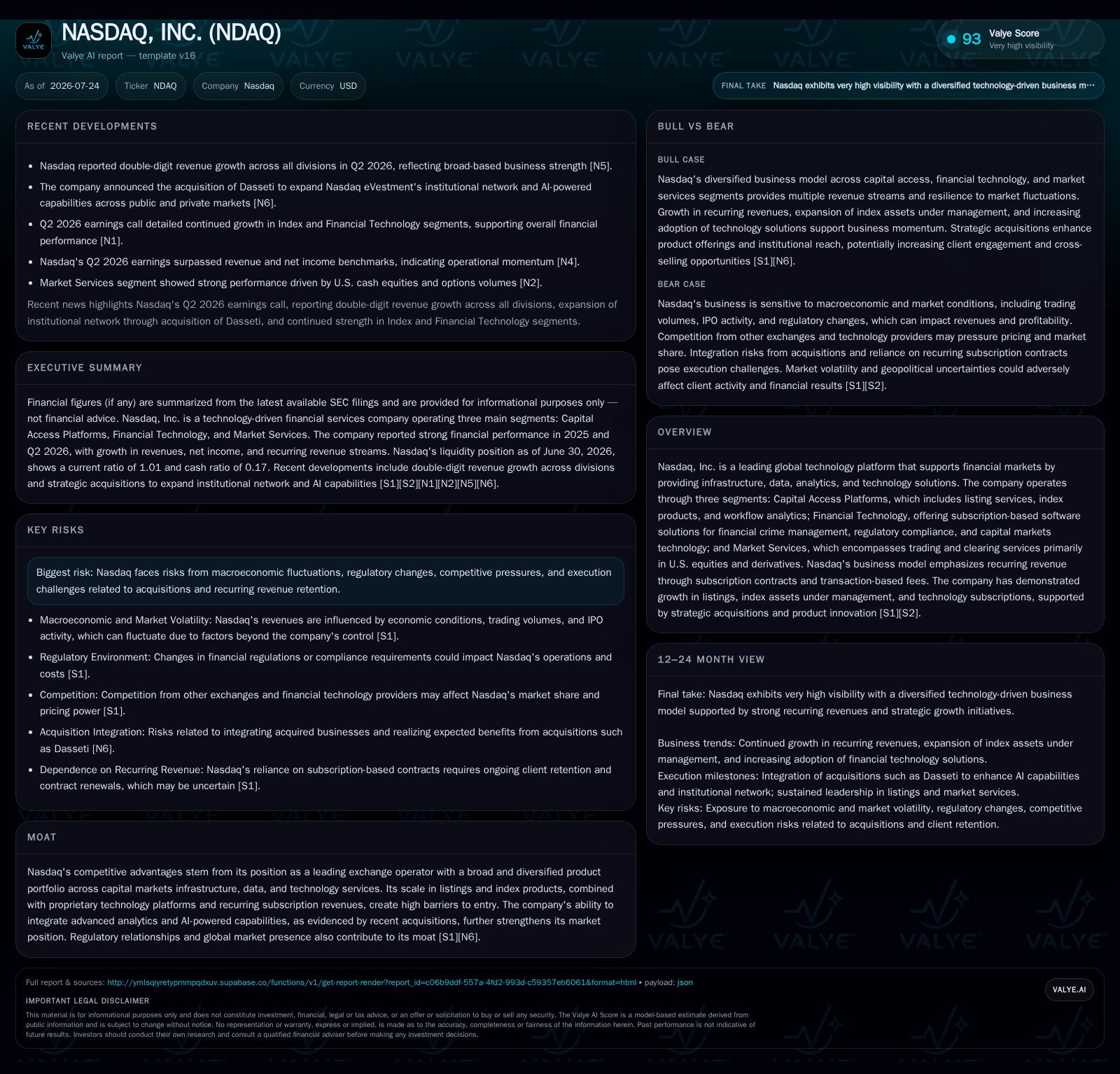
In its latest quarterly report, Nasdaq demonstrated continued strength across its Capital Access Platforms, Financial Technology, and Market Services segments, anchoring its leadership in equity listings and index products while expanding its financial technology subscription base. The company’s business model leverages a diversified mix of transaction-based fees and recurring annual subscription revenue, benefiting from global market infrastructure scale and innovative technology integration. Key growth drivers include robust IPO and listing activity, accelerating index assets under management, and growing adoption of AI-powered financial technology solutions. Risks remain around regulatory scrutiny in Europe and macroeconomic volatility impacting trading volumes. Liquidity remains stable with a current ratio near parity and manageable leverage despite a high gross debt level.
Recent Operating Update
The accompanying earnings release attests that all major divisions delivered “double-digit” revenue increases in Q2, reflecting persistent demand for both transaction services related to equity listings/trading and subscription services tied to data analytics and compliance technology solutions [N5]. Alongside earnings beat expectations, Nasdaq declared a quarterly cash dividend reinforcing steady shareholder returns [S3].
Business Model Overview
Nasdaq operates at the confluence of exchange operator functions, financial data/analytics provision, and SaaS-based fintech solutions — positioning it uniquely within the financial markets technology value chain [S1][S6]. Its revenues derive from:
- Listing services: charges on companies going public or switching exchanges; scale here supports recurring engagement from issuers seeking capital raising opportunities.
- Index products: licensing fees on proprietary indices underpin ETFs/futures/options contracts; growth hinges on expanding ETP counts linked to growing index AUM.
- Subscription-based software: primarily via Nasdaq’s Financial Technology segment offering cloud-enabled regulatory compliance tools, risk analytics platforms (e.g., Adenza acquisition), and institutional workflow software (eVestment).
- Transaction fees: earned on trading volumes in cash equities, derivatives (options/futures), clearing & settlement activities largely in U.S. markets.
This hybrid model buffers Nasdaq against pure volume cyclicality by layering steady ARR growth from fintech while leveraging transactional throughput benefits from market volatility or capital formation surges [S6][S22]. Nasdaq reported approximately 5,599 listed companies spanning U.S., Nordic/Baltic exchanges with combined market caps exceeding $43 trillion as of December 2025—highlighting significant moats created through scale in listings plus proprietary tech platforms utilized by institutional clients [S6][S11]. The Index segment boasts $882 billion in ETF-linked assets tracking Nasdaq indices globally with more than 27 exchanges hosting these products bolstering geographic diversification of fee income streams.
Fintech offerings drive strong subscription margins via SaaS contracts emphasizing repeatability amid incremental upsells/cross-sells within customer bases comprising hedge funds, asset managers, consultants, and corporates leveraging regulatory/risk tools [S1][S6]. Acquisition strategies augment product breadth (Adenza) while recent purchases like Dasseti integrate AI-driven analytics designed to increase stickiness within institutional workflows supporting asset allocation decisions across public/private markets [N1]. This synergy between technology sophistication and global market infrastructure strengthens Nasdaq's competitive moats relative to peers such as CME Group or Intercontinental Exchange which focus more heavily on derivatives trading or clearing.
Industry Structure and Competitive Position
Within the broad financial markets technology ecosystem—encompassing exchange operators (Nasdaq, CME Group), index providers (MSCI, S&P Global), data & analytics firms (Refinitiv), and fintech solution vendors—Nasdaq stands out for vertical integration across multiple asset classes including equities, derivatives, commodities as well as adjacent subscription tech services. The industry demands constant innovation to maintain relevance amid evolving regulation (e.g., MiFID II in Europe), competitive alternative trading venues (dark pools/blockchains), and disruptive fintech entrants deploying AI/ML capabilities.
Nasdaq leverages its leadership position as the top U.S. exchange by proceeds raised for seven consecutive years alongside record listing transfers ($1.2 trillion switch volume) maintaining dominant issuer relationships critical to sustaining listing fee income streams despite episodic IPO cycles [S1]. Its comprehensive index suite feeds ETF product pipelines that diversify revenues away from volatile trading volumes while offering high-margin intellectual property licensing fees that grow with global ETF adoption trends.
The strategic buildout of subscription software platforms targeting institutional asset managers provides complementary and more resilient revenue growth via ARR metrics important in SaaS-led businesses [S15]. Compared to peer exchanges predominantly reliant on transaction fees exposed to market swings, Nasdaq’s diversified model exhibits better margin stability under variable macroeconomic conditions; however regulatory scrutiny particularly within Europe remains a risk vector unlike some domestic regional exchanges less subject to EU competition investigations currently underway against Nasdaq concerning derivatives market conduct
Growth Drivers
Nasdaq's trajectory suggests several clear catalysts shaping future expansion:
- Capital raising environment: Sustained or improving IPO activity alongside large-scale listing migrations drive capital access platform revenues; macroeconomic rebound or policy stimuli would amplify these trends.
- Index innovation: Launches of new international indices particularly targeting insurance annuities and thematic ETFs fuel licensing income growth; overseas ETF adoption widens addressable markets.
- Subscription FinTech penetration: Continued uptake of SaaS solutions powered by AI analytics enhances ARR growth; cross-selling within existing client bases including post-Adenza integrations promises expanding wallet share.
- Market volatility effects: Elevated trading volumes across U.S. equities options bolster transaction revenues; conditions of heightened uncertainty temporarily lift fee generation though introduce cyclical variability risks.
- Acquisitions: Complementary deals like Dasseti fortify institutional insights network enabling superior data-driven workflows which remove friction points for asset managers overseeing both public/private market investments.
- Geographic diversification: Expansion into Nordic/Baltic alternative marketplaces plus scaling European operations ensures balanced exposure against domestic cycles while navigating regulatory environments.
These drivers emphasize structural demand for integrated financial market infrastructure augmented by cutting-edge technological capabilities—a hallmark alignment for Nasdaq’s scalable diversified platform approach.
Risks and Watchpoints
Despite strengths Nasdaq confronts notable constraints:
- Regulatory environment: The EC antitrust investigation focusing on alleged collusion risks fines or operational restrictions possibly affecting derivatives trading dominance in EU jurisdictions which could impact competitive positioning or open avenues for rivals [S15].
- Market dependence: Trading volume-linked fees remain sensitive to economic downturns or sustained periods of low volatility reducing activity levels impacting Market Services segment performance [S1].[N3]
- Integration risk: Assimilating large acquisitions such as Adenza involves execution challenges that could delay planned synergy realization or dilute focus temporarily impeding revenue acceleration.
- Recurring revenue retention: Maintaining high net retention rates across fintech subscriptions requires ongoing client satisfaction amid intensifying competition from emerging cloud-native startups offering specialized compliance tools.
- Currency exposure: International operations subject earnings fluctuations driven by foreign exchange movements particularly given Euro-denominated debt obligations noted at about $8.5 billion total leverage level reflecting substantial gross rather than net indebtedness.[F1]
Stakeholders should monitor developments around regulatory reviews compelling proactive engagement strategies plus periodic updates on capital raising trends influencing transactional segments’ top-line variability.
What To Watch Next
Key signals pertinent for gauging Nasdaq’s forward path include: - Quarterly announcements detailing fintech ARR growth trajectories and net retention metrics confirming subscription base health supported by newly acquired capabilities like Dasseti's AI offerings. - Updates on IPO pipeline strength or secondary market listing transfers indicating sustainable Capital Access Platforms momentum. - Index inflows tracking quarterly AUM changes signaling investor appetite for ETPs tied to proprietary indices underpinning recurring license fees. - Regulatory investigation outcomes in Europe providing clarity on competitive landscape dynamics potentially reshaping derivatives market structure balance among incumbents. - Trade volume trends especially in U.S. equities options providing indicative outlooks for Market Services transactional revenues during different volatility regimes. - Further M&A moves targeting niche tech accelerants fostering innovation pipelines complementing existing fintech stack entrenched since Adenza purchase [N1][N2]
These operational checkpoints will reveal if Nasdaq can maintain its leadership status amidst intensifying industry competition tempered by geopolitical uncertainties.
Financial Profile Discussion
As of June 30, 2026, Nasdaq held approximately $520 million in cash and equivalents against total debt near $8.49 billion yielding a net debt position around $7.97 billion with a current ratio close to parity at 1.01 based on current assets versus liabilities — suggesting sound near-term liquidity management though elevated gross leverage emphasizes prudent capital stewardship remains critical amid interest rate sensitivities [F1]. Dividends have grown steadily with a payout over $1 per share in 2025 underscoring shareholder return commitment backed by stable free cash flows generated from diversified operations [S3].[N3]
Despite sizeable fixed obligations including operating leases ($638 million total contractual commitments) and scheduled debt maturities extending beyond five years ($10 billion principal plus interest), Nasdaq appears positioned to service liabilities through internal cash flow generation supplemented by revolving credit facilities capacity capped above current utilization levels providing buffer funding flexibility [S3].[F1] However monitoring leverage ratios remains essential especially if macroeconomic shocks pressure earnings or disrupt capital access activities adversely impacting liquidity cushion sustainability.
This analysis is grounded exclusively on reported SEC filings up to July 2026 along with significant company disclosures without speculative projections or investment research views.
Disclaimer: This is research-only, informational analysis and not investment advice. It may include AI-generated interpretation and general industry context. Always verify important details using primary sources.

Comments