
NightFood’s Strategic Robotics Expansion Elevates Hospitality Automation
NightFood Holdings’ recent supply agreements and IP acquisitions signal a critical shift toward scaled commercialization of AI-powered robotics in hospitality.
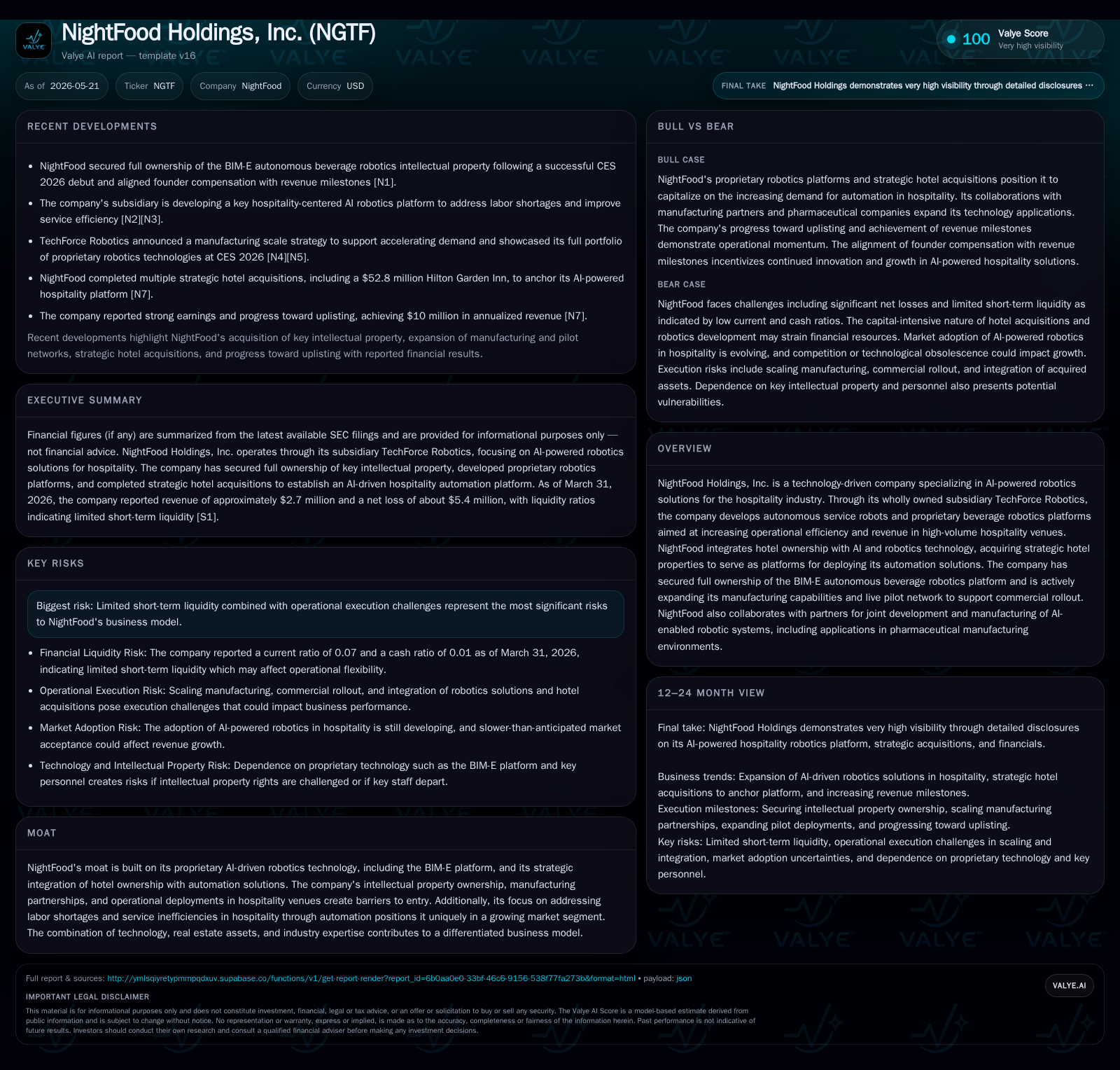
In its latest quarterly filing, NightFood Holdings, Inc. solidified its transition from early-stage development to scalable manufacturing through a strategic supply agreement with NUWA Robotics and Hon Hai (Foxconn), anchored by full ownership of its proprietary BIM-E beverage robotics platform. The company uniquely integrates robotics technology development with hotel ownership, using real estate assets as testbeds and revenue sources while addressing labor shortages in hospitality. Despite promising growth drivers from expanding pilot deployments and manufacturing capacity, NightFood faces significant liquidity constraints that could challenge execution in the near term.
Recent Quarterly Operating Update: Manufacturing Partnerships and Commercial Readiness
NightFood’s definitive step towards commercialization was crystallized on April 11, 2026, via the Supply Agreement entered into by its wholly owned TechForce Robotics subsidiary with NUWA Robotics Corp. and Hon Hai Precision Industry Co., Ltd [S3]. (Foxconn). This tripartite collaboration establishes a product development and manufacturing framework where TechForce prescribes technical requirements for robotic systems, NUWA performs engineering development and system integration, and Foxconn undertakes large-scale manufacturing, testing, packaging, and delivery
Crucially, TechForce retains exclusive ownership of finished products and related intellectual property except pre-existing IP held by Foxconn. This non-transferable IP rights arrangement safeguards NightFood’s proprietary technological moat while benefiting from Foxconn’s globally established manufacturing capabilities. The supply agreement also incorporates upfront payment terms where NUWA advances full payment before material procurement begins [S3]. Such terms underscore the forward commitment by collaborating parties towards achieving scale.
This partnership addresses a historic bottleneck faced by tech-driven hospitality robotics startups — moving beyond prototypes and pilots toward sustained volume production [S2][S3]. It signals NightFood’s evolving operational footprint from niche deployments to commercial readiness, positioning the company to meet anticipated enterprise demand ramp-ups
Business Model: AI-Enabled Robotics Integrated With Hotel Ownership
NightFood's distinctive business model straddles three interlocking domains: the development of robotic automation through TechForce Robotics; operational deployment via hotel ownership; and real-world testing within those owned properties. The company monetizes by selling or licensing its robotic platforms — notably autonomous service robots tailored for high-volume hospitality venues — while leveraging its hotels as both customers and showcases.
This integrated model creates dual revenue streams: direct sales/licensing of automation technologies to external hospitality enterprises alongside income generated from hotel operations augmented by robotics efficiencies. Against a backdrop of acute labor shortages in hospitality leading to rising personnel costs and service inconsistencies, NightFood’s offering satisfies clear customer needs for labor substitution without sacrificing guest experience.
Furthermore, embedding automation pilots within owned hotels yields iterative product validation and incremental operational cost savings. This ecosystem approach creates switching cost advantages by deeply integrating NightFood’s robotic systems into venue workflows, reinforcing client retention potential.
Product Innovation and IP Moat: The BIM-E Autonomous Beverage Platform
At the core of NightFood's product suite is the BIM-E (Beverages In Motion - Everywhere) autonomous beverage dispensing platform. Acquired fully in early 2026 alongside intellectual property rights, BIM-E sets NightFood apart with a proprietary design capable of high-throughput automated drink service customized for hospitality environments [S22]
The company has secured exclusive use rights not only for hardware but also software innovations encompassed within BIM-E’s operational framework. These IP rights encompass patents, software algorithms, trade secrets, and associated trademarks affixed to the product [S3]. Control over this IP elevates barriers to entry against emerging competitors who face challenging OEM partnerships or must license externally developed technologies.
Capacity expansion plans facilitated by their new manufacturing partners ensure NightFood can meet scale demands originating from live pilot programs transitioning towards broader commercial adoption [S3]. The exclusive IP framework paired with vertically collaborative manufacturing arrangements confirms NightFood’s moat strategy rooted in innovation ownership combined with global supply chain scale
Industry Structure: Competitive Dynamics in Hospitality Robotics Automation
The hospitality robotics space remains an evolving sector characterized by fragmented supply bases, nascent technological adoption curves, and labor market pressures compelling automation investment. Persistent staffing shortages across hotels, restaurants, and entertainment venues underpin what appears to be a structural rather than cyclical demand tailwind for service robots replacing or augmenting human labor.
Industry incumbents vary widely from pure-play robotics firms offering modular platforms to integrators combining hardware with AI-driven software suites. However, scaling manufacturing reliably remains a gating factor; few players have secured partnerships comparable to NightFood’s deal with Hon Hai/Foxconn — a key advantage given global supply chain complexities.
Pricing transparency is limited but likely skews premium due to bespoke integration work required per venue type plus ongoing software maintenance contracts. Switching costs rely heavily on technical integration compatibility plus user experience feedback loops sourced from multi-location deployments. Thus, companies like NightFood possessing end-to-end control—from hotel assets through technology innovation to manufacturing—operate with elevated competitive moats relative to peers reliant solely on one dimension.
Growth Drivers: Scaling Manufacturing Capacity and Expanding Pilot Deployments
Core growth vectors emerge from scaling manufacturing throughput enabled by the new supply agreement involving Foxconn as mass manufacturer coupled with NUWA Robotics’ systems integration expertise [S3]. This manufacturing expansion replaces prior smaller-scale assembly models with global production capabilities tuned for high-volume orders.
Concurrently, NightFood is broadening its live pilot network primarily across its hotel portfolio but increasingly targeting third-party venues seeking automated beverage dispensing solutions powered by BIM-E. These pilots act as proof points demonstrating operational cost savings, boosting customer traction that can drive license renewals and new order pipelines.
Additionally, TechForce's joint development venture with Oncotelic Therapeutics to create GMP-compliant AI-enabled robotic systems for pharmaceutical applications provides nascent diversification potential though it remains incremental at this stage [S6][S11]. Nonetheless, it positions NightFood within adjacent complex automation markets enhancing future growth optionality.
Risks and Constraints: Limited Liquidity and Execution Challenges
Notwithstanding operational advances, NightFood faces severe liquidity constraints evidenced by a perilously low current ratio of approximately 0.07 (current assets $1.88M versus current liabilities $25.38M) as of March 31, 2026 [F1]. Such tight working capital limits flexibility to finance inventory buildup or absorb scale-up delays without further capital infusion.
Total net debt hovers near $30M on recent balance sheets putting pressure on cash flow generation that remains negative given ongoing research & development expenses linked to product advancement [F1]. Execution risk is elevated as delays or cost overruns in partner-driven manufacturing or pilot conversions could compound funding gaps.
Moreover, while automation adoption in hospitality gains structural justification, customer acceptance hurdles persist around reliability perceptions and guest service expectations impacting deployment velocity. The niche nature of beverage robotics may also constrain immediate addressable market size pending broader generalization.
Key Milestones and What Investors Should Monitor Next
Upcoming monitoring points include incremental pilot deployment updates quantifying units installed or drinks served metrics; these will validate user adoption trends critical for scaling revenues [S3]. Progression against milestone payments under both NUWA-Hon Hai supply agreements and pharmaceutical licensing deals will reveal commercialization pacing.
Watchpoints also encompass any refinancing announcements or capital raises necessary to remedy strained liquidity profiles before large-scale commercial ramp-up expenditures intensify. Furthermore, licensing contract launch dates for robotic software platforms signed post-pilot phases offer tangible leading signals about recurring revenue formation.
Operational clarity on production timelines as articulated through TechForce will be crucial markers reflecting successful handoff from R&D through mass manufacture — failure here could materially delay topline inflection events documented since late 2025 [S3]
Financial Snapshot: Capital Position Supports Growth but Remains Stretched
NightFood ended Q1 2026 with current assets totaling approximately $1.88 million against current liabilities exceeding $25 million [F1], yielding a highly leveraged liquidity stance that restricts near-term operational maneuverability absent financing initiatives [F1][S2]. Cash plus cash equivalents stood at just over $350 thousand as of mid-2025 latest available data point [F1], indicating limited runway given recurring negative operating income trends tied to R&D investments.
Total debt hovers near $30 million on a net basis as of June 30th last year figures corroborated by balance sheet snapshots [F1]. This leverage level combined with ongoing losses accentuates execution risk given reliance on successful pilot-to-commercial conversions plus milestone achievements embedded in partnership contracts whose financial terms remain undisclosed but presumably material based on prior disclosures [S3].
In summary, while NightFood has secured strategic alliances fundamental to transitioning into volume production modes positioning it well within hospitality automation value chains, the company must manage its stretched capital structure carefully alongside operational execution challenges during this pivotal growth phase.
This analysis synthesizes publicly filed SEC documents up to May 20th, 2026 alongside proprietary Valye Research insights under strict compliance policies prohibiting investment advice.
Disclaimer: This is research-only, informational analysis and not investment advice. It may include AI-generated interpretation and general industry context. Always verify important details using primary sources.

Comments