
National HealthCare’s Growth Through Strategic Expansion and Operational Excellence
NHC combines targeted acquisitions and strong operational metrics to drive senior healthcare growth amid reimbursement and lease challenges.
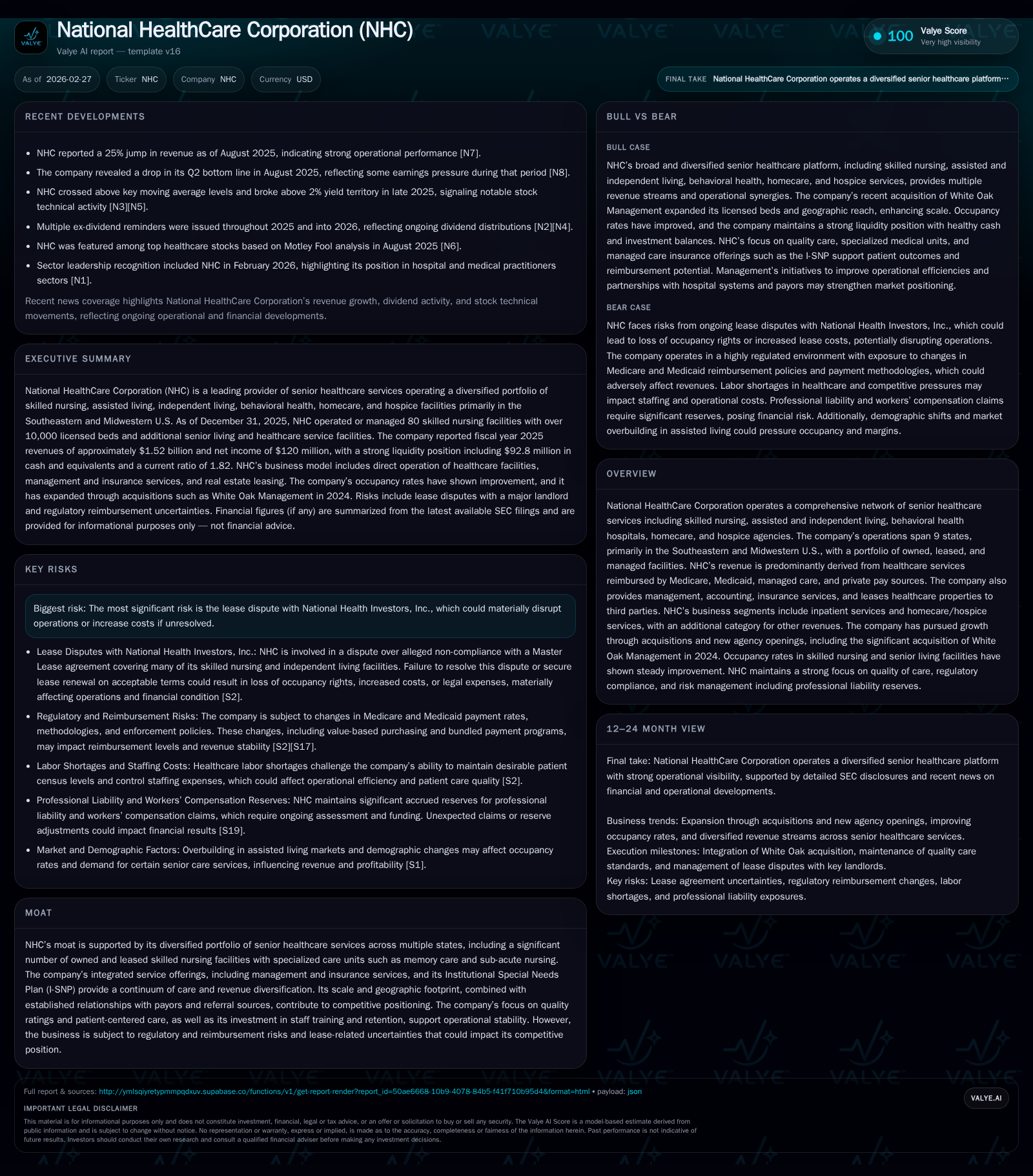
National HealthCare Corporation expanded its senior healthcare footprint notably through the 2024 acquisition of White Oak Management and organic growth in homecare and hospice agencies. This expansion coincides with improved occupancy rates, a superior CMS Five-Star quality rating profile, and robust revenue growth driven by diversified payor mixes. However, operational momentum is tempered by ongoing lease disputes with National Health Investors, Inc. and persistent reimbursement regulation risks. NHC’s disciplined capital allocation includes moderate dividend increases and share repurchases, backed by strong operating cash flow generation despite rising capital expenditures.
Expanding NHC’s Footprint: Acquisition and Organic Growth Trends
National HealthCare Corporation has demonstrated considerable growth over recent years propelled by both acquisition activity and organic expansion. The landmark acquisition of White Oak Management on August 1, 2024 added substantially to NHC's network scope — incorporating 15 skilled nursing facilities with nearly 2,000 licensed beds — along with assisted living and independent living units across South Carolina and North Carolina [S1][S10]. Complementing this inorganic growth were multiple new agency openings in hospice services (notably four agencies placed in service between April and October 2024) and assisted living expansions during mid-2023 [S1][S10].
Historical performance (annual)
| FY | Rev ($mm) | Net ($mm) | CFO ($mm) | OpInc ($mm) | Rev YoY | Net YoY |
|---|---|---|---|---|---|---|
| 2025 | 1518 | 120 | 185 | 128 | +16.1% | +17.7% |
| 2024 | 1307 | 102 | 107 | 86 | +14.5% | +52.6% |
| 2023 | 1142 | 67 | 111 | 57 | +5.1% | +197.6% |
| 2022 | 1086 | 22 | 9 | 32 |
Source: SEC companyfacts cache [F1].
Capital returns and efficiency (annual)
| FY | Div ($mm) | Buybacks ($mm) | FCF ($mm) |
|---|---|---|---|
| 2025 | 39 | 15 | 149 |
| 2024 | 37 | 14 | 80 |
| 2023 | 36 | 2 | 83 |
| 2022 | 35 | 10 | -21 |
Source: SEC companyfacts cache [F1].
Overall, the company's post-acute care capacity encompasses 80 skilled nursing facilities aggregating over 10,300 licensed beds distributed approximately evenly between owned (53%) and leased or managed operations (47%) [S1][S5]. Assisted living units total about 1,400 while independent living approaches nearly 800 units spanning nine states focused primarily in the Southeastern and Midwestern U.S., reflective of demographic concentration trends for senior housing demand [S1][S5].
FY2025 revenue reached $1.52 billion representing a full-year increase of +16.1% year-over-year attributable to the expanded bed base and enhanced agency service offerings [F1]. This accelerated growth follows a progression from $1.09 billion in FY2022 to $1.31 billion in FY2024 underscoring the success of NHC’s expansion strategy [F1].
Operational Drivers Behind Recent Revenue and Margin Improvement
NHC's performance gains extend beyond topline expansion into underlying operational efficiencies. Skilled nursing facility occupancy advanced steadily from 87.9% in FY2023 to near 89.7% in FY2025, outperforming many peers facing labor shortages that typically depress census levels [S1]. These occupancy gains reflect management initiatives targeting referral source engagement as well as innovations to attract qualified clinical personnel amid industry-wide workforce tightness [S2][S18].
This operational leverage translated into a sizeable jump in operating income to $128 million for FY2025 (+49.7% YoY), far outpacing revenue growth — indicative of controlled expense scaling despite inflationary headwinds particularly around labor costs [F1][S18]. Management continues to monitor cost pressures relative to reimbursement trends carefully given sticky Medicare/Medicaid payment structures [S6][S14].
Quality Ratings as a Competitive Differentiator in Senior Healthcare
A critical moat component resides in NHC's commitment to high-quality patient care evidenced by linkage to financial outcomes under value-based reimbursement schemes such as CMS’ Five-Star Quality Rating system. As of December 31, 2025, approximately 62.5% of NHC’s skilled nursing facilities qualified for Four or Five Star ratings compared with the industry average of just 38.6%, positioning the company well within competitive referral networks [S1].
Beyond reputation effects, these ratings influence reimbursement levels under PDPM methodologies that reward quality outcomes more than volumetric care measures – an imperative given ongoing regulatory shifts favoring efficiency benchmarks [S14].
Managing Complex Revenue Streams from Medicare, Medicaid, and Private Payors
The revenue mix is diversified but heavily reliant on government payors: Medicare accounts for roughly 31%, Medicaid another 30%, with managed care at ~12% and private pay making up about 27% of net patient revenues as of FY2025 [S5]. Each segment carries unique reimbursement risks.
Medicare spending reductions mandated under legislation like the Budget Control Act impose automatic cuts potentially up to 2%, which have been consecutively extended through fiscal year 2030 [S6][S13]. Hospice agencies face additional constraints through inpatient day caps (maximally covering no more than one-fifth of total patient days) and aggregate payment ceilings that require repayments if caps are exceeded [S6].
Moreover, increasing emphasis on value-based purchasing shifts reimbursement from volume-based payment towards performance-linked compensation increasing audit susceptibility during claims settlements or retroactive adjustments [S14]. Post-payment audits intensify scrutiny especially for documentation completeness related to medical necessity determinations – issues known to impact long-term care providers nationally.
Lease Agreement Disputes: Risks Surrounding Key Real Estate Partnerships
One prominent operational risk involves an ongoing lease dispute with National Health Investors, Inc., concerning multiple leased skilled nursing and independent living facilities governed by a master lease agreement [S2][S6][S11]. NHI has alleged non-monetary defaults related to lease terms that could escalate into an event of default permitting termination rights.
NHC disputes these allegations but must negotiate renewal terms with uncertainty surrounding fair rental values excluding tenant-funded improvements made voluntarily over lease tenure extending through December 31, 2026 with potential five-year extension options granted by notice submitted October 2025 [S2]. An unfavorable outcome could lead to loss or forced transition out of several key facilities or increased rent burdens affecting profitability and operational continuity.
Evaluating NHC’s Capital Allocation: From Dividends to Buybacks
NHC maintains disciplined capital allocation balancing shareholder returns with reinvestment needs post-acquisition growth phases. Dividends paid rose modestly from $35.6 million in FY2023 to $38.7 million in FY2025 reflecting approximately a +5% annual increase signaling steady income return commitment [F1]. Concurrently, share repurchases accelerated sharply reaching $14.7 million last fiscal year from just $2.48 million two years prior — indicative of opportunistic capital recycling amid robust free cash flows [F1].
This dual-pronged approach reflects strategic flexibility enabling reinforcement of equity liquidity while sustaining funding for organic growth projects.
Cash Flow Generation and Capital Expenditures Underpinning Strategic Priorities
Robust cash flow generation underpins NHC’s strategic execution capabilities; operating cash flow soared +72.5% YoY from $107 million in FY2024 to $185 million in FY2025 fueled by higher earnings and working capital management improvements [F1][S17]. After accounting for capital expenditures which increased +32.1% YoY to $36.4 million reflecting investments toward new agency openings and upgrades addressing aging facility concerns, free cash flow remains strong at approximately $149 million for FY2025 supporting debt servicing capacity and shareholder distributions [F1][S17][S18].
Ongoing capex is critical given industry pressures requiring modernization amidst competition from newer centers often hypertargeting memory care units requiring sophisticated staffing ratios [S11].
What Investors Should Watch: Upcoming Milestones and Industry Dynamics
Looking ahead, key points include resolution progress on the National Health Investors lease dispute pivotal for risk mitigation around site continuity and financial exposure. Regulatory actions influencing Medicare/Medicaid reimbursement rates or enforcement intensity remain vital variables—as does census evolution influenced by labor market tightness impacting staffing availability.
Additionally, monitoring quality rating trajectories will indicate how effectively NHC sustains its competitive advantage within increasingly outcome-driven payment frameworks.
This analysis synthesizes public filings through February 26, 2026, offering a comprehensive overview without investment recommendations or price forecasts.
Disclaimer: This is research-only, informational analysis and not investment advice. It may include AI-generated interpretation and general industry context. Always verify important details using primary sources.

Comments