Northrop Grumman’s Strategic Position and Operational Dynamics in Aerospace & Defense
An in-depth analysis of Northrop Grumman’s recent developments, business model, competitive landscape, and operational economics.
Northrop Grumman remains a leading U.S. aerospace and defense contractor with a diversified portfolio spanning aeronautics, mission, and defense systems. Recent contract wins and solid financial results underscore sustained government demand, while operational risks from supply chain and regulatory scrutiny persist. The company’s integrated systems approach, long-term government contracts, and advanced technology investments underpin its competitive moat in a complex, high-barrier industry.
What Changed Recently
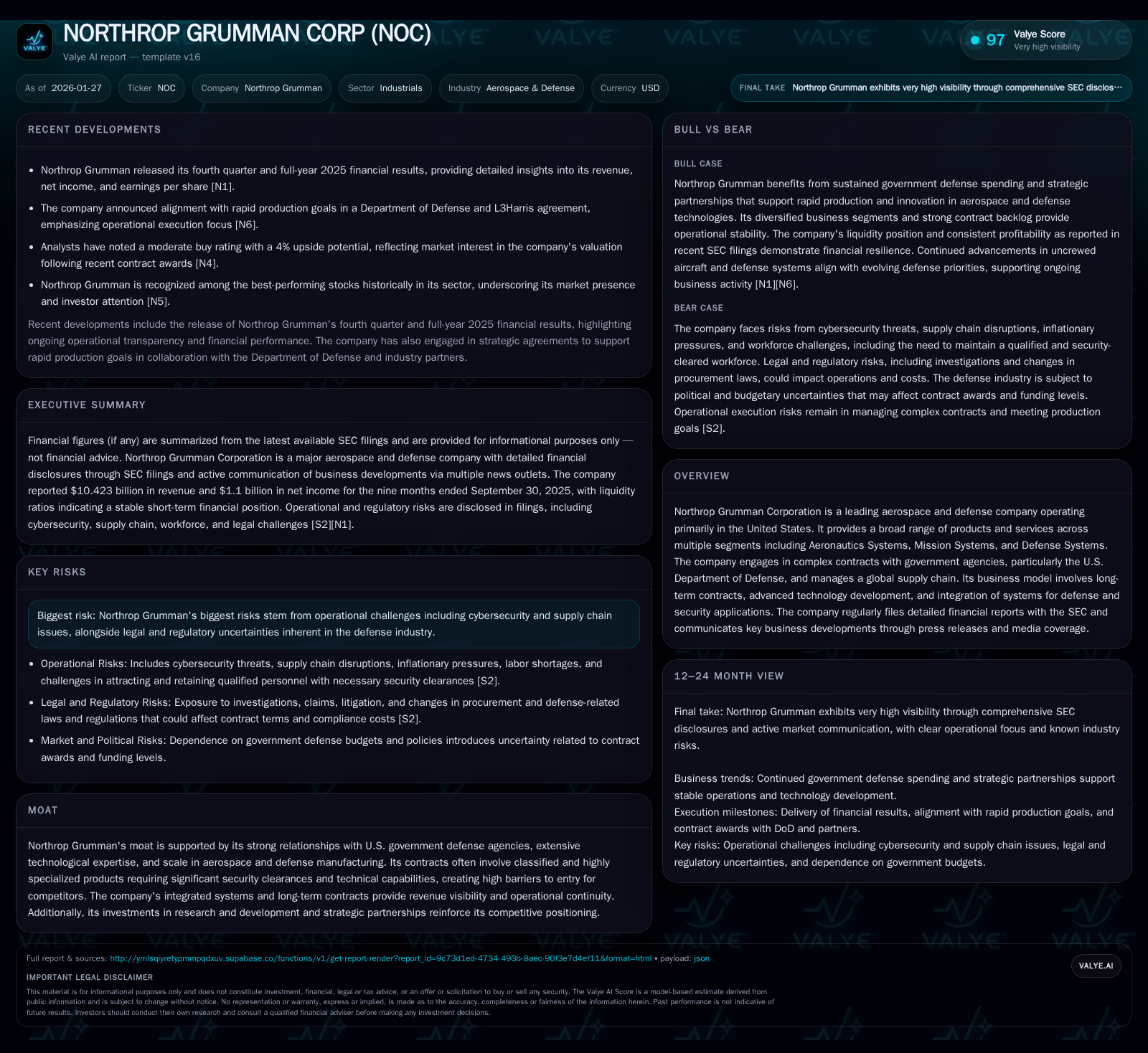
Northrop Grumman released its fourth quarter and full-year 2025 financial results on January 27, 2026, confirming steady growth with strong revenue performance across its segments [N1][N2][N3]. The company notably secured a contract award for the U.S. Marine Corps uncrewed aircraft program, reflecting ongoing demand for advanced autonomous systems in defense applications [N4]. Analysts have moderately upgraded forecasts, factoring in the firm’s robust contract wins and operational execution [N5][N10]. Additionally, Northrop announced alignment with the Department of Defense and L3Harris on rapid production goals, which signals a focus on accelerating delivery and meeting urgent defense needs [N12]. These developments underscore Northrop’s continuing momentum in a competitive defense environment.
Business Model as a System
Northrop Grumman operates through three principal segments: Aeronautics Systems, Mission Systems, and Defense Systems. Each segment contributes distinct but complementary capabilities, ranging from aircraft and autonomous systems to sensor integration and missile defense [S1]. The firm’s revenue primarily derives from contracts with U.S. government agencies, particularly the Department of Defense, accounting for nearly all sales given export restrictions and the classified nature of many products [S7][S8].
The business model involves securing long-term, often multi-year contracts with complex performance requirements and rigorous oversight. These contracts demand advanced R&D, integration of cutting-edge technologies, and compliance with stringent security and regulatory standards. Northrop’s supply chain is global and multifaceted, involving numerous subcontractors and suppliers for components, raw materials, and services—each subject to inflation, availability challenges, and compliance demands [S4].
Revenue recognition follows contract milestones or delivery schedules, with a significant portion of backlog providing revenue visibility. Intersegment sales—transfers of goods and services between operating segments—also play a role in internal resource allocation and cost absorption [S3].
Northrop’s organizational incentives emphasize innovation, security, quality assurance, and cost management to meet government performance obligations. The firm invests heavily in R&D, with capital expenditures and operating expenses supporting technology development, manufacturing capabilities, and workforce training [S16].
Industry Map & Competitive Battlefield
The aerospace and defense sector is dominated by a handful of large prime contractors, including Northrop Grumman, Lockheed Martin, Boeing, Raytheon Technologies, and General Dynamics. These firms compete primarily for U.S. government contracts, often in an oligopolistic environment characterized by significant entry barriers such as high capital intensity, regulatory hurdles, and security clearance requirements.
Northrop’s competitive strengths lie in its integrated systems approach, combining aeronautics, electronics, and missile systems to deliver comprehensive solutions. Its expertise in classified programs and autonomous systems positions it favorably against rivals, particularly in emerging domains such as unmanned and hypersonic technologies.
The industry is influenced by geopolitical dynamics, government defense budgets, procurement policies, and technological innovation cycles. Competitors vie not only on price but also on technological superiority, delivery reliability, and longstanding government relationships.
Supply chain resilience and cybersecurity have become critical competitive factors, as disruptions or breaches can jeopardize contract performance and reputation. Collaborative partnerships, such as the one with L3Harris for rapid production, illustrate the trend toward ecosystem alliances to meet escalating demand and complexity [N12].
Internationally, Northrop’s exposure is limited due to U.S. export controls and the sensitive nature of its products, though some business does occur in allied countries [S7].
Where the Economics Become Real
Northrop’s unit economics are shaped by contract pricing structures that often include fixed-price, cost-plus, or incentive-based arrangements. Managing costs is critical, given the inflationary pressures on raw materials, labor, and components, as well as supply chain constraints [S4][S9].
Margins depend on the company’s ability to control overhead, optimize manufacturing processes, and leverage scale. The reported cost of goods sold and operating expenses reflect significant investment in labor-intensive, high-precision production and stringent quality controls [S9][S16].
Research and development expenses, while substantial, are essential for maintaining technological leadership and securing future contracts. Northrop balances this investment with disciplined capital allocation and cash flow management, supported by a liquidity position with over $1.9 billion in cash and equivalents and a current ratio around 1.11 [S15][XBRL].
Debt levels are manageable, with recent repayments of senior notes reducing interest burdens and preserving financial flexibility [S11]. Operating leverage benefits from the company’s scale but can also amplify risks if contract delays or cost overruns occur.
The availability of a qualified workforce with necessary security clearances remains a bottleneck. Retention and recruitment strategies are critical, given competition for technical talent and the specialized nature of Northrop’s work [S4].
Diligence Questions / Disconfirming Signals
- How will ongoing investigations by government agencies, including the Department of Justice and Defense Contract Management Agency, affect Northrop’s regulatory exposure and financial contingencies? The outcomes remain uncertain and could materially impact operations [S20].
- Given inflation and supply chain volatility, can Northrop maintain cost discipline and meet contract delivery schedules without margin erosion?
- How effective is the company’s strategy for attracting and retaining cleared personnel in an increasingly competitive labor market?
- To what extent could geopolitical shifts and changes in U.S. defense priorities impact Northrop’s backlog and contract renewals?
- How resilient is Northrop’s supplier base in the face of global disruptions, and what mitigation strategies are in place?
- What risks could arise from accelerated production demands in emerging technologies, such as uncrewed systems and hypersonics, in terms of quality and integration?
- How do Northrop’s investments in digital transformation and innovation translate into sustainable competitive advantage relative to peers?
This analysis is based on publicly available information and does not constitute investment advice. Data points and company-specific facts are drawn from reported financial results, press releases, and regulatory filings. Industry context is provided for analytical purposes and should be considered in conjunction with direct company disclosures.
Disclaimer: This is research-only, informational analysis and not investment advice. It may include AI-generated interpretation and general industry context. Always verify important details using primary sources.

Comments