
Northern Trust’s Wealth Management Engine: Navigating AUM Growth, Interest Income, and Competitive Pressures
Northern Trust’s recent earnings underscore the dual engine of net interest income and asset under management growth, but the company’s future trajectory will be shaped by fee dynamics, market volatility, and evolving client expectations in a competitive wealth management landscape.
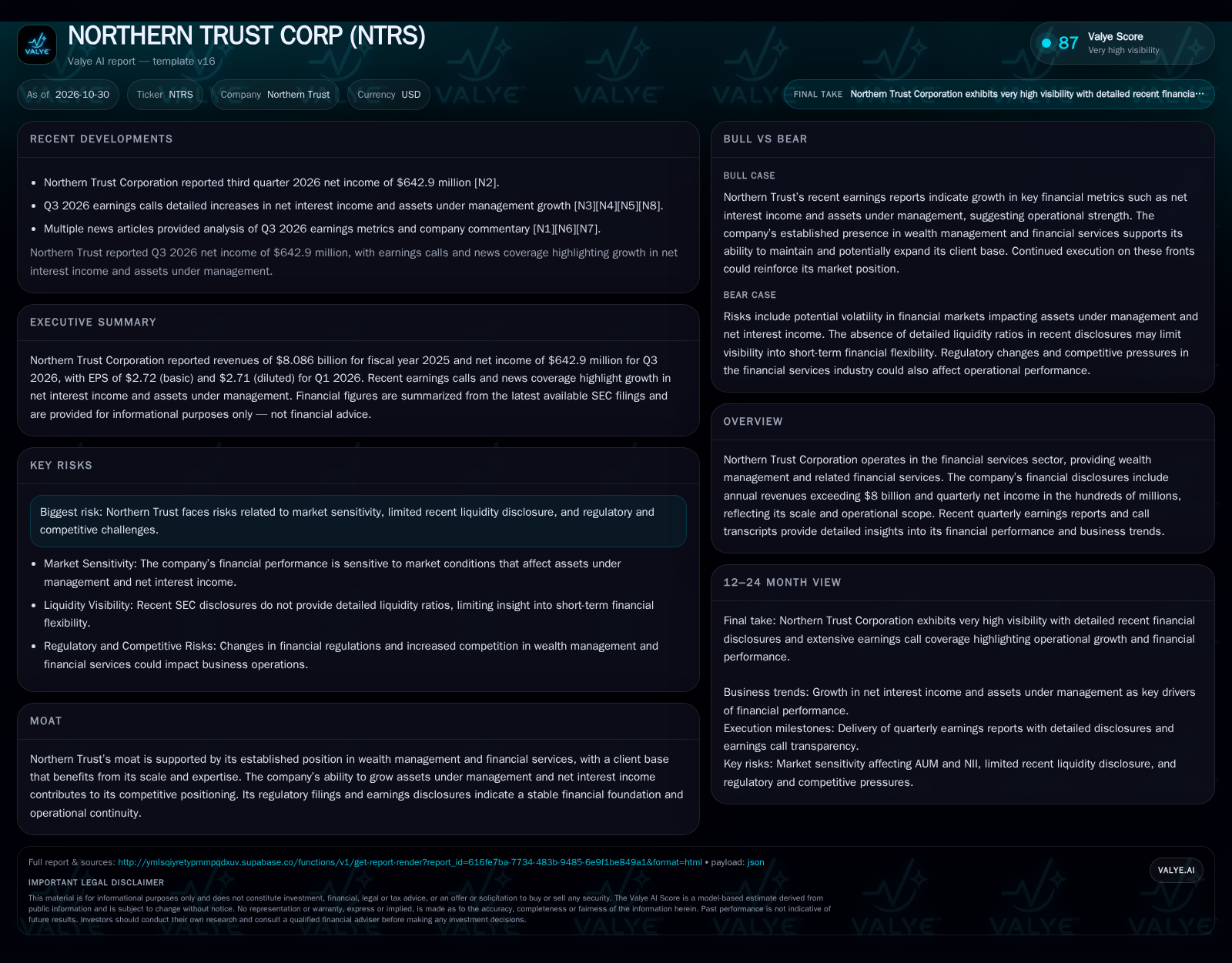
Northern Trust reported strong Q3 2026 results, with net income of $642.9 million and ongoing growth in net interest income and assets under management. The company’s model relies on a mix of fee-based wealth management and net interest spread, both sensitive to market and rate cycles. The critical levers for the next phase include sustained AUM inflows, pricing discipline, and efficiency improvements in a rapidly evolving financial services ecosystem. [S2] [N2] [N5] [N8]
Northern Trust’s latest financial disclosures emphasize the continued importance of net interest income and asset under management (AUM) growth as dual engines for profitability. With Q3 2026 net income of $642.9 million and annual revenues above $8 billion, the company’s operational scale is clear. However, in a sector where revenue mix, pricing power, and sensitivity to interest rates and market volatility can rapidly shift the profit landscape, Northern Trust’s ability to maintain AUM inflows, manage fee compression, and respond to regulatory and competitive challenges will be decisive for its forward trajectory. [S1] [S2] [N2] [N5] [N8]
Recent Earnings and Growth Engines: The Current State of Play
Northern Trust reported net income of $642.9 million for the third quarter of 2026, supported by increases in both net interest income (NII) and assets under management (AUM), as highlighted in recent earnings calls and news coverage. The company’s FY2025 revenues reached $8.0864 billion, underscoring its scale and reach in wealth management and financial services. These results reflect a period of operational strength, with management and analysts pointing to NII and AUM as the main levers of profitability and growth. [S1] [S2] [N2] [N5] [N8]
How Northern Trust Makes Money: Revenue Mix, Leverage, and Sensitivities
Northern Trust’s business model is fundamentally anchored in two revenue streams: fee-based income from wealth management and custody services, and net interest income derived from managing client deposits and investment portfolios. Fee income is typically linked to the value of client assets under management or custody, making it highly sensitive to financial market performance, client inflows/outflows, and pricing discipline. Net interest income, meanwhile, depends on the spread between interest earned on loans/investments and interest paid on deposits—a dynamic that is both a strength during favorable rate cycles and a vulnerability when yield curves flatten or invert.
The company’s large operational scale provides opportunities for operating leverage; incremental AUM often drives higher revenues with relatively modest increases in fixed costs, especially as digital platforms and automation improve efficiency. However, the cost base is not entirely fixed: technology investments, regulatory compliance, and talent remain significant and can rise during periods of business expansion or heightened scrutiny. The absence of recent liquidity disclosures means it is unclear how much financial capacity is available for organic investment or opportunistic acquisitions. Capital requirements are also influenced by regulatory capital ratios and stress-testing outcomes, which can constrain payout policies and risk appetite, particularly in uncertain markets.
Wealth Management Competition: Scale, Trust, and the Threat of Fee Compression
Northern Trust operates in an intensely competitive landscape, vying with large global custodians, private banks, and diversified financial institutions for high-net-worth and institutional clients. Its longstanding reputation, scale, and breadth of services provide a degree of client stickiness, but barriers to switching—while real—are not insurmountable as digital platforms and new entrants lower friction for asset transfers. Fee compression remains a persistent headwind, fueled by client demands for lower costs, the rise of passive investment vehicles, and aggressive pricing from both fintechs and established rivals.
Technology-enabled offerings and integration with clients’ broader financial lives are increasingly important for retention and wallet share. In this environment, differentiation is likely to hinge on service quality, digital experience, and the ability to offer holistic solutions (including tax, estate, and succession planning). Regulatory scrutiny and the evolving landscape of compliance costs could disproportionately impact smaller players, but scale alone is not a guarantee of margin protection if fee rates continue to erode.
Sustained AUM Inflows and Margin Expansion Could Drive a Positive Re-rating
If Northern Trust succeeds in sustaining robust net new asset inflows—particularly from institutional and ultra-high-net-worth clients—while maintaining pricing discipline and expanding its value-added service offerings, it could achieve meaningful margin expansion. Higher average AUM would support both fee income and cross-sell opportunities, while a stable or rising interest rate environment could further bolster net interest income. Investments in digital client experience and operational efficiency could enhance scalability, driving improved operating leverage.
Confirmation of this scenario would come from continued quarterly growth in AUM, resilience in fee rates, expansion in adjusted profit margins, and evidence of client wins against notable competitors. Additional signals would include successful launches of new advisory or technology-driven solutions, and positive commentary from management on pipeline momentum and pricing environment. Falsification would be indicated by stagnating or declining AUM, persistent fee compression, or a reversal in net interest income trends if rate cycles turn adverse.
Managing Through Cycles: Steady Performance Amid Market Fluctuations
The most plausible trajectory for Northern Trust is continued moderate growth, with financial results oscillating in line with broader market and interest rate cycles. AUM may rise or fall with asset values and client flows, while fee rates gradually compress under competitive and client pressure. Net interest income could stabilize or grow modestly if interest rates remain range-bound, but would be at risk if the yield curve sharply flattens or inverts.
In this scenario, operating leverage remains intact but is offset by incremental investments in technology, compliance, and talent. The company maintains its established market position but does not significantly outpace peers in growth or margin improvement. Evidence for this scenario would include quarterly earnings that track sector averages, stable but unremarkable AUM growth, and margins that move within a predictable band. Signs of deviation would include either a sudden acceleration in net new assets or a material contraction in fee income or NII.
Market Volatility and Fee Erosion Could Expose Structural Weaknesses
A sharp decline in global asset prices, coupled with persistent outflows or loss of key clients, could drive AUM materially lower, pressuring both fee income and ancillary revenue streams. In a scenario where interest rates fall or the yield curve inverts, net interest income could contract, compounding the revenue headwinds. If fee compression accelerates—either from competitive actions or client renegotiations—margins could be squeezed, particularly if fixed costs remain elevated due to regulatory or technology mandates.
This scenario would be confirmed by sequential declines in AUM, sharp drops in fee-based revenues, and negative operating leverage. Additional red flags would include management commentary on pricing pressure, loss of major mandates, or the need for cost-cutting initiatives. The absence of detailed liquidity disclosures increases uncertainty about the company’s ability to weather such a storm without resorting to capital raises or asset sales.
Testing the Thesis: What Will Determine Northern Trust’s Next Act?
Quarterly trends in net new asset inflows/outflows—if disclosed—would provide direct evidence of client franchise strength and competitive position.
The trajectory of fee rates and any explicit management commentary on pricing pressure or competitive responses would help test margin resilience.
Net interest income sensitivity to shifts in the yield curve and deposit mix remains a core metric, especially in changing rate environments.
Operating expense growth versus revenue growth will signal whether efficiency initiatives are offsetting inflation and investment costs.
Any disclosed updates on technology investments or digital platform adoption would indicate progress on operational scalability and client experience.
Regulatory capital ratios and risk-weighted asset disclosures, if provided, would clarify capital flexibility and potential payout constraints.
Management commentary on competitive wins/losses or new service launches could reveal shifts in growth prospects or strategic direction.
Disclaimer: This is research-only, informational analysis and not investment advice. It may include AI-generated interpretation and general industry context. Always verify important details using primary sources.

Comments