
New ERA Energy & Digital Accelerates Digital Infrastructure Buildout Amid Funding Hurdles
Latest quarterly filings reveal New ERA’s significant capital access challenges as it advances AI-targeted data center development in the Permian Basin.
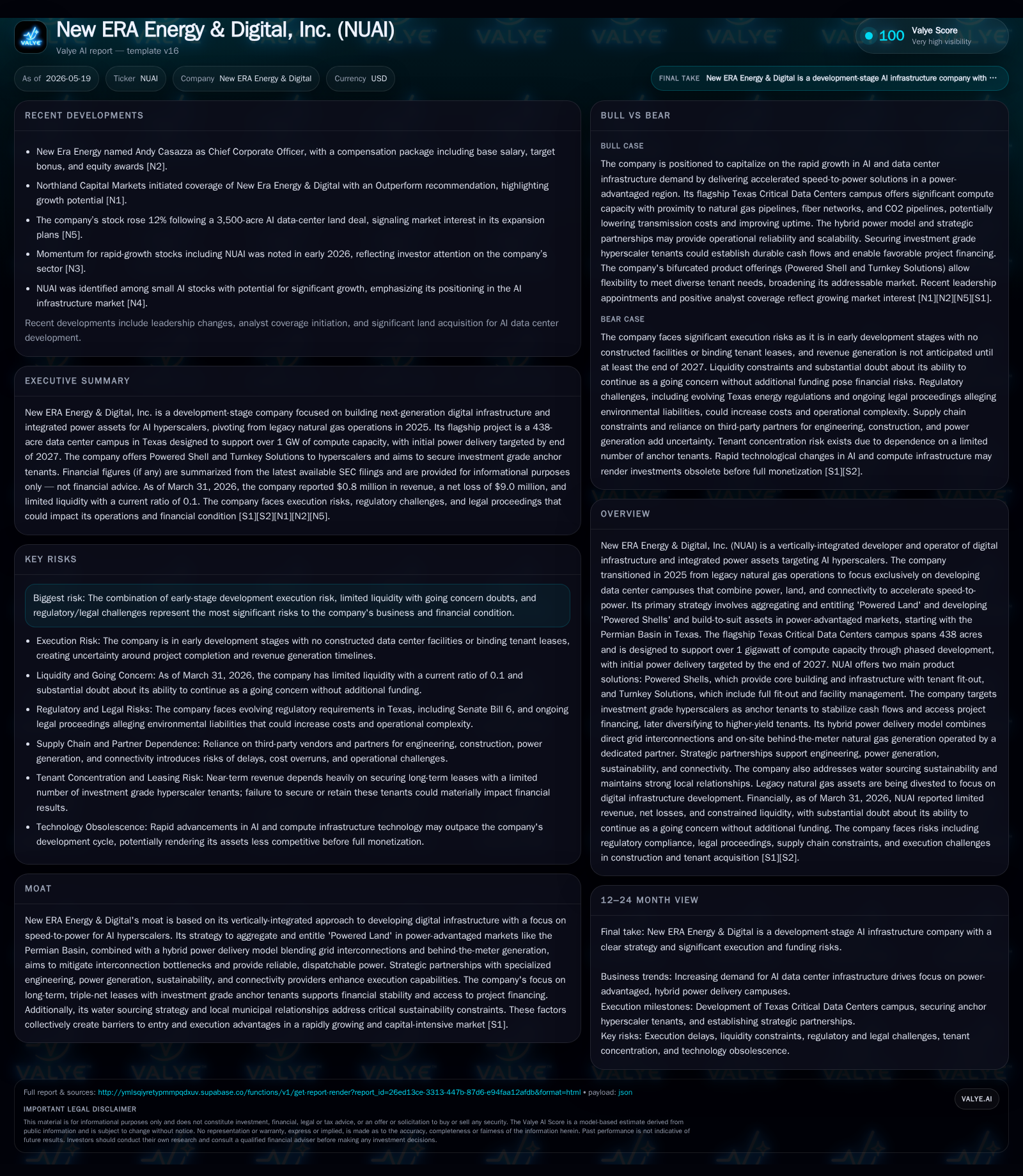
New ERA Energy & Digital, Inc. (NUAI) is intensifying its buildout of large-scale digital infrastructure aimed at AI hyperscalers, centered on its flagship Texas Critical Data Centers campus. The company’s vertically integrated model combines power generation, land entitlements, and build-to-suit data center shells in a power-advantaged market. However, the latest quarterly disclosure highlights substantial doubts regarding the firm's ability to secure needed financing for its ambitious phased development. This tension between execution ambitions and near-term liquidity constraints shapes NUAI’s growth trajectory and risk profile through 2027 and beyond.
Latest Operating Update Highlights Capital Access Challenges
In its most recent quarterly filing dated May 15, 2026, New ERA Energy & Digital (NUAI) disclosed explicit material doubt regarding its ability to secure sufficient project financing, commercial borrowings, or access to debt and equity capital markets necessary to fund its "significant anticipated capital expenditures" related to ongoing development activities [S2]. This admission underscores a pressing near-term financing risk that directly threatens the company's planned execution timeline for its flagship digital infrastructure projects. With large upfront capital commitments typical of hyperscale data center campus development — particularly when integrating complex behind-the-meter power — NUAI faces critical pressure to secure new funding sources or restructure existing obligations.
This liquidity uncertainty necessarily colors the strategic review of NUAI's operating model and growth prospects in a capital-intensive environment where accelerated speed-to-power is both a customer imperative and a competitive differentiator.
Vertical Integration and Speed-to-Power Business Model Explained
NUAI transformed its core business in the latter half of 2025 by pivoting away from legacy natural gas exploration toward a vertically integrated developer/operator model focused exclusively on next-generation digital infrastructure designed for AI hyperscalers [S1],[S11]. This transition marked a fundamental overhaul, repurposing prior operational experience into a platform that controls the aggregation of "Powered Land," the development of "Powered Shells," and deployment of flexible power generation solutions co-located on campus.
Revenue will primarily come from long-term triple-net leases with select investment-grade hyperscale tenants who require low-latency, highly reliable compute environments powered by a blend of grid resources and on-site generation capacity. By owning or entitling large contiguous parcels (e.g., the 438-acre Texas Critical Data Centers campus) in power-advantaged regions such as the Permian Basin — an energy-rich area offering regulatory clarity and fiber connectivity — NUAI aims to simplify interconnection logistics and compress time-to-operation.
Crucially, their hybrid approach pairs direct grid connections (bypassing congested transmission nodes via proximate merchant plants like Vistra and Quail Run) with dedicated behind-the-meter power generation housed on a strategically allocated 20-acre parcel managed by an expert third-party partner responsible for permitting, financing, construction, ownership, and operations [S4]. This not only reduces upfront capex burden but also enhances operational resilience for clients demanding uptime guarantees exceeding typical market standards.
NUAI's business model therefore depends intricately on: (a) successful land aggregation with clear entitlements; (b) standardized yet modular Powered Shell building packages enabling tenant fit-outs; (c) strategic partnerships defraying power asset risks; (d) securing anchor tenants willing to commit long term under take-or-pay leases; and (e) navigating environmental and local regulatory considerations including water sourcing strategies essential for sustainability in Texas conditions.
Industry Context: Power-Advantaged Data Center Development for AI Hyperscalers
Demand for high-performance computing driven by generative AI training workloads has triggered an acute expansion in data center infrastructure needs globally but especially in certain US hubs characterized by energy abundance and fiber network density [S1]. The Permian Basin offers unique advantages due to existing natural gas pipeline proximity supporting dispatchable power generation while providing regulatory frameworks conducive to large load customers — though recent Texas legislation such as Senate Bill 6 shifts some transmission upgrade costs to end users potentially increasing complexity [S20].
Industry players are racing to solve interconnection bottlenecks where utilities historically have limited capacity expansions relative to accelerating demand spikes. NUAI’s strategy addresses this challenge directly through its hybrid grid plus behind-the-meter generation approach aiming not only for baseload capacity but also operational flexibility vital for fluctuating AI compute loads.
This market context elevates speed-to-power as a critical dimension distinguishing viable developers. Large hyperscalers prefer providers able to rapidly deliver scalable infrastructure under triple-net lease terms backed by bankable investment-grade counterparties enabling non-recourse financing solutions. NUAI’s alignment with these sector dynamics underpins its competitive positioning though execution risks remain substantial given early project stage.
Growth Drivers: Powered Land Aggregation and Strategic Partnerships
NUAI’s growth blueprint centers on systematically aggregating "Powered Land" with full entitlements in the Permian Basin necessary for multi-gigawatt scale deployments. Their initial focus is on TCDC — designed for phased buildout exceeding 1 GW compute capacity with first power delivery anticipated by year-end 2027 [S1]. This phased approach lets NUAI manage capital deployment against milestones such as permitting completions and anchor tenant commitments serving as KPIs reducing project risk progressively.
Partnerships are foundational; advanced discussions with a specialized on-site power provider shift substantial generation CAPEX out of NUAI’s balance sheet converting raw assets into service contracts while enhancing reliability metrics essential for client retention. These alliances facilitate project finance solutions isolating development hazards within ring-fenced asset entities bore out by industry precedent favoring limited recourse debt secured solely against stabilized cash flows rather than corporate balance sheets [S4],[S27].
Standardized Powered Shell offerings create product differentiation enabling tenant customization without extensive developmental lead times or cost overruns typical in bespoke builds. By blending modular design with infrastructure ownership rights aligned with energy delivery reliability goals, NUAI hopes to capture structural gains amidst expanding AI workload demands.
Key Risks: Liquidity, Execution Complexity, and Regulatory Exposure
A constellation of risks clouds NUAI's near-term outlook. Foremost is severe liquidity strain highlighted in its recent filing showing cash reserves around $2.2 million juxtaposed against current liabilities exceeding $64 million—a stark current ratio near 0.1 evidencing urgent funding gaps likely requiring fresh equity injections or structured debt refinancings soon or else threatening continuation as a going concern [F1], [S2].
Operationally, the pivot from natural gas assets leaves NUAI without revenue-generating operations until at least late 2027 pending first lease-up subleases plus behind-the-meter energy commencement — heightening cash burn pressures during extended construction cycles [S1],[S13]. Execution risks tied to permitting delays, supply-chain volatility affecting construction timelines/costs, tenant leasing hesitancy amid macro uncertainties compound these stresses.
Tenant concentration risk remains material given dependency on a limited group of high-quality hyperscalers willing to enter extended take-or-pay leases at scale; any failure or repricing here impairs both projected cash flow profiles and subsequent asset financing opportunities [S17],[S20].
Regulatory exposure is nontrivial: evolving environmental laws affecting operating permits alongside legacy legal actions—such as ongoing litigation initiated by New Mexico authorities relating to prior oil and gas activities involving management—add potential financial burdens diverting focus away from core infrastructure development [S13],[S20],[S21].
Monitoring Milestones: Capital Markets Activity, Permitting Progress, and First Power Delivery
Investor focus should prioritize updates regarding successful equity raises or project-level non-recourse financings sufficient to bridge heavy front-loaded capex phases effectively de-risking buildout schedules ahead of initial tenancy occupancy starts. Equally critical will be progress towards securing binding long-term triple-net leases from investment-grade hyperscaler anchors which underpin standardized term sheets for downstream lending syndicates [S3],[S2].
Permitting milestones culminating in full entitlement clearance materially govern schedule adherence while integrations involving strategic power partnership commissioning—particularly behind-the-meter generation assets—function as visible gatekeepers enabling first-phase energization pegged tentatively for year-end 2027 efforts.
Clear communications around contract wins or amendments signaling growing tenant adoption rates would substantially bolster confidence given absence of near-term operating revenues currently constraining liquidity.
Liquidity Snapshot and Financial Position at March 2026
According to the latest reported quarter ending March 31, 2026, NUAI held approximately $2.22 million in cash equivalents facing current liabilities exceeding $64 million resulting in an extremely constrained operating buffer represented by a current ratio near 0.1—well below healthy thresholds indicating urgent capital requirements [F1],[S2]. Total debt stood close to $2.79 million with net debt approximating $0.56 million using best-available figures confronting substantial upcoming expenditure commitments related primarily to campus infrastructure rollout phases.
Such imbalance between liquid assets and due short-term obligations typifies early-stage development firms undergoing strategic pivots but accentuates dilution risk if markets prove unreceptive or if execution slips incur cost overruns necessitating additional bailouts.
This analysis is based solely on publicly available information from SEC filings as of May 19, 2026. It does not constitute investment advice nor research views regarding any securities.
Disclaimer: This is research-only, informational analysis and not investment advice. It may include AI-generated interpretation and general industry context. Always verify important details using primary sources.

Comments