
Nuvalent’s Clinical Advances Contrast with Mounting Operating Losses and Capital Demands
Focused on selective kinase inhibitors, Nuvalent’s key candidates progress through pivotal trials while the company absorbs increasing R&D costs.
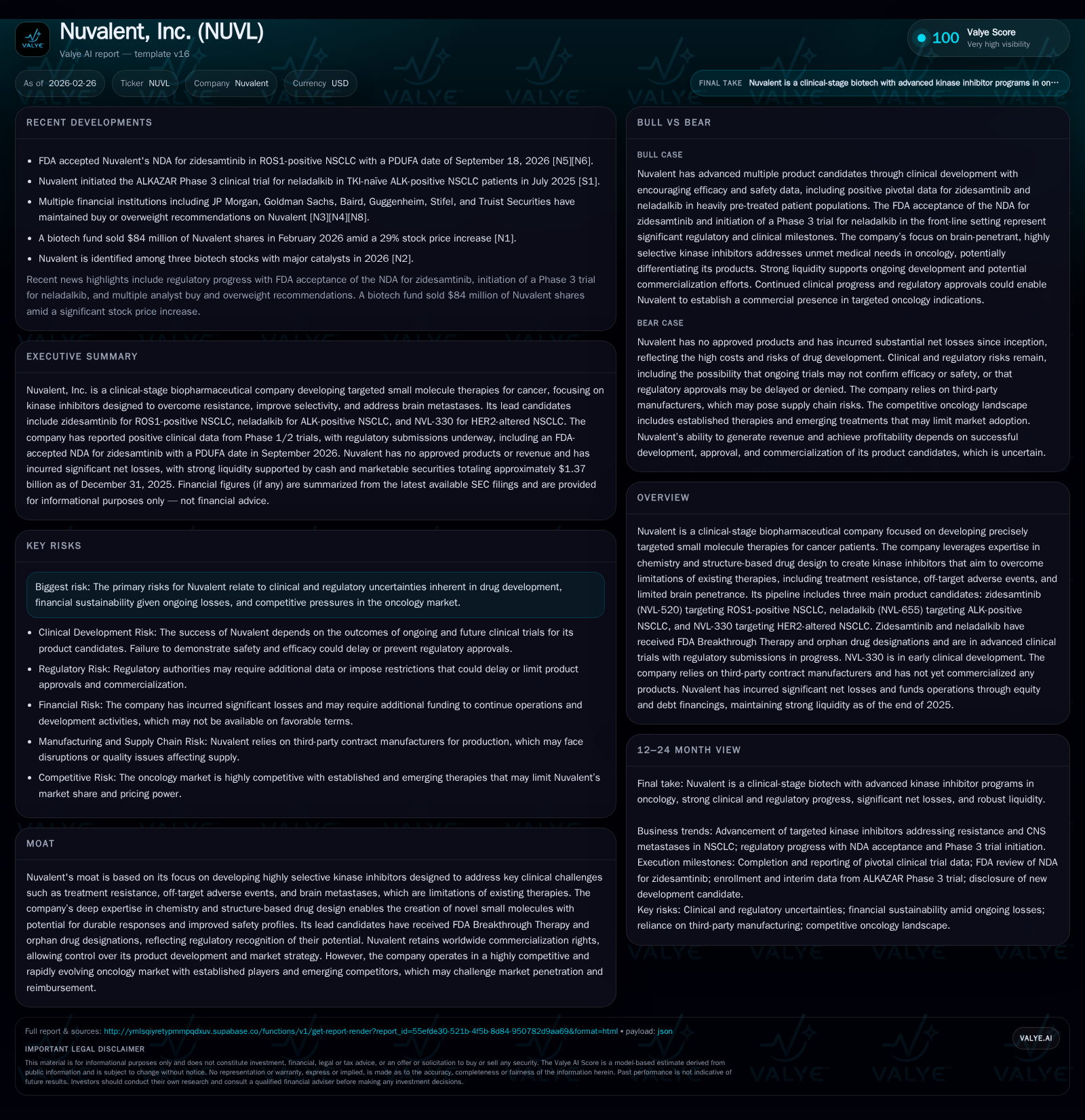
Nuvalent, Inc. is a clinical-stage biopharmaceutical company developing novel kinase inhibitors targeting specific mutations in non-small cell lung cancer (NSCLC). Despite promising clinical data and multiple FDA Breakthrough Therapy designations for its lead assets — particularly zidesamtinib and neladalkib — the company remains unprofitable with widening operating losses and negative cash flow as it prepares for potential commercialization. Supported by robust equity funding and over $260 million in year-end cash equivalents, Nuvalent faces typical biotech risks including regulatory hurdles, competitive oncology markets, and reimbursement uncertainties. Its financial runway extends into 2028, but future capital raises or partnerships may be needed to complete late-stage development and support launch efforts.
Company Overview and Historical Performance
Founded as a targeted oncology specialist, Nuvalent leverages deep chemistry expertise combined with structure-based drug design to develop highly selective kinase inhibitors. These drugs address notable drawbacks of currently available treatments—namely emergent resistance mutations within kinases, off-target adverse events caused by broader inhibition profiles, and poor brain penetrance which limits efficacy against CNS metastases.
Nuvalent's proprietary pipeline centers on three clinical candidates with distinct NSCLC targets:
- Zidesamtinib (NVL-520): A ROS1-selective inhibitor designed for patients harboring ROS1-positive NSCLC; it aims to overcome resistance to prior TKIs and improve CNS activity.
- Neladalkib (NVL-655): Targeting ALK-positive NSCLC with similar goals of addressing resistance mutations relevant to this patient group.
- NVL-330: An earlier-stage candidate focused on HER2-altered NSCLC.
Both zidesamtinib and neladalkib have received FDA Breakthrough Therapy status alongside orphan drug designations underscoring their differentiated potential.[S1][S2] Zidesamtinib is furthest advanced clinically with a completed Phase 1 segment enrolling 104 patients by August 2023 followed by a large Phase 2 expansion where over 435 patients have been dosed across treatment-naïve and pre-treated cohorts. Positive pivotal data released mid-2025 showed durable responses in TKI pre-treated patients, bolstering registration prospects.[S1]
Financially, Nuvalent remains pre-revenue since commercial launch has not commenced. The company’s losses have escalated substantially as it pushes late-stage development forward. Operating income deteriorated from an approximately -$86 million loss in FY2022 to -$414 million in FY2025—a near fivefold increase reflecting scaled R&D investment plus incremental commercial preparations.[F1] Net losses mirror this pattern reaching -$425 million in the latest fiscal year.
Operating cash flows remained negative at $275 million for 2025 indicating substantial cash burn consistent with progression through clinical milestones.[F1] Nevertheless, Nuvalent reported a healthy liquidity position with over $261 million in cash equivalents as of December 31, 2025 alongside current assets exceeding current liabilities by over a factor of fifteen—a conservative financial buffer during this growth phase.[F1]
Historical performance (annual)
| FY | Net ($mm) | CFO ($mm) | OpInc ($mm) | Net YoY |
|---|---|---|---|---|
| 2025 | -425 | -275 | -414 | -63.1% |
| 2024 | -261 | -185 | -280 | -106.6% |
| 2023 | -126 | -100 | -149 | -54.2% |
| 2022 | -82 | -65 | -86 |
Source: SEC companyfacts cache [F1].
Capital returns and efficiency (annual)
| FY | ROE% |
|---|---|
| 2025 | -34.1 |
| 2024 | -24.4 |
| 2023 | -18.0 |
| 2022 | -17.7 |
Source: SEC companyfacts cache [F1].
Figures from SEC filings unless otherwise indicated; negative CFO aligns with stepping up pipeline development costs.[F1][S1][S2]
Pipeline Dynamics and Growth Prospects
Nuvalent’s immediate growth driver depends critically on regulatory milestones related to their lead candidates’ potential market entry:
Zidesamtinib: Data from the ARROS-1 trial have shown encouraging efficacy signals that could support filing NDA applications imminently or within months following comprehensive Phase 2 dataset maturation for both TKI-pretreated and treatment naïve cohorts.[S1][S2] Positive FDA communications reinforce this trajectory given the Breakthrough Therapy designation status.
Neladalkib: Although less developed publicly compared to zidesamtinib, neladalkib also benefits from breakthrough therapy designation. Regulatory submissions are anticipated pending clinical data readouts expected within a comparable timeframe.[N1][S1]
NVL-330: This candidate remains in earlier clinical stages focused on HER2 alterations prevalent in NSCLC subsets; timeline for advancement beyond Phase 1/early development is evolving per ongoing study outcomes.
The key constraints likely involve:
Clinical Risks: As with all oncology therapeutics under development, late-stage trials might reveal unforeseen safety signals or insufficient efficacy which could delay approval timelines or narrow label indications.
Regulatory Uncertainty: Evolving FDA policies around accelerated approvals, real-world evidence requirements, and post-market commitments could impact timing or conditions attached to approvals.[S6][S10]
Market Competition: Established players possess first-mover advantage in ROS1/ALK domains; biosimilars or newer modalities like antibody-drug conjugates could encroach on target populations requiring continuous innovation from Nuvalent to maintain competitive differentiation.
Financial Outlook and Capital Allocation Strategy
Nuvalent currently has zero product revenue reflecting its clinical-stage status. It relies almost exclusively on equity capital markets complemented by convertible debt deals and strategic investor participation for funding operations. Its sizeable liquidity reserves (~$261 million cash equivalents as of Dec 2025) paired with over $1 billion in equity underpin a runway management approach extending into at least mid-to-late decade without immediate capital needs reported.[F1][S14][S20]
Despite the large quarterly operating loss ramp expected around pivotal data disclosures combined with scaling commercial capabilities ahead of potential launches,[S14] Nuvalent has not disclosed definitive near-term capital raises but acknowledges funding through public offerings or collaborations is among options if required.[S17][S22]
The company deploys capital predominantly toward:
- Advancing clinical programs through costly trials globally including patient enrollment expenses.
- Commercial preparation encompassing market access planning, manufacturing scale-up via contract manufacturers, medical affairs infrastructure buildout.
- Regulatory compliance efforts including safety monitoring systems aligned with U.S., EU frameworks.
No dividend payments or share repurchases exist reflecting standard industry practice at this stage. The calculated ROE based on latest annual net loss relative to equity stands at around -34%, typical given developmental expenses outpacing revenues heavily during pipeline maturation phases.[F1]
Competitive Positioning and Industry Context
Nuvalent’s moat stems from its chemistry-driven approach producing selective kinase inhibitors designed to address major unmet needs such as treatment resistance mutations that erode efficacy of first-generation TKIs. Its dual focus on enhanced CNS penetration tackles brain metastasis challenges—a critical differentiator given high incidence of CNS involvement in advanced NSCLC cases.[S1]
However, oncology markets targeted are highly fragmented yet fiercely competitive involving large-cap pharmaceutical companies with established product lines alongside emerging biotechnology firms pursuing alternative mechanisms such as bispecific antibodies or combination regimens. Pricing pressures arising from payor reforms—particularly driven by CMS initiatives emphasizing cost transparency and international drug price comparisons—pose ongoing risks.
Furthermore, regulatory scrutiny regarding promotional activities requires deliberate navigation to avoid costly sanctions while enabling effective stakeholder engagement ahead of full approvals.[S10][S11]
Upcoming Milestones to Monitor (Analysis)
While explicit forward guidance on NDA submission dates or expected commercial launch is absent,[N1][S3] key events that will define near-term prospects include:
- Full pivotal dataset presentations for zidesamtinib’s Phase 2 cohorts including TKI-naïve groups.
- FDA meetings regarding proposed labeling indications derived from ARROS-1 trial results.
- Early clinical updates on NVL-330 potentially establishing next indications beyond ROS1/ALK-targeted therapies.
- Corporate announcements related to financing strategy adjustments amidst evolving market conditions.
In summary, Nuvalent stands at a critical inflection point transitioning from research-focused expenditures toward commercialization readiness fueled by compelling clinical developments. The company demonstrates robust scientific underpinnings but must manage considerable execution risks inherent to biotech commercialization.
This analysis incorporates data extracted from Nuvalent’s SEC filings through February 26, 2026 ([F1],[S#]), supplemented by recent news reports [N1]. No investment recommendations are offered herein.
Disclaimer: This is research-only, informational analysis and not investment advice. It may include AI-generated interpretation and general industry context. Always verify important details using primary sources.

Comments