
NVDA’s Transition to Blackwell AI Infrastructure Drives Revenue Growth Amid Margin Pressure and Supply Chain Shifts
NVIDIA's fiscal 2026 results reflect robust data center demand offset by inventory charges and a shift in product mix impacting gross margins.
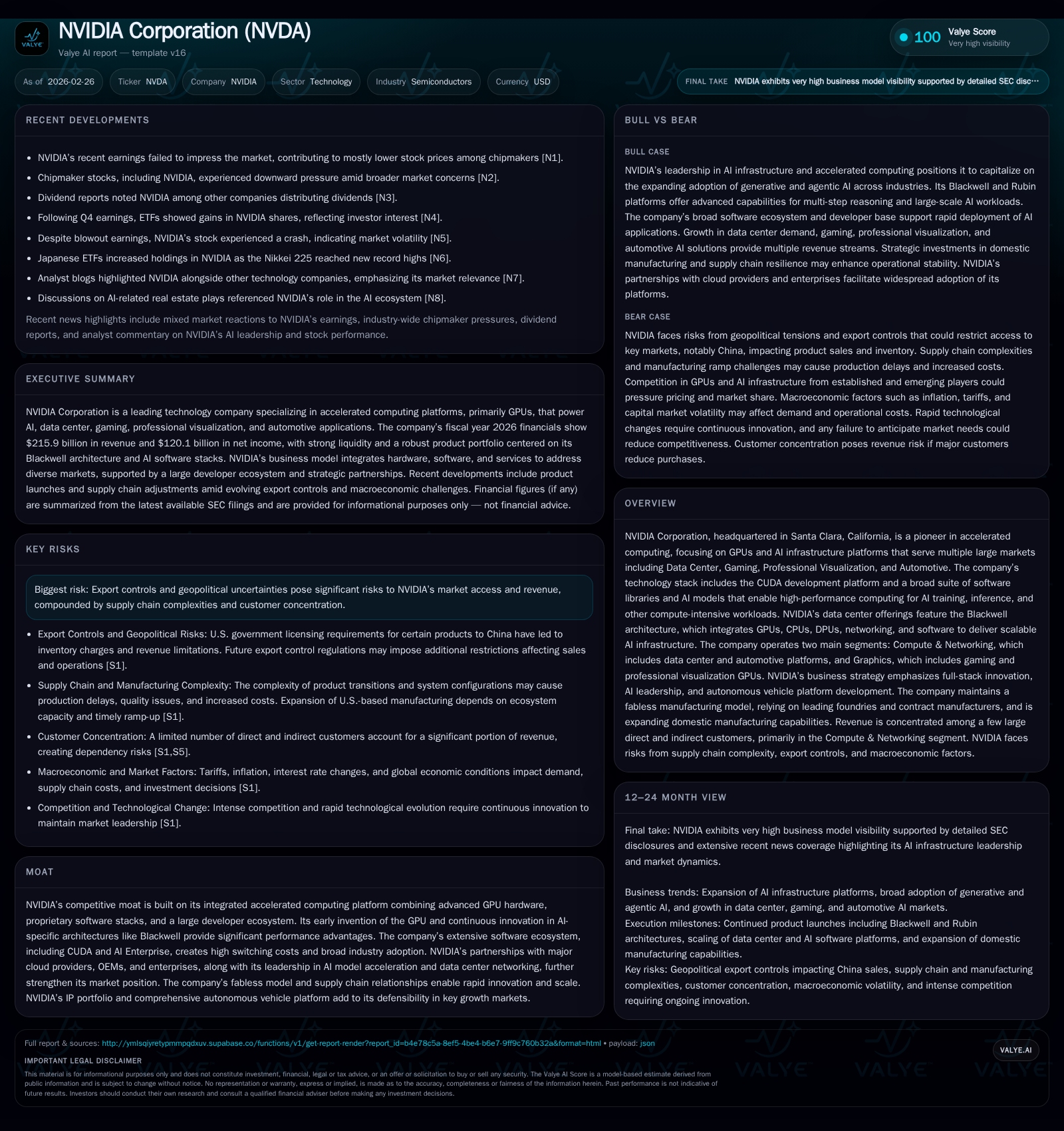
NVIDIA sustained significant top-line growth in fiscal 2026, powered chiefly by its Compute & Networking segment, particularly its data center AI infrastructure based on the Blackwell architecture. Despite expanding revenue, gross margins declined amid a large $4.5 billion charge for excess H20 inventory due to export restrictions and a strategic transition from Hopper HGX to Blackwell systems. Capital allocation remains aggressive with share repurchases totaling over $40 billion in FY26 alongside incremental dividend payments. Supply chain realignment towards more resilient geographies aims to mitigate geopolitical risks. Industry-wide challenges such as export controls and dependency on limited customers introduce notable execution risks.
Company Overview and Historical Performance
NVIDIA Corporation has evolved from a pioneer of GPU technology primarily targeted at PC gaming to a dominant force in accelerated computing infrastructure, with an emphasis on artificial intelligence workloads across multiple industries including data center operations, gaming, professional visualization, and automotive technologies [S1].
Its fiscal year 2026 financial performance underscores this transformation, with revenues reaching $215.9 billion, up from $130.5 billion in fiscal 2025, driven predominantly by the Data Center segment which now contributes roughly $194 billion annually [S10]. This segment's growth reflects widespread adoption of NVIDIA’s Blackwell architecture and associated AI infrastructure platforms integrating GPUs with CPUs, DPUs, networking components, and holistic software optimized for massive-scale AI training and inference.
The Graphics segment also reported revenue gains but remains smaller relative to Compute & Networking [S1]. NVIDIA’s business model leverages its CUDA development platform alongside an extensive suite of AI-specific SDKs and APIs fostering a strong developer community that increases ecosystem value [S21].
Financial Summary Table
| FY | Revenue ($B) | Operating Income ($B) | Net Income ($B) | Capex ($B) | Dividends Paid ($M) | Share Buybacks ($B) | Revenue Growth |
|---|---|---|---|---|---|---|---|
| 2026 | 215.9 | 139.3 | ~141.5 | 6.1 | 974 | 40.4 | +65% |
| 2025 | 130.5 | 88.0 | ~84.0 | 3.4 | N/A | N/A | +114%* |
| 2024 | 60.9 | 37.9 | ~33.8 | N/A | N/A | N/A | - |
*Note: The strong increase between FY24 and FY25 aligns with accelerating global AI adoption trends.
Drivers of Past Growth
NVIDIA’s recent growth stems from:
- Early leadership in GPU innovation enabling highly parallel architectures essential for modern AI workloads.
- Expansion into data center scale infrastructure markets offering integrated hardware (GPUs), networking (DPUs), CPUs, software stacks (CUDA), and AI models supported by thousands of developers [S1][S21].
- Surging generative AI adoption driving demand among cloud service providers (CSPs), hyperscale enterprises, and AI model makers who are key direct customers (two accounted for 36% of revenue in FY26) [S16].
- Continuous product cadence delivering architectures such as Rubin and Blackwell Ultra advancing performance per watt [S1].
- Extensive partnerships across OEMs, ODMs, distributors, system integrators that amplify market reach [S21].
However, headwinds include geopolitical developments such as U.S export controls requiring licenses for sales into China markets impacting availability especially for the H20 GPU family leading to a $4.5 billion inventory impairment in Q1 FY26 [S1]. These regulatory constraints created supply-demand imbalances contributing to margin compression despite healthy demand elsewhere.
Future Growth Prospects
Near-term growth is anchored on capitalizing on surging demand for AI infrastructure critical for next-generation computing workloads including large language models (LLMs) and autonomous vehicle neural network training [N2][S1]. The rollout of Blackwell architecture-based platforms—including Blackwell Ultra—forms the cutting edge of their data center offerings.
Key enablers include:
- Expansion of data center deployments with accelerator-rich environments;
- Software ecosystem enhancements boosting platform stickiness through domain-specific libraries tailored for verticals like healthcare or telecom;
- Strategic investments totaling $17.5 billion in early-stage AI startups during FY26 supporting long-term demand expansion [S1];
- Geographic supply chain diversification mitigating Asia concentration risks while enabling timely production ramp-up amid regulatory challenges [S1];
- Potential licensing approvals that could partially restore China market access under restrictive terms including tariffs [S1].
Constraints include regulatory uncertainties affecting global market expansions; capital availability and energy costs limiting data center scale; competitive pressures from open-source foundation models running on alternative hardware; complexities managing sophisticated product transitions without disrupting supply or incurring warranty costs [S1][S22].
Forecasts and Milestones
NVIDIA maintains an annual cadence introducing new GPU architectures aimed at efficiency and scalable performance [S1]. Recently shipped Blackwell Ultra GB300 units mark tangible progress demonstrating commitment to leading-edge benchmarks vital for hyperscale AI deployments.
Though explicit guidance was not disclosed in filings provided [S3], key developments include:
- Rubin platform ramp throughout fiscal year 2026;
- Sales under newly granted licenses for limited shipments of H20/H200 products into China;
- Operating margin recovery prospects linked to inventory normalization following substantial reserve releases post-Q1 charges;
- Expansion pace into new manufacturing geographies to reduce delivery risks;
- Regulatory updates influencing export license frameworks critical for Asian market access.
Returns and Capital Allocation
Robust operating cash flow supports aggressive capital deployment strategies [S20]:
- Share repurchases totaled $40.4 billion in FY26 substantially reducing shares outstanding supported by premium cash flow generation capacity [S20];
- Dividends paid reached $974 million reflecting steady shareholder returns while maintaining flexibility [S9][S20];
- Capex nearly doubled to $6.1 billion aimed primarily at capacity expansion aligned with demand growth [S12];
Gross margins declined from about 75% in FY25 to approximately 71% in FY26 due mainly to H20 excess inventory charges combined with structural shifts from Hopper HGX systems toward Blackwell full-scale datacenter solutions carrying different cost profiles [S12][S7].
Leverage remains modest with senior notes outstanding near $8.5 billion; liquidity ample supported by commercial paper program capped at $25 billion offering ready funding resources [S25][S20].
Market Concentration and Customer Dynamics
Revenue concentration is high with two direct customers accounting for over one-third of total revenues in FY26 primarily within Compute & Networking segment [S10][S16]. Indirect customers through system integrators or distributors also represent significant individual revenue shares exceeding 10% internally estimated [S8].
Geographically, customer headquarters located in the United States contribute about 69% of revenues with Taiwan-based customers approximately another ~20%, while China’s share has declined partly due to export controls impacting market access [S10][S16]. This geographic reallocation shapes supply chain strategies balancing operational continuity against compliance requirements.
Risk Environment
Key risks include:
- Intensified regulatory scrutiny worldwide concerning competition practices alongside export controls restricting addressable markets notably advanced semiconductor exports to China impacting GPU sales directly tied to technology classification standards [N2][S22];
- Complex supply chain dependencies concentrated largely in Asia prompting shifts toward U.S./Latin America manufacturing expansions enhancing resilience but adding operational complexity [S1];
- Product transition risks involving delays or quality issues increasing warranty provisions potentially causing earnings volatility;
- Competitive threats from advanced open-source foundation models deployed on alternative hardware possibly diluting NVIDIA platform adoption trends over time;
- Revenue dependence on a narrow set of major customers introducing negotiation leverage risk if buying patterns change abruptly.
Conclusion
NVIDIA remains at the forefront of accelerated computing underpinning today’s expansive AI surge leveraging proprietary GPU architectures integrated within broad ecosystem platforms spanning software through hardware layers. Despite near-term margin pressure due principally to inventory write-downs alongside concentrated customer exposure risks, sustained growth prospects backed by relentless innovation pipelines, strategic investments supporting foundational AI ecosystems, capital effectiveness via massive share buybacks, and supply chain resilience initiatives collectively reinforce NVIDIA’s competitive position within semiconductor megatrends shaping modern industries.
This analysis reflects information available as of February 26, 2026 based on SEC filings [S#] and news reports [N#], without constituting investment advice or recommendations.
Disclaimer: This is research-only, informational analysis and not investment advice. It may include AI-generated interpretation and general industry context. Always verify important details using primary sources.

Comments