
BioLife Solutions Examines Revenue Compression and Innovation Imperatives in Biopreservation
The company’s financial trajectory reveals significant revenue pressures alongside the imperative to innovate amid intensifying competition and customer concentration.
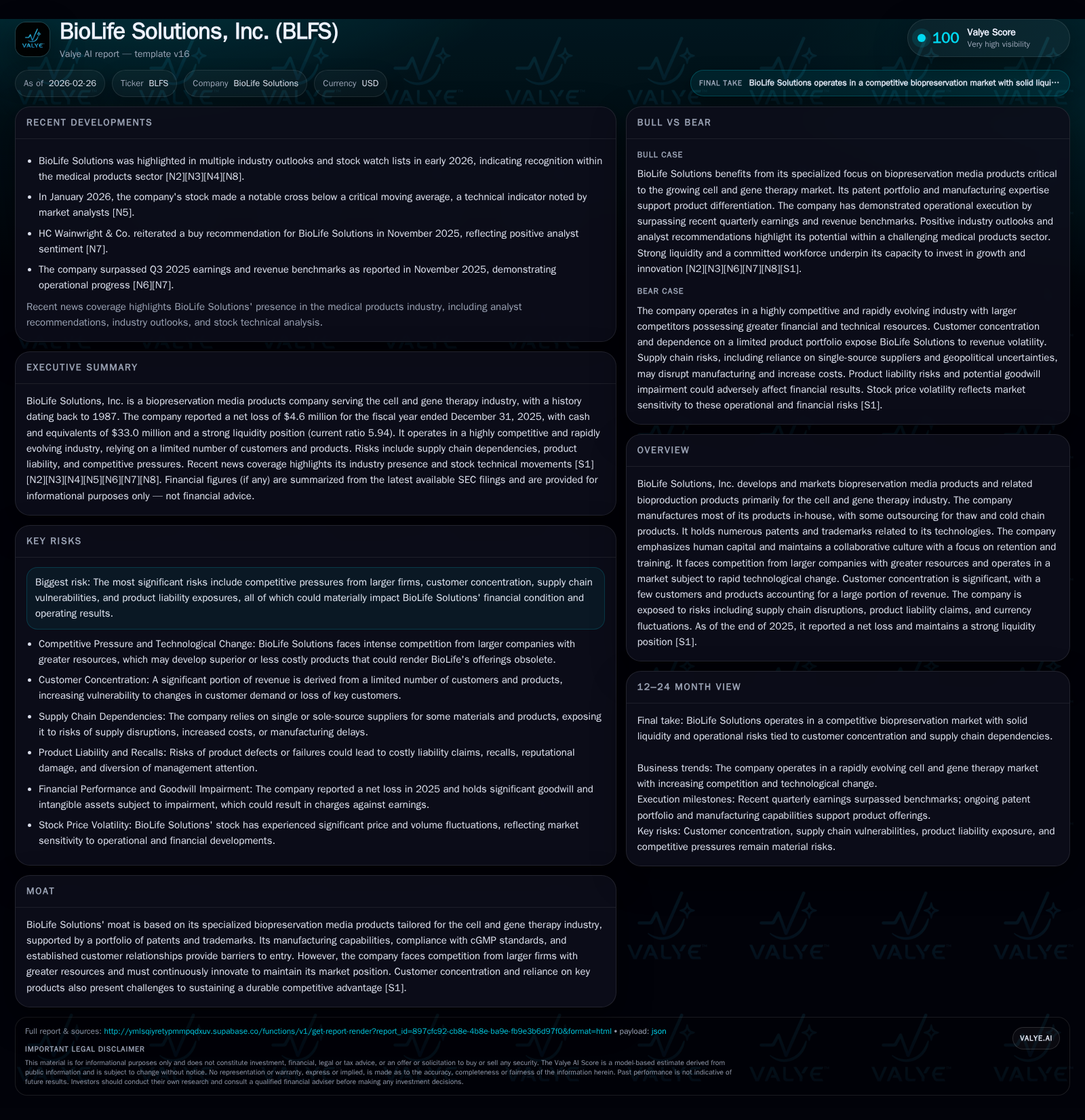
BioLife Solutions, Inc. has historically grown its specialized biopreservation portfolio but faces recent revenue compression, notably a near-31% decline in fiscal 2025. Despite operating losses, cash flow generation improved substantially, reflecting operational leverage and investment focus. The firm maintains a strong patent portfolio and cGMP-compliant manufacturing that underpin its moat, though it contends with concentrated customers and technological competition from larger industry players. Future growth depends on expanding beyond core CryoStor reliance and navigating evolving regulatory frameworks.
Historical Revenue Evolution and Profitability Trends
BioLife Solutions experienced a marked contraction in annual revenues during fiscal year 2025, declining by approximately 30.8% compared to the prior year as documented in SEC filings [F1]. This decline followed a multi-year growth trajectory where revenues had expanded substantially since FY2011 (from about $2.76 million to over $6.19 million reported most recently). Despite top-line shrinkage, the company exhibited improved profitability dynamics — the operating loss decreased significantly from $7.13 million in FY2024 to $16.6 million in FY2025, an improvement over prior multi-year losses. Similarly, net losses narrowed by over 77%, demonstrating enhanced cost control and operational efficiency capabilities while achieving a positive shift in cash generation.
Operating cash flow turned strongly positive at $20.1 million for fiscal 2025, more than doubling from $8.4 million in the previous year, driven partly by working capital management and cost discipline efforts during revenue contraction [F1]. Capital expenditures nearly tripled to $9.48 million, signaling continued reinvestment despite earnings pressure. The company's balance sheet remains robust with a current ratio near six times liquidity coverage maintained by approximately $33 million in cash equivalents paired against current liabilities under $23 million.
Historical performance (annual)
| FY | Net ($mm) | CFO ($mm) | OpInc ($mm) | Capex ($mm) | Net YoY |
|---|---|---|---|---|---|
| 2025 | -5 | 20 | -17 | 9 | +77.2% |
| 2024 | -20 | 8 | -7 | 3 | +69.6% |
| 2023 | -66 | -12 | -71 | 6 | +52.5% |
| 2022 | -140 | -8 | -146 | 10 |
Source: SEC companyfacts cache [F1].
Capital returns and efficiency (annual)
| FY | FCF ($mm) | ROE% |
|---|---|---|
| 2025 | 11 | -1.2 |
| 2024 | 5 | -5.8 |
| 2023 | -19 | -19.7 |
| 2022 | -19 | -38.4 |
Source: SEC companyfacts cache [F1].
Note: Revenue reported annually since FY2011 demonstrates initial growth followed by recent volatility driven by market dynamics.
The juxtaposition of steep revenue declines with improving margins foreshadows oscillations typical for firms engaged in cutting-edge bio-industrial sectors as they grapple with commercialization scale-up costs balancing maturing market demand.
Technological Edge and Competitive Dynamics in Biopreservation Media
BioLife sustains a defendable competitive moat primarily through its specialized biopreservation media tailored for cell and gene therapies – an intensely innovative industry sector [S1]. The company’s patent portfolio encompasses approximately eighty-seven issued patents along with forty-five registered trademarks protecting its novel CryoStor formulations and related technologies crucial for maintaining cell viability during storage and transport.
Manufacturing practices adhere rigorously to current Good Manufacturing Practice (cGMP) standards—a critical regulatory baseline facilitating acceptance in clinical manufacturing settings where quality compliance is mandatory [S4][S8]. Such standards elevate barriers for new entrants due to cost and complexity.
Nonetheless, BioLife faces aggressive competition from larger incumbents possessing deeper R&D budgets and wider commercial reach who may develop alternative or disruptive biopreservation technologies that challenge BioLife’s cost-effectiveness or application suitability claims [S1][S12]. The rapid pace of biotechnology innovation necessitates continuous advancement to defend existing IP rights and maintain technological differentiation.
Customer Concentration Impact on Operational Stability
A considerable proportion of BioLife’s revenues derive from a concentrated customer base — the three largest customers represented roughly twenty-nine percent of overall sales as of the end of FY2025—resulting in pronounced customer concentration risk [S10]. Such dependency exposes BioLife to fluctuations driven by order timing variability or strategic shifts within these customers’ clinical programs.
Product concentration further compounds risk; the CryoStor product line alone comprises about eighty-two percent of total revenues persistently over recent years [S10]. This uneven revenue mix mandates that any disruption or delayed adoption around these core offerings can sharply affect earnings visibility.
Capital Allocation Strategies: From Cash Flow to Investment Priorities
Although BioLife remains unprofitable on a net income basis—return on equity hovered at negative approximately -1.2% as of fiscal year-end—operating cash flow generation has been robust recently ($20 million in FY25), facilitating meaningful reinvestment into operational capacity expansion [F1]. Capital expenditures surged nearly threefold year-over-year reaching close to $9.48 million as resources are deployed into manufacturing infrastructure upgrades or new technology platforms.
No dividends or share repurchase programs were reported indicating a prudent focus on internal reinvestment over shareholder returns at this stage [F1]. Cash reserves exceeding $33 million provide liquidity cushioning amid ongoing expansion investments.
Navigating Regulatory and Manufacturing Complexity
While BioLife’s marketed biopreservation products currently avoid direct FDA approval pathways required for drugs or biologics themselves—because they function as ancillary materials—the company voluntarily complies with cGMP requirements reflecting expectations set by clinical manufacturing partners and regulatory bodies [S4][S8]. This proactive compliance aids market acceptance but adds costs impacting margins.
Potential FDA regulation inclusion remains an uncertainty; should future products be classified differently or expanded regulation be imposed due to evolving public health policies or classification changes related to cell/gene therapy advancements—BioLife could face delays or cost escalation impacting timely commercialization [S4][S5].
Additionally notable are increasing insurance premiums linked to product liability exposures amid complex litigation landscapes facing life science supply companies—a sector-wide trend that BioLife explicitly acknowledges as materially impacting risk profiles [S7][S8].
Supply chain challenges also arise due to reliance on certain single-source suppliers for inputs essential to manufacturing quality-controlled biopreservation media; interruptions could hamper production schedules adversely affecting customer deliveries [S14].
Future Growth Drivers and Market Expansion Prospects
Growth opportunities hinge largely on accelerating adoption within the expanding cell and gene therapy market where preservation solutions remain indispensable across research through commercial manufacturing stages [N2][N3][N4][S1]. BioLife’s extensive patent pipeline also provides avenues toward developing next-generation bioproduction media enhancing performance or embedding complementary functionalities not covered by CryoStor currently.
Diversification efforts appear critical given core product concentration; potential new product lines leveraging proprietary formulations adapted for other therapeutic modalities or geographies could expand total addressable market if successfully brought forward [S1][N3].
Key Milestones to Watch: Financial and Technological Benchmarks
Investors should monitor announcements regarding:
- Signs of revenue stabilization or growth resumption following recent compression documented for FY25 [N3];
- Updates around timing for new product launches providing differentiation or entering less penetrated therapeutic niches;
- Regulatory developments particularly indications whether any products become subject to formal FDA oversight affecting development cycles or compliance costs;
- Progression evidenced by R&D investment outcomes reflected through patent grants or partnership contracts highlighted periodically within SEC documents or press releases [S3][N3].
Risks and Risk Mitigation: Supply Chains, Product Liability, and Competition
Material risks remain pronounced:
- Customer concentration means variability can produce outsized impacts on near-term revenue results combined with possible shifts if competitors win favored supplier status at core clients ([S10]).
- Supply chain disruptions owing partly to geopolitical tensions or sole-source dependencies could impact timely production fulfillment requiring fallback strategies yet unguaranteed ([S14]).
- Product liability claims despite insurance coverage pose reputational damage threats alongside escalated insurance costs limiting coverage breadth necessitating careful risk monitoring ([S7][S8]).
- Technological obsolescence risks prevail given well-capitalized competitors potentially launching superior substitutes requiring ongoing R&D vigilance ([S1]).
- Currency exchange fluctuations add complexity given international operations subject to foreign currency volatility ([S29]).
Mitigation initiatives include maintaining diversified supply contracts where possible; proactive cultural engagement focused on talent retention fostering innovation capacity among the workforce of about 155 full-time employees; ongoing patent portfolio defense strategies; adherence to rigorous quality controls supporting reliable delivery; and cautious capital deployment focused on scalable growth infrastructure ([S1],[F1],[S14]).
This analysis synthesizes publicly available SEC filings alongside recent industry commentary without offering investment advice. It highlights BioLife Solutions’ distinctive positioning tempered by evident market challenges touching revenue consistency and innovation demands essential for durable competitiveness within the dynamic cell and gene therapy biopreservation sector.
Disclaimer: This is research-only, informational analysis and not investment advice. It may include AI-generated interpretation and general industry context. Always verify important details using primary sources.

Comments