
Relay Therapeutics Navigates Clinical Development and Regulatory Hurdles Amid Ongoing Investment
Relay Therapeutics advances its proprietary Dynamo® platform in oncology and genetic disease therapies while managing significant operational, clinical, and regulatory challenges.
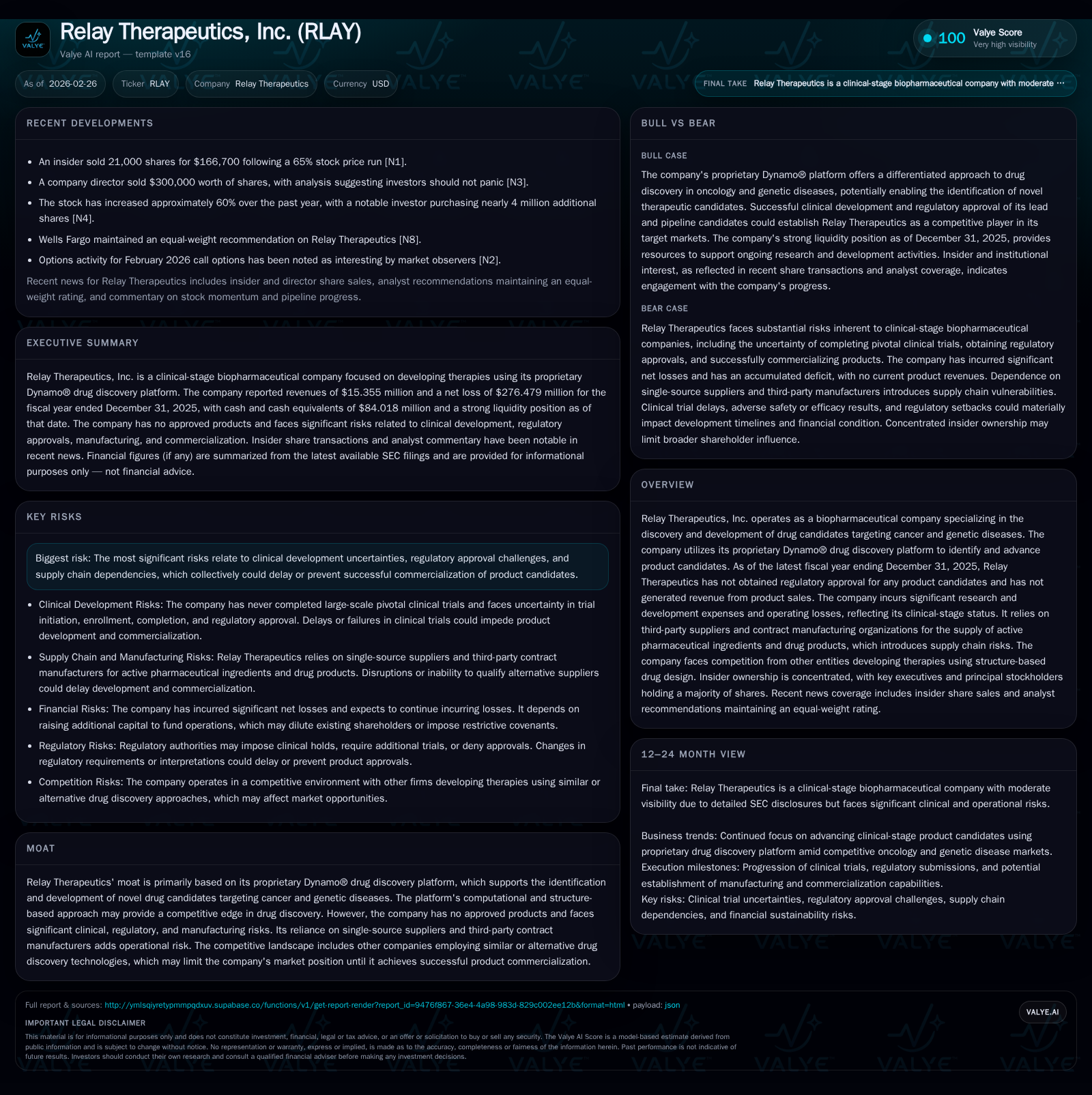
Relay Therapeutics, a clinical-stage biopharmaceutical firm, relies on its Dynamo® drug discovery platform to develop novel therapies. Despite technology progress, the company remains unprofitable with no approved products and reported $15.4 million in revenue in 2025 primarily from collaborations. Operating losses narrowed modestly year-over-year but remain substantial. The company faces risks including clinical trial uncertainties, regulatory complexities, supply chain dependencies, intellectual property challenges, and ongoing capital needs.
Company Overview
Relay Therapeutics is a clinical-stage biopharmaceutical company based in Cambridge focused on the development of oncology and genetic disease therapies leveraging its proprietary Dynamo® platform. This platform utilizes computational approaches to capture dynamic protein motions for structure-based drug discovery aiming to identify novel small molecules that modulate disease-relevant targets. While this technology differentiates Relay within drug discovery, the company has not yet secured regulatory approvals or generated product sales revenue [S1][F1].
Historical Financial Performance
The company's revenue primarily arises from collaboration agreements as no products have been commercialized. Revenue grew from $1.38 million in 2022 to $15.4 million in 2025, representing a 53% increase over the prior year driven by partnerships rather than product sales [F1]. Operating losses remain substantial but improved moderately: operating income loss narrowed from -$373 million in 2023 to -$303 million in 2025, an approximate 19% improvement year-over-year. Net losses similarly improved but totaled -$276 million for the latest fiscal year.
Operating cash flows continue negative trends consistent with capital-intensive clinical development efforts. Cash used by operations was -$235 million in 2025 compared to -$249 million the prior year. Capital expenditures are minimal (approximately $0.41 million in 2025), reflecting limited investment in fixed assets relative to operating expenses [F1].
Historical performance (annual)
| FY | Rev ($mm) | Net ($mm) | CFO ($mm) | OpInc ($mm) | Rev YoY | Net YoY |
|---|---|---|---|---|---|---|
| 2025 | 15 | -276 | -235 | -303 | +53.4% | +18.1% |
| 2024 | 10 | -338 | -249 | -372 | -60.8% | +1.2% |
| 2023 | 26 | -342 | -300 | -373 | +1749.8% | -17.7% |
| 2022 | 1 | -291 | -229 | -299 |
Source: SEC companyfacts cache [F1].
Capital returns and efficiency (annual)
| FY | FCF ($mm) | ROE% |
|---|---|---|
| 2025 | -236 | -48.8 |
| 2024 | -251 | -43.4 |
| 2023 | -304 | -45.5 |
| 2022 | -239 | -30.6 |
Source: SEC companyfacts cache [F1].
Note: Revenue growth variability reflects timing of collaboration revenue recognition.
Growth Drivers
Future growth prospects depend heavily on successful progression of lead candidates through clinical trials toward regulatory approval, leveraging the Dynamo® platform's unique approach to dynamic protein targeting [N2][S1]. Positive clinical data could facilitate investigational new drug (IND) applications and subsequent marketing submissions.
However, uncertainties around trial timelines, manufacturing scale-up relying on third-party suppliers, potential FDA or other regulatory agency clinical holds, evolving healthcare regulations including pricing reforms (such as proposed Most Favored Nation pricing models), and reimbursement complexities pose significant challenges [S1][S11][S18][S19].
Expansion into additional indications or collaborations may enhance growth opportunities but lack specific disclosure currently.
Key Risks
- Clinical Development: No large-scale pivotal trials completed; efficacy and safety outcomes remain uncertain which could delay or prevent approvals [S1][S7].
- Regulatory Risks: Potential changes in FDA/EMA requirements or additional post-approval obligations could impact timelines and costs [S9][S15][S19].
- Supply Chain: Dependence on third-party manufacturing introduces risks of delays or interruptions affecting clinical programs and commercialization preparedness [S1][S26].
- Intellectual Property: Competitive patent landscape with ongoing litigation risk could undermine exclusivity or increase legal expenses .
- Financial Sustainability: Continued substantial net losses and negative operating cash flow require sustained access to capital markets; limited liquidity could constrain operations [F1].
- Compliance Complexity: Global anti-corruption laws, healthcare fraud statutes, data privacy regulations (e.g., GDPR, CCPA), and emerging AI legislation present increasing compliance costs and operational challenges particularly for international activities [S4][S6][S17][S27].
Capital Allocation & Returns
The company has not paid dividends or conducted share repurchases given its developmental stage prioritizing reinvestment into research and development activities [F1]. At fiscal year-end 2025, shareholders' equity stood at approximately $567 million while cash balances totaled about $84 million suggesting reliance on financing activities to fund ongoing operations.
Return on equity remains deeply negative at roughly -49%, reflecting persistent net losses relative to equity base [F1]. Free cash flow remains significantly negative due to high operating cash burn exceeding minimal capital expenditures.
Near-Term Milestones & Outlook Considerations
While explicit forward guidance is absent from public filings, key near-term indicators include progress updates from ongoing clinical trials, IND submission milestones, scale-up of manufacturing capabilities, and regulatory interactions that will shape the developmental trajectory [N2][S3].
Recent insider stock sales following notable share price appreciation alongside analyst upgrades indicate mixed investor sentiment potentially influenced by valuation considerations or liquidity needs [N1][N2].
Evolving healthcare policies around pricing reform and data privacy regulation add further uncertainty to commercial outlooks.
Industry Context Analysis
Biotechnology firms employing structure-based drug design face intense competition where innovation speed and validation rigor are critical for success. Relay’s Dynamo® platform aims to advance this frontier by incorporating protein dynamics insights; however, translating these discoveries into approved therapies requires overcoming inherent translational medicine risks including biomarker validation challenges and heterogeneous reimbursement environments across markets.
Regulatory scrutiny continues to intensify around mechanistic rationale supporting accelerated approval pathways underscoring the importance of robust empirical evidence.
Conclusion
Relay Therapeutics exemplifies a cutting-edge biotech leveraging computational platforms for drug discovery yet remains engaged in an inherently risky development phase characterized by sizable net losses without diversified revenue streams beyond collaborations. Financial discipline combined with successful clinical milestones will be essential to navigate complex regulatory landscapes while maintaining investor confidence over extended timelines preceding commercialization potential. Continued monitoring of pipeline progression alongside external regulatory developments will provide critical insight into value creation prospects balanced against downside risk exposures.
Disclaimer: This report is for informational purposes only and does not constitute investment advice.
Disclaimer: This is research-only, informational analysis and not investment advice. It may include AI-generated interpretation and general industry context. Always verify important details using primary sources.

Comments