
STMicroelectronics’ Declining Revenues and Strategic Pivot Toward Cloud Computing
STM faces margin compression amid declining revenues, while its expanded AWS collaboration signals a pivot to cloud and AI semiconductor growth.
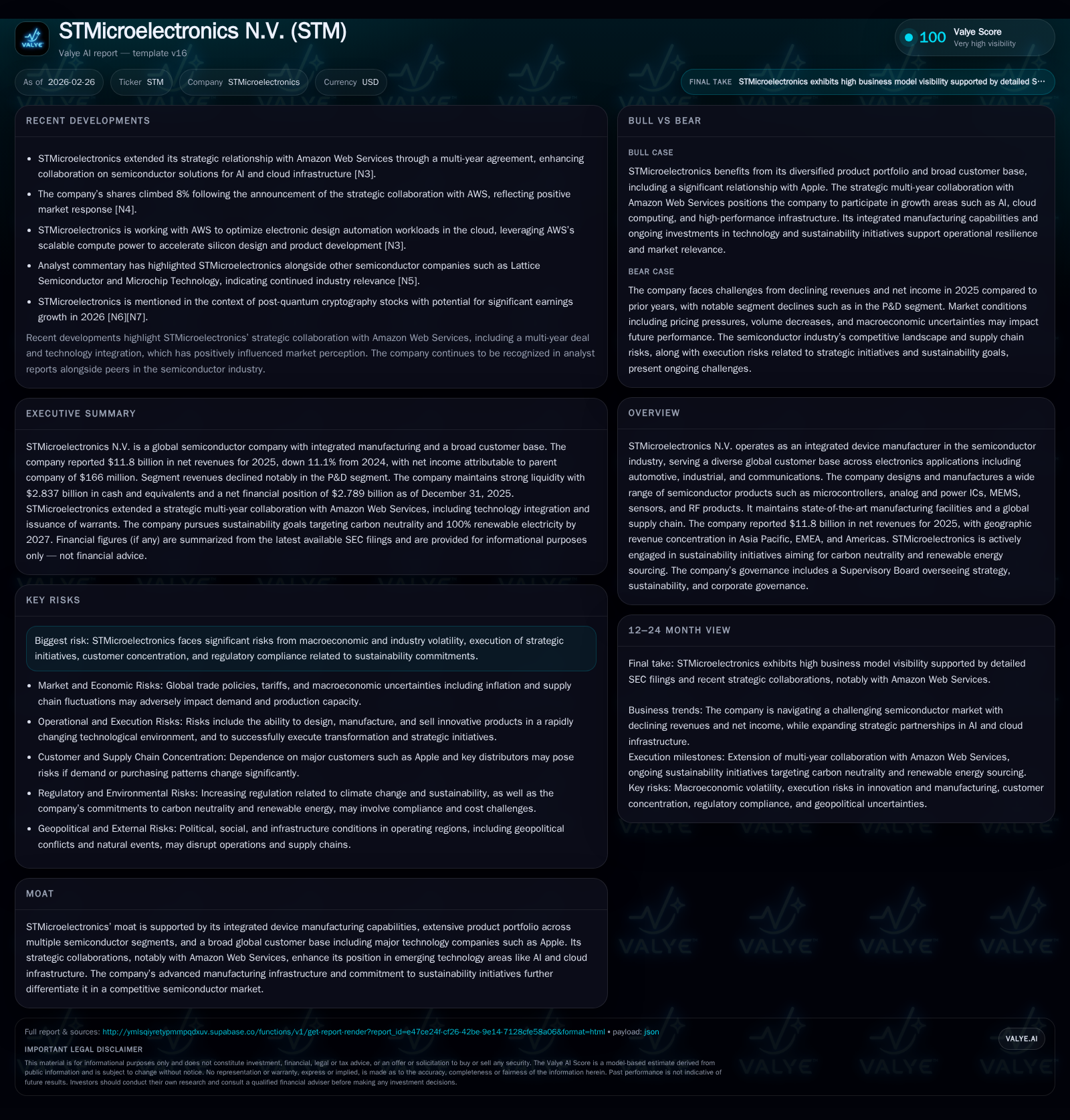
STMicroelectronics reported an 11.1% revenue decline in 2025 following a more severe 23.2% drop in 2024, driven by falling volumes and ASP reductions across segments. Gross margin contracted by 540 basis points due to manufacturing inefficiencies and product mix pressures. Despite financial headwinds, STM's strategic multi-year collaboration with Amazon Web Services aims to position it as a key supplier of high-performance semiconductors for cloud and AI data centers. Capital allocation balanced dividends with significant buybacks and a sharp surge in capex to support manufacturing upgrades.
Historical Financial Performance and Revenue Drivers
STMicroelectronics (STM) experienced significant top-line contraction over the last two years, with net revenues falling from $17.29 billion in FY2023 to $13.27 billion in FY2024 (-23.2%) and further declining by 11.1% to $11.8 billion in FY2025 [S1][F1]. This erosion reflected a combined impact of lower average selling prices (ASPs) declining approximately 6% year-over-year in 2025 due to adverse product mix shifts and pricing pressures, coupled with a roughly 5% volume decrease [S1]. The company's largest customer, Apple Inc., expanded its revenue contribution steadily from 12.3% in FY2023 to 17.7% by FY2025, underscoring increasing customer concentration risk amidst the broader sales decline [S1].
Historical performance (annual)
| FY | Net ($bn) | CFO ($bn) | OpInc ($bn) | Net YoY |
|---|---|---|---|---|
| 2025 | 0.2 | 2.2 | 0.2 | -89.3% |
| 2024 | 1.6 | 3.0 | 1.7 | -63.0% |
| 2023 | 4.2 | 6.0 | 4.6 | +6.3% |
| 2022 | 4.0 | 5.2 | 4.4 |
Source: SEC companyfacts cache [F1].
Capital returns and efficiency (annual)
| FY | Div ($mm) | Buybacks ($mm) | ROE% |
|---|---|---|---|
| 2025 | 71 | 367 | 0.9 |
| 2024 | 72 | 359 | 8.9 |
| 2023 | 346 | 25.2 | |
| 2022 | 346 | 31.2 |
Source: SEC companyfacts cache [F1].
Data sourced from STM filings with SEC ([F1], [S1])
Segment-Specific Trends Influencing Recent Revenues
STM segments are broadly classified as Automotive & Discrete-Sensors (AM&S), Power & Discrete components (P&D), Emerging Products (EMP), and RF-Optical Communications (RFOC). P&D revenues plummeted by nearly one-third (-31.5%) in FY2025 due to a dramatic ~29% decrease in ASPs reflecting unfavorable product mixes dominated by commoditized discrete components plus volume declines [S1]. The AM&S segment saw a more moderate revenue drop of about 6%, driven predominantly by volume reductions partially offset by better pricing on certain analog/MEMS sensor products [S1]. EMP also declined (-7%) from reduced volume and less favorable sales mix mainly impacting microcontrollers [S1]. Interestingly, RFOC soaked up some downside as increased volumes (+14%) partially balanced weaker selling prices leading to a smaller net decline (-4.9%) [S1].
These trends attest to pressures across discrete semiconductors and legacy analog product lines coinciding with slower industrial end-markets but show pockets of resilience or growth where specialty mixed-signal ICs remain strategically important.
Gross Margin Compression and Its Operational Causes
Gross margin suffered notable contraction falling from an already diminished level of 39.3% in FY2024 down to just under 34% (33.9%) in FY2025 — a deterioration of approximately 540 basis points [S1]. Management attributes margin compression mainly to lower manufacturing efficiencies attributable to suboptimal fab utilization rates and yield challenges germane to IDM operations balancing mature and advanced nodes [S1]. Additionally, chargeable unused capacity costs rose amid cyclical demand softness while adverse currency swings trimmed profitability further.
From a production standpoint, these dynamics spotlight how IDM chipmakers like STM incur fixed cost burdens during periods of weaker demand that dilute operating leverage essential for healthy margin profiles.
Strategic Collaboration With Amazon Web Services: A Catalyst for Future Growth
In early February 2026, STM renewed an extended multi-year commercial alliance with Amazon Web Services valued at several billion dollars designed to supply bespoke semiconductor solutions powering AWS’s cloud infrastructure especially targeting AI workload optimization [N5][N6][S3]. Under this arrangement STM will provide advanced mixed-signal processing ICs delivering high bandwidth connectivity alongside energy-efficient power management integrated circuits tailored for hyperscale data center environments.[S3]
This partnership leverages STM’s IDM expertise across advanced microcontroller development and power ICs adapted for intelligent infrastructure system management aiming to reduce operational costs and scale large compute-intensive workloads leveraged heavily by machine learning applications.[N6] This positioning counters segment headwinds faced elsewhere by embedding STM technology into next-generation compute platforms spearheaded by hyperscalers.
Market Channel and Geographic Revenue Shifts
Revenue composition by distribution channel shows modest shifts towards indirect channels: Distribution accounted for about 28% of total net revenues in FY2025 versus roughly 27% in FY2024—reflecting slight rebalancing within the global supply chain ecosystem common among semiconductor firms adapting channel strategies [S1]. OEM direct business remains dominant at approximately 72%.
Regionally, Asia Pacific remains STM’s largest market (~63% of total sales) but posted a moderate revenue decline (-4.8%) primarily reflecting weakness in certain industrial-related P&D sales [S1]. EMEA endured the sharpest falloff with revenue dropping over one-quarter (-26%), mainly from reduced Analog device volumes compounded by automotive microcontroller softness [S1]. The Americas region showed a double-digit revenue decline (-10%) yet some pockets like RF Optical Communications improved on stronger ASPs offsetting general weakness elsewhere.[S4]
This shift underscores the geopolitical complexities impacting supply chains alongside competitive intensity across regions.
Capital Allocation: Dividends, Buybacks, and Investment Priorities
Despite profitability pressures, STM continued disciplined capital returns including dividends totaling approximately $71 million paid out during FY2025 with consistent quarterly distributions approved [S14][F1]. Share repurchases accelerated slightly to $367 million supporting shareholder value amid undervalued stock price considerations observed through the year [S5][F1].
Concurrently, capital expenditures surged sharply (+130%) reaching over $2.5 billion as part of aggressive investments supporting capacity expansions within state-of-the-art IDM fabs located primarily in Europe including wafer fab upgrades suitable for analog/mixed-signal devices aligned with cloud infrastructure priorities [S9][S11][F1].
Return on equity remains muted at roughly ~0.9%, reflecting transitional profitability lows compounded by heavy investment phases essential for sustaining long-term competitiveness as an IDM player under pressure from fab utilization challenges [F1].
Liquidity, Cash Flow Dynamics, and Financial Health
Operating cash flow declined around one quarter (-27%) year-over-year down to approximately $2.15 billion during FY2025 but remained sufficiently positive permitting support for rising capital expenditure demands without liquidity strain.[F1][S20] Total liquidity remains healthy with excess cash equivalents of about $2.8 billion complemented by additional short-term investments summing near $5 billion overall.[F1][S20]
The company's current ratio stands robust at approximately 3.36 reflecting solid short-term asset coverage well above typical semiconductor IDM peer averages; this provides resilience against uncertain macroeconomic conditions.[F1] Long-term debt was managed prudently including EIB loans backing R&D programs without materially elevating leverage risk profile.[S20]
Outlook: Managing Challenges While Fueling Innovation in AI and Cloud Semiconductors
STM continues facing near-term growth headwinds inherent within the cyclical semiconductor industry marked by demand softness extending through mid-2026.[N9][S1] Pricing pressures driven by changing product mixes towards commoditized components compound challenges impacting margins absent immediate scale benefits.
However, the strategically deepened alliance with AWS underscores STM’s targeted pivot toward supplying specialized high-value semiconductors integral to expanding hyperscale data center infrastructures supporting AI workloads — an area forecasted for sustained structural growth.[N6][N5] Success hinges on achievable manufacturing efficiency improvements that restore gross margins alongside expanded integration into diversified OEM cloud platforms beyond AWS.
Investors should monitor sequential fab output utilization data alongside updates on order backlog execution reflective of AWS collaboration milestones as key indicators signaling recovery trajectories within evolving product clusters while also watching global supply chain dynamics that may impose logistical constraints.
This analysis draws exclusively on publicly disclosed company filings ([S#],[F1]) complemented by reported news sources ([N#]). It holds no investment recommendation or valuation perspective.
Disclaimer: This is research-only, informational analysis and not investment advice. It may include AI-generated interpretation and general industry context. Always verify important details using primary sources.

Comments