
NVIDIA's Blackwell Launch and Data Center Leadership Drive AI Infrastructure Expansion
NVIDIA's latest quarter reveals operational shifts centered on Blackwell Ultra platform ramp and complex regulatory headwinds within the AI data center market.
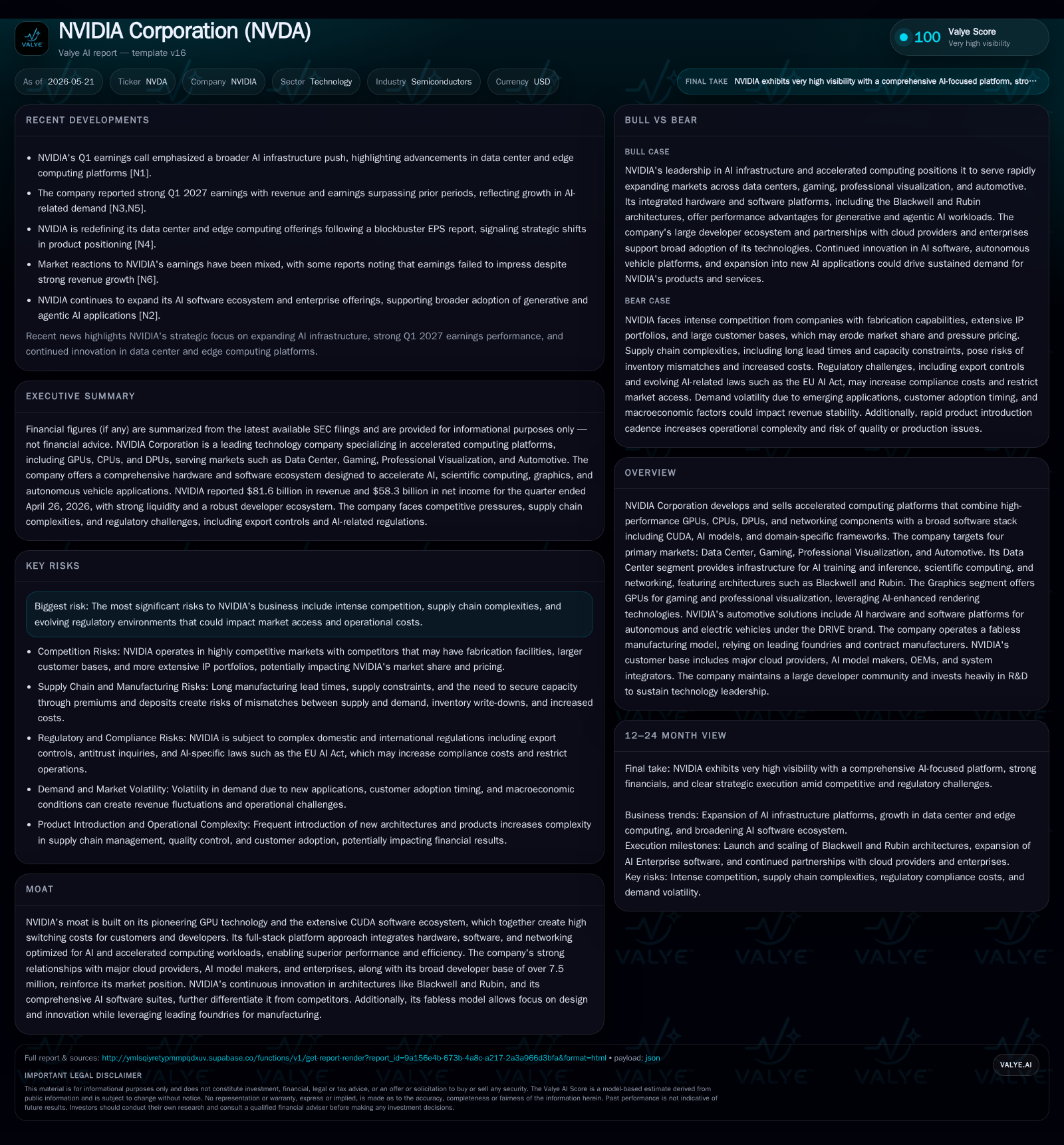
In its 2026 Q1 filing, NVIDIA launched production of its Blackwell Ultra GPU platforms, marking a key evolution in its AI infrastructure leadership while navigating export license constraints impacting China shipments. The company’s fabless strategy couples cutting-edge architectures with a robust CUDA software ecosystem, driving deep customer lock-in across gaming, data center, and automotive sectors. Growth is propelled by surging demand for AI training and inference solutions underpinned by full-stack innovations from hardware to networking. Despite intensifying competition from chip makers with integrated fabs and growing open-source alternatives, NVIDIA’s scale, developer base, and platform breadth sustain its competitive moat. Key risks remain around supply chain complexities and geopolitical regulatory controls influencing revenue timing and product availability.
Latest Quarterly Operating Update: Blackwell Architecture and Data Center Dynamics
NVIDIA's Q1 FY2027 10-Q dated May 20, 2026, introduces significant operational developments anchored on the launch of its Blackwell Ultra GPU production shipments starting in Q2 FY26 [S2]. This new platform represents a major architectural leap designed to fuel accelerated computing needs underpinning modern AI training and inference workloads. However, NVIDIA discloses that the product transition entails considerable complexity which has introduced supply chain management challenges including potential delays in fulfilling demand as well as fluctuations in revenue recognition [S2].
Alongside this technological ramp, the company confronts regulatory headwinds related to United States export control licenses that govern shipments to China. Previously, exports of the H20 product were curtailed pending export licenses leading to a substantial $4.5 billion charge for excess inventory recognized early in fiscal 2026 [S1]. Although licenses were partially granted enabling limited H20 sales generating close to $60 million revenue [S1], newer H200 products face stringent inspection requirements coupled with a punitive 25% tariff on imports into the U.S., restricting broader sales momentum [S1]. The licensing program for H200 is nascent with no recorded revenues yet under this scheme [S1].
These regulatory dynamics have introduced deferrals in revenue recognition for certain advanced datacenter products destined for China while complicating supply chain planning as NVIDIA balances manufacturing ramp with variable market access [S2]. The company has concurrently expanded its footprint beyond traditional Asia-based supply chains into U.S. and Latin America locations aiming to strengthen resilience amidst global trade uncertainties [S1].
NVIDIA’s Business Model: From GPUs to Full-Stack Accelerated Computing Platforms
NVIDIA’s operating model centers around a fabless design philosophy where it develops sophisticated semiconductors encompassing GPUs, CPUs, DPUs, interconnects, plus an expansive software stack anchored by CUDA — its proprietary parallel computing platform framework rendering strong ecosystem lock-in [S1][S24]. By delivering tightly integrated hardware-software systems such as those built on the Blackwell architecture family for data centers alongside graphics platforms for gaming and visualization, the company caters to multiple substantial end markets.
The Compute & Networking segment dominates revenue generation, powered by data center AI workload demand where high-performance training and inference require scalable architectures [S16]. This segment integrates GPUs optimized for AI along with networking components supporting hyperscale deployments. Meanwhile, the Graphics segment leverages NVIDIA’s AI-enhanced rendering technologies catering primarily to gaming applications and professional visualization tools [S24]. The Automotive segment focuses on AI hardware/software platforms enabling autonomous vehicle solutions under its DRIVE brand [S1].
Strategically, NVIDIA capitalizes on multi-billion-dollar addressable markets by unifying these offerings through consistent underlying architecture that runs CUDA across devices; this approach creates developer momentum exceeding 7.5 million registered users globally which further cements switching costs for customers dependent on NVIDIA platforms [S24]
Product Quality and Innovation in CPUs, GPUs, DPUs, and Software Ecosystem
At the core of NVIDIA’s product leadership is its architectural innovation exemplified by the Blackwell Ultra platform representing next-generation GPUs with extreme co-design principles integrating chipsets alongside high-speed networking fabric optimized for large-scale AI training clusters [S1]. The Rubin platform slated for future introduction continues this cadence of annual hardware revolutions aimed at performance advancement [S1].
Complementing hardware is an extensive software ecosystem comprising CUDA libraries, domain-specific frameworks tailored for vertical use cases (healthcare analytics, telecom optimization), plus AI models facilitating generative and agentic workflows pivotal in today’s advanced machine learning deployments [S1][N2]. This holistic co-design ensures software can exploit hardware capabilities fully enhancing efficiency while driving reproducible customer value.
Challenges remain in managing yield variability and quality assurance during complex system transitions—as highlighted by recent supply bottlenecks impacting timely delivery and inducing inventory provisions related to excess or slow-moving units [S2]. Nonetheless, NVIDIA consistently invests heavily (over $18 billion incremental R&D spend in fiscal year 2026) to sustain pipeline innovation critical for differentiated performance [S1][S10].
Industry Landscape: Fabless Model, Supply Chain, and Competitive Pressures
NVIDIA operates exclusively on a fabless basis outsourcing wafer fabrication to leading-edge foundries—a model that prioritizes research innovation over capital-intensive manufacturing build-out—but exposes it to capacity constraints inherent in third-party ecosystems [S1][S24]. To mitigate risks associated with concentrated Asian foundry reliance given geopolitical tensions, NVIDIA has embarked on diversifying manufacturing locales into U.S. and Latin America facilities to build redundancy and shorten lead times [S1]. The extent of success hinges on host region scaling capabilities which remain challenging given semiconductor production complexity.
Competitive pressures intensify as some rivals wield integrated fabs offering cost advantages or pursue bespoke ASIC designs optimized for specific workloads reducing dependency on generalized GPU platforms—a threat amplified by major cloud providers increasingly investing in proprietary silicon development potentially eroding NVIDIA’s market share over time [S20][S25]. Additionally adverse pricing competition driven by new entrants or consolidation among competitors may compress margins. However, NVIDIA’s ability to bundle full-stack hardware-software-network solutions delivers differentiated total cost-of-ownership value which remains difficult for competitors replicating solely at chip level.
Growth Drivers: AI Infrastructure Demand, Platform Adoption, and Software Lock-in
Demand drivers are fundamentally structural as enterprises across industries escalate investments into generative AI models requiring vast compute infrastructure characterized by accelerated computing power scaling exponentially annually. Cloud service providers (CSPs) upgrade data centers deploying latest architectures like Blackwell Ultra supporting higher throughput training/inference tasks fueling Compute & Networking segment growth [N1][N2][S16].
Developer ecosystem expansion continues strengthening barriers through widespread CUDA adoption empowering software portability while network effects expand usability across diverse workloads—generative content creation spanning text-to-image synthesis through autonomous system control velocity relies heavily on NVIDIA architectures' adaptability [S1][N2]. The company’s sizable equity investments ($17.5 billion into startups) amplify exposure to emergent AI innovation pipelines likely spurring future product demand from next-gen model makers relying exclusively on NVIDIA gear [S1].
Recurring purchases linked to infrastructure refresh cycles within hyperscale environments underpin revenue visibility though NVIDIA acknowledges logistical supply-demand imbalances may create episodic fluctuations warranting close operational alignment going forward.
Risks and Watchpoints: Competition, Supply Constraints, Regulatory Challenges
Execution risks reflect both industry cyclicality tied to semiconductor lead-time unpredictability compounded by global macroeconomic uncertainty affecting enterprise capital expenditure pace. Delays or mismatches in supply provisioning have previously triggered costly inventory writes notably related to export-restricted H20 product lines illustrating sensitivities around regulatory dependencies particularly U.S.-China trade policies restricting market access causing deferred revenue impacts plus tariffs adding margin pressure [S1][S2][S20]
Competitive encroachment emanates from silicon vendors with vested fabrication capabilities or those deploying vertically integrated stacks; proprietary ASIC designs adopted by hyperscalers risk truncating traditional GPU-driven share gains; open-source AI frameworks running alternative compute backends potentially diminish NVIDIA’s exclusive platform value proposition across developer segments needing careful ecosystem stewardship [S20][N2].
Intensifying geopolitical scrutiny presents evolving compliance overhead risks including export licenses that could restrict scalability of certain product lines reliant on sensitive technologies—incremental inspection protocols increase shipment cycle times imposing operational burdens currently evident within H200 licensing program rollout uncertainties.
What to Watch Next: Product Cadence, Supply Chain Expansion, Customer Capital Access
Key forward indicators include monitoring Rubin architecture launch timelines targeted next fiscal year as part of NVIDIA's one-year cadence series extending Blackwell innovations driving successive performance uplift cycles [S1][N5]. Supply base expansions into U.S./Latin America require validation through volume ramp speed metrics critical for meeting accelerating customer demand surges tied to hyperscale/datacenter capital deployments.
Close attention should be paid to commercial uptake of newly licensed products permitting Chinese market entry under constrained conditions since revenue recognition here remains volatile due to tariff exposure plus mandatory inspections slowing fulfillment processes evident from initial absence of recognized sales under H200 programs [S2][N9]
Additionally tracking capital availability among smaller OEMs/startups—many backed via NVIDIA ecosystem investments—will help gauge midterm consumption trends foundational for broader accelerated computing adoption ultimately influencing top-line growth trajectories.
This analysis synthesizes all currently available SEC filings up through May 2026 alongside contemporaneous industry news without referencing unsupported financial projections or speculative commentary. The narrative strives to present operational insights grounded firmly within verified disclosures while situating NVIDIA within broader competitive semiconductor landscape dynamics shaping strategic outlooks going forward.
Disclaimer: This is research-only, informational analysis and not investment advice. It may include AI-generated interpretation and general industry context. Always verify important details using primary sources.

Comments