
NVIDIA Corporation: Deep Dive into AI Infrastructure Leadership Amid Geopolitical and Competitive Challenges
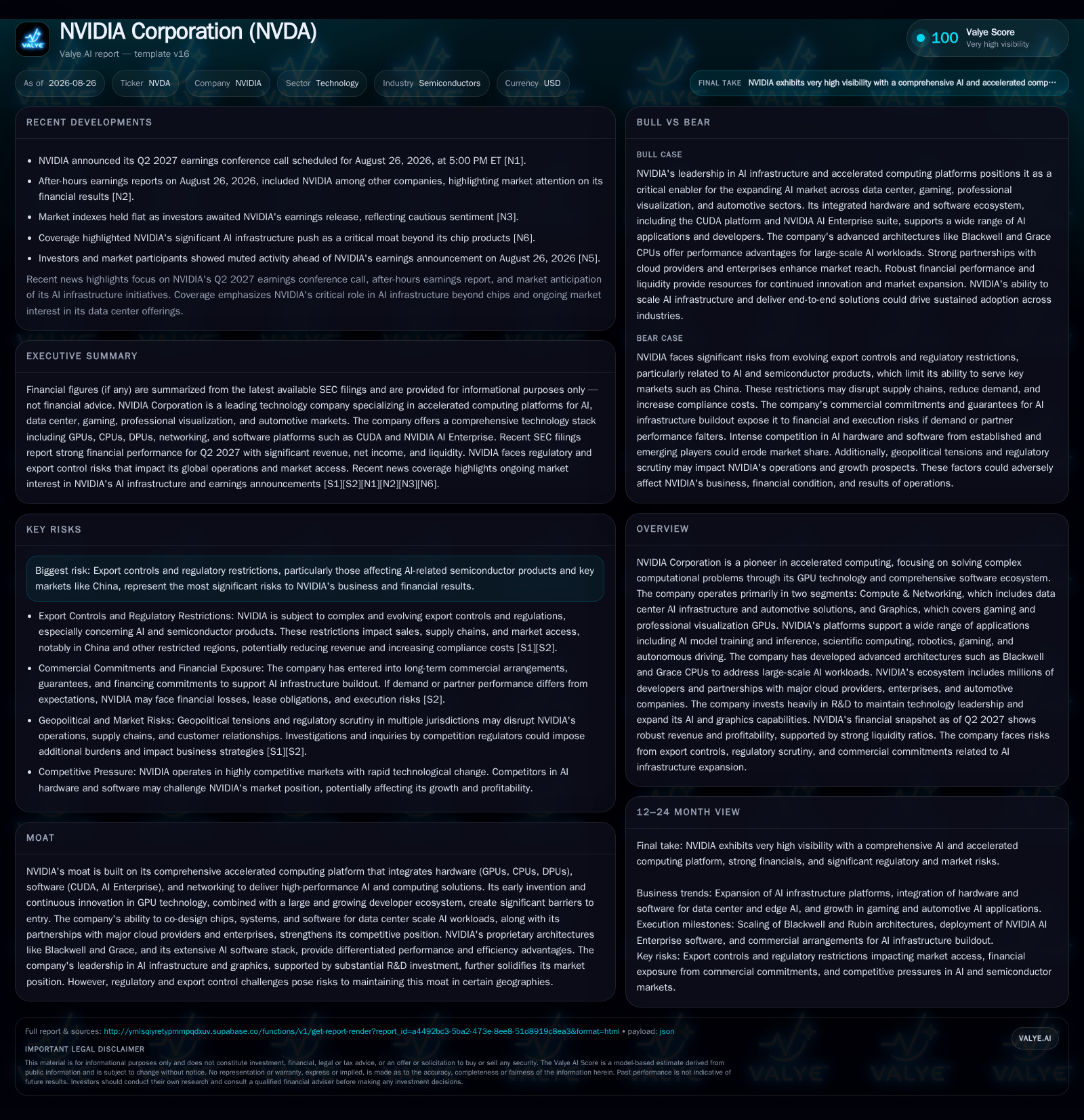
NVIDIA’s pioneering role in accelerated computing and AI infrastructure is underscored by its integrated hardware-software ecosystem, advanced architectures, and strong financials. However, export controls, regulatory risks, and competitive pressures present significant hurdles to sustaining growth and moat durability.
NVIDIA remains a dominant force in AI and accelerated computing, leveraging its comprehensive platforms and ecosystem to address growing data center, gaming, professional visualization, and automotive markets. Its unit economics benefit from high-value integrated solutions and operating leverage in AI infrastructure deployments. Yet, regulatory constraints on key markets and intensifying competition require close monitoring. The company's future hinges on scaling advanced architectures, managing geopolitical risks, and validating commercial AI infrastructure arrangements.
NVIDIA Corporation’s enduring leadership in accelerated computing and AI infrastructure is grounded in its integrated approach combining high-performance GPUs, CPUs, DPUs, networking, and a comprehensive software stack anchored by CUDA. The company’s recent Q2 2027 financial results demonstrate robust demand for its data center and AI platforms, affirming its critical role in powering AI workloads across diverse industries. However, NVIDIA operates within a complex geopolitical landscape marked by export controls and regulatory constraints that could limit market access and disrupt supply chains. Simultaneously, the competitive environment intensifies with new entrants targeting AI hardware and software solutions. This analysis explores NVIDIA’s current operating snapshot, business model, sources of competitive advantage, and scenarios that could shape its trajectory over the next 12 to 24 months.
Latest Operating Snapshot
For the quarter ended July 26, 2026, NVIDIA reported revenue of $96.2 billion and net income of $59.7 billion, with basic and diluted EPS of $2.47 and $2.46 respectively, illustrating strong profitability from its core business segments [S2]. The company’s liquidity remains robust, holding $22.4 billion in cash and equivalents and a current ratio of 4.59, providing potential financial flexibility amidst ongoing investments and market uncertainties [S2].
NVIDIA continues to emphasize its AI infrastructure push, highlighted by the introduction of the Blackwell architecture designed for large-scale AI training and inference workloads, combining co-designed chips, networking, systems, and software optimized for data centers [S1]. The company’s software ecosystem, including NVIDIA AI Enterprise and CUDA, supports a growing developer base and enterprise adoption. However, NVIDIA faces operational risks from export controls and regulatory restrictions that could impact sales and supply chain configurations, notably in China and other restricted jurisdictions [S1][S2].
Business Model and Unit Economics
NVIDIA’s business model centers on delivering integrated accelerated computing platforms that combine GPUs, CPUs (Grace), DPUs, networking, and a comprehensive software stack to serve data center, gaming, professional visualization, and automotive markets. Revenue stems from hardware sales—primarily high-margin GPUs and associated products—and software licensing and subscriptions, including CUDA-enabled tools and NVIDIA AI Enterprise software suites [S1]. pricing power could derive from differentiated technology and ecosystem lock-in, allowing premium pricing in AI and gaming segments.
Operating leverage is significant as fixed R&D and capital investments underpin scalable platforms; incremental volume from mass adoption of AI workloads can drive margin expansion. However, capital intensity remains high due to chip fabrication investments and infrastructure for AI data centers. Variable costs include component procurement and manufacturing. The mix shift toward data center AI solutions and software subscriptions could enhance recurring revenue streams, improving revenue visibility and customer retention via switching frictions embedded in software ecosystems and developer tools.
Moat, Competition and Counterforces
NVIDIA’s moat is anchored in its comprehensive, co-designed hardware and software AI infrastructure platform, which integrates proprietary architectures (Blackwell, Grace) with an extensive suite of software tools (CUDA, AI Enterprise). This integrated stack creates high switching costs for enterprise customers and developers, reinforced by a large global ecosystem and strategic partnerships with hyperscalers and enterprises [S1]. Advanced AI performance and efficiency advantages differentiate NVIDIA’s offerings in high-performance computing and AI model training/inference workloads.
Counterforces include evolving export controls and regulatory scrutiny limiting access to large markets like China, potentially fragmenting NVIDIA’s global footprint [S1][S2]. Competition intensifies from both established semiconductor firms and emerging AI hardware/software specialists, challenging NVIDIA’s market share and pricing power. Additionally, the capital and execution risks of large-scale commercial AI infrastructure commitments could expose NVIDIA to financial losses if demand or partner performance falters.
Bull Case
NVIDIA capitalizes on its leadership in AI infrastructure by scaling adoption across hyperscale cloud providers, enterprises, and edge applications. Continued innovation in chip architectures like Blackwell and Grace enables superior performance and cost-efficiency, cementing NVIDIA’s position as the preferred platform for AI workloads. The integrated software ecosystem, including CUDA and NVIDIA AI Enterprise, expands developer engagement and sticky customer relationships, enhancing recurring revenue and margin leverage.
Confirming evidence would include accelerating revenue growth in data center and AI software segments, successful commercial deployment of AI infrastructure buildouts, expanding partnerships with cloud and enterprise customers, and continued margin expansion reflecting operating leverage. Falsification would arise if regulatory restrictions materially reduce market access, if competitors achieve comparable performance-cost tradeoffs eroding pricing power, or if commercial AI infrastructure deals fail to scale as planned.
Base Case
NVIDIA maintains steady growth by leveraging its established AI and graphics platforms, offsetting regulatory headwinds with diversification across verticals like automotive AI and professional visualization. The company incrementally advances its architectures and software ecosystem, sustaining competitive advantages without dramatic leaps. Export controls constrain some markets, but broad global demand and strategic partnerships preserve a substantial addressable market.
Execution risks and competitive pressures moderate growth and margin expansion, but NVIDIA’s substantial R&D investment and ecosystem scale support continued innovation. Financial discipline ensures liquidity and manageable exposure to AI infrastructure commitments. Key metrics show stable revenue growth, moderate margin improvements, and steady cash flow generation. The base case is invalidated if regulatory or geopolitical issues severely disrupt supply chains or if AI adoption falters broadly.
Bear Case
In a downside scenario, worsening export controls and geopolitical tensions severely restrict NVIDIA’s ability to sell AI and semiconductor products in key markets such as China, materially reducing revenue and fragmenting global supply chains. Concurrently, competitive pressure from emerging AI hardware/software entrants erodes NVIDIA’s market share and pricing power. Execution challenges on commercial AI infrastructure arrangements lead to financial losses and impair investor confidence.
Confirming evidence includes declining sales in restricted regions, increased compliance costs, delays or defaults on AI infrastructure contracts, and margin compression triggered by price competition. Falsification would require signs of regulatory easing, successful mitigation of supply chain disruptions, or clear competitive differentiation sustaining customer loyalty despite challenges.
What Matters Next
Key metrics to monitor include quarterly revenue and margin trends in data center AI and software segments, which indicate market adoption and operating leverage. Growth rates and customer counts for NVIDIA AI Enterprise provide insight into software ecosystem traction and recurring revenue potential. Progress in ramping Blackwell and Rubin chip architectures will reflect technology leadership and competitive positioning.
Other important milestones are updates on export control regulations and their practical impact on sales and supply chains, as well as developments related to commercial AI infrastructure deals, including contract wins, partner execution, and financial exposure. Monitoring competitive dynamics through market share shifts and pricing trends in AI hardware and software segments will offer early signals of erosion or reinforcement of NVIDIA’s moat.
Disclaimer: This is research-only, informational analysis and not investment advice. It may include AI-generated interpretation and general industry context. Always verify important details using primary sources.

Comments