
NOVONIX Ltd's Strategic Expansion in Synthetic Graphite and Battery Testing: Capital and Growth Under Pressure
NOVONIX is scaling North American synthetic graphite production amid ongoing losses, growing battery technology revenue, complex patent challenges, and capital demands.
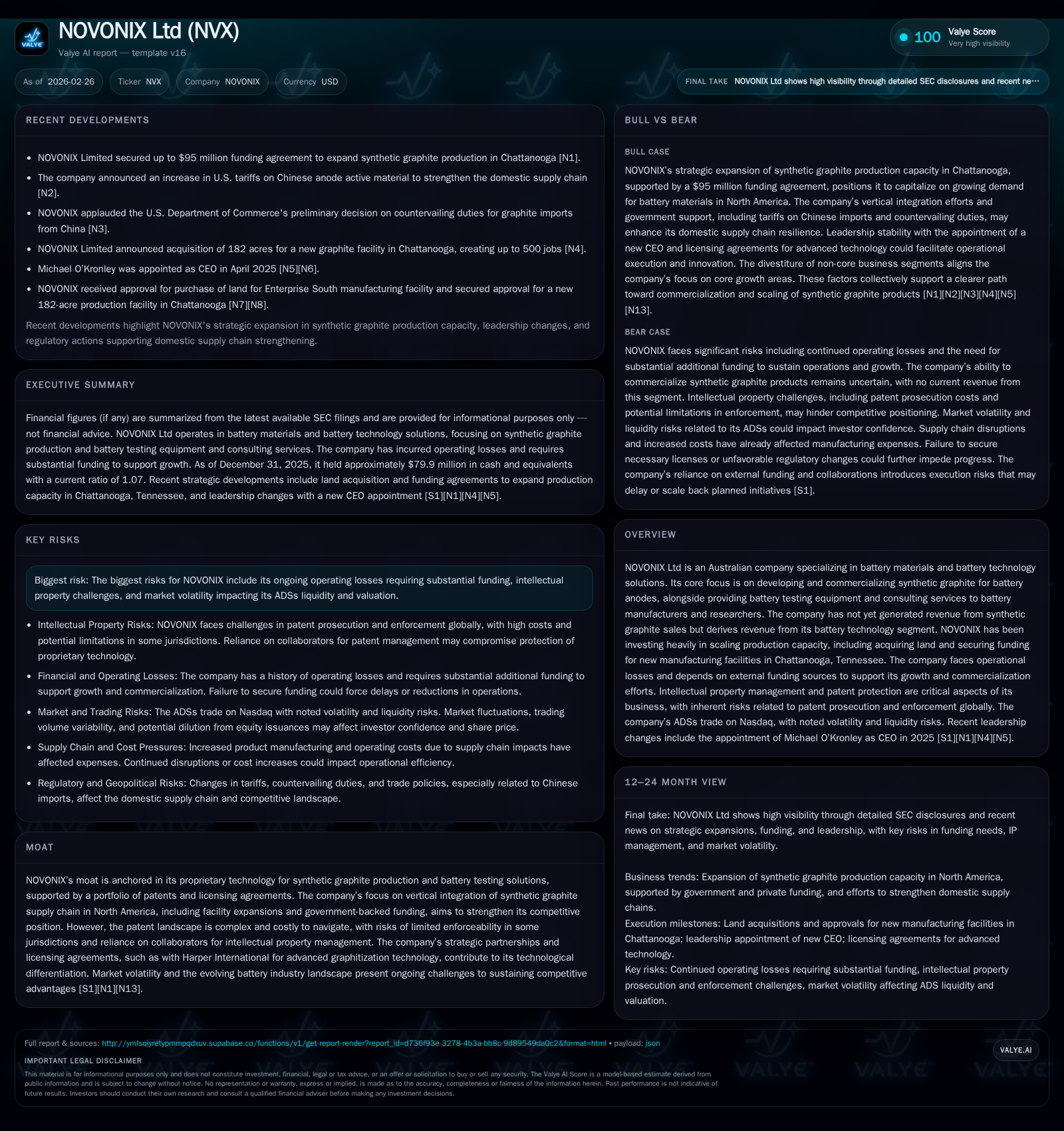
NOVONIX Ltd operates a dual business model consisting of battery technology solutions generating current revenues and an emerging synthetic graphite production segment that remains pre-commercial. The company has experienced rapid revenue growth from its battery testing sales but continues to incur substantial operating losses due to heavy investments in synthetic graphite manufacturing scale-up, including building new facilities in Tennessee. Intellectual property management risks are heightened by the cost and complexity of global patent prosecution, affecting NOVONIX’s protective moat. Financing initiatives like convertible debentures and equity raises have bolstered liquidity, yet cash runway and profitability timelines remain uncertain as NOVONIX depends partly on government grants and successful execution of commercial milestones.
Historical Revenue Growth and Operating Losses: The Role of Battery Technology Sales
NOVONIX’s financial history reveals a pronounced transition stage marked by increasing revenues from its Battery Technology Solutions (BTS) segment while continuing to absorb operating losses driven by ongoing investments into its NOVONIX Anode Materials (NAM) synthetic graphite business. Although the company began generating revenue primarily from BTS hardware sales and consulting services, reported consolidated top-line figures reached approximately $8.1 million in fiscal year (FY) 2023, representing a sharp year-over-year growth of roughly 198% from just $2.7 million in FY 2022 [F1].
Despite this revenue acceleration, NOVONIX has not yet realized revenue from its synthetic graphite products as of the latest filings [S1][S20]. This duality underscores the company's status: one arm is a growing battery testing tools vendor providing cash flow; the other remains a pre-revenue commercial development endeavor focused on proprietary synthetic graphite. Net income figures span four years of substantive losses reflecting this investment phase — widening from about negative $27.9 million in FY 2022 to nearly negative $92.7 million by FY 2025 [F1]. These losses emphasize the large expenditures on scale-up activities, particularly capex for manufacturing expansion paired with R&D intensity.
Historical performance (annual)
| FY | Rev ($mm) | Net ($mm) | Rev YoY | Net YoY |
|---|---|---|---|---|
| 2025 | -93 | -23.9% | ||
| 2024 | -75 | -61.8% | ||
| 2023 | 8 | -46 | +198.1% | -66.0% |
| 2022 | 3 | -28 |
Source: SEC companyfacts cache [F1].
Capital returns and efficiency (annual)
| FY | ROE% |
|---|---|
| 2025 | -57.4 |
| 2024 | -54.4 |
| 2023 | -25.1 |
| 2022 | -12.3 |
Source: SEC companyfacts cache [F1].
Revenue reflects consolidation of BTS segment only; NAM revenues not yet recognized [F1][S20].
Scaling Synthetic Graphite Production: Investments and Commercialization Timeline
NOVONIX’s strategy tightly centers on establishing a vertically integrated supply chain for synthetic graphite anode materials located in North America — a region deemed critical for advanced lithium-ion battery manufacturing sovereignty [S1]. Central to this initiative is the Riverside production facility near Chattanooga, Tennessee, which is actively undergoing equipment installation and commissioning phases targeted at fulfilling a volume supply contract with Panasonic Energy slated for late 2027 [S1][S5].
Capital expenditures have ramped alongside these efforts as NOVONIX installs advanced graphitization technology licensed via key partners such as Harper International [S1][S6]. However, scaling vertically integrated synthetic graphite production remains operationally complex due to costly plant construction requirements and process optimization hurdles inherent to producing battery-grade materials at industrial scale.
Management commentary disclosures signal that Riverside’s manufacturing capacity build-out commands a substantive share of total investment capital alongside incremental R&D programs aimed at optimizing battery material performance characteristics [S5][S7]. The timeline continues to be subject to typical industrialization risks including supply chain shocks evidenced by marginal increases in product manufacturing costs at the BTS hardware segment though not yet materialized at NAM [S14].
Intellectual Property Strategy and Patent Enforcement Risks in Global Markets
Patents are foundational to NOVONIX’s competitive moat given its proprietary processes for producing synthetic graphite materials as well as its innovative battery testing solutions [S1][S6][S9][S10]. The company currently maintains an evolving intellectual property portfolio that supports licensing agreements essential for core graphitization methods — notably with Harper International that underpins parts of their plant equipment intellectual property.
Nevertheless, NOVONIX confronts several challenges related to patent prosecution costs and global enforcement variances which may dilute protective barriers internationally. Countries outside the United States often impose higher patentability thresholds or restrict enforceability against government entities thereby limiting legal recourse [S6]. Furthermore, reliance on partners or collaborators for filing or defending patents introduces additional vulnerability risks if interests diverge or priorities shift unsatisfactorily [S6][S18].
Recent jurisprudential trends further complicate IP value certainty—U.S. Supreme Court decisions narrowing patent scopes together with evolving patent laws abroad suggest persistent unpredictability regarding new filings and enforcement efficacy [S6][S18]. This fragile IP landscape necessitates vigilant management of patent strategy to sustain differentiation within a rapidly evolving global battery ecosystem.
Capital Structure Dynamics: Convertible Debentures, Equity Issuance, and Liquidity Position
Supporting their growth agenda amidst ongoing operating deficits required significant external financing activity during FY 2025. NOVONIX issued approximately $95 million in convertible debentures primarily subscribed by Yorkville alongside an equity raise closing around $25.1 million net of transaction costs estimated at $7.7 million [S4][F1].
These financings raised cash positions enabling continued infrastructure investment including Riverside commissioning while servicing contractual obligations linked to various debt instruments. As of December 31, 2025 cash and cash equivalents totaled approximately $79.9 million with current assets slightly exceeding current liabilities yielding a current ratio of roughly 1.07 — signaling tight but positive short-term liquidity coverage [F1][S4].
While demonstrated financing successes indicate some access to capital markets supportive of strategic progressions thus far, this leverage introduces refinancing optionality concerns should market conditions deteriorate or technological challenges delay commercial ramp-ups.
Forecasting Break-even: Production Milestones and Dependence on Government Grants
Explicit profitability forecasts remain undisclosed; however, NOVONIX management has emphasized critical dependencies for break-even achievement tied directly to satisfactorily scaling NAM production lines and achieving commercial product sales volume commencing late 2027 aligned with Panasonic Energy’s demand schedule [S1].
Partial mitigation of capital intensity arises from governmental support programs—specifically DOE’s Charging Materials Energy Innovation (CMEI) grant program — through which approximately $23 million has been claimed toward an anticipated total commitment near $100 million [S1][N1]. This infusion serves both as validation magnetizing further investment interest while also defraying some capital expenditure burdens.
Nonetheless operational risks such as delays in equipment commissioning or qualification hold potential to defer commercial revenues indefinitely impacting cash burn rates negatively.
Divestiture of Non-Core Assets and Portfolio Streamlining Efforts
In alignment with sharpening strategic concentration on core vertical integration initiatives within North America’s synthetic graphite domain, NOVONIX divested its Mt Dromedary natural graphite exploration interests during early 2026 [S3].
This move eliminates ancillary asset management distractions permitting reallocation of management bandwidth and capital resources squarely towards accelerating primary industrial capabilities at Riverside and supporting customer engagement efforts within the anode materials market segment.
Financial Return Metrics: ROE, Cash Flow Trends, and Capital Allocation Priorities
Continued operating losses exert pressure on return metrics resulting in an approximate return on equity (ROE) nearing negative 57.4% as calculated from fiscal year-end net income relative to shareholders’ equity at December 31, 2025 [F1].
Cash flow statements highlight enduring negative cash flows from operations compounded by sizeable investing activities predominantly directed at fixed assets necessary for fabrication scale-up [F1][S5]. No dividend distributions nor share repurchases have been initiated given ongoing prioritization of reinvesting all available capital toward growth objectives.
This allocation profile is characteristic for companies entrenched in heavy industrial build-out stages wherein operating leverage benefits remain nascent or unrealized against already elevated fixed cost bases.
Risks from Market Volatility and Funding Dependencies: What to Watch Next
Equity market reactions underscore sensitivity toward NOVONIX’s substantial funding requirements coupled with intrinsic uncertainties regarding patent protection efficacy as well as timing risk associated with production commercialization efforts. Significant share price volatility noted in early January 2026 evidences investor apprehension related chiefly to cash runway sustainability amid sizeable operating outflows [N1][F1].
Additional considerations deserving close observation include potential need for fresh capital raises beyond existing convertible notes maturities given extended commercial ramp timelines plus any material shifts in collaborative partner dynamics affecting IP prosecution or enforcement strategies [S6][S9][S12][S15]. Regulatory or legal changes influencing U.S./international patent frameworks could materially impact competitive positioning costs.
Upcoming corporate milestones involve:
- Finalizing Riverside plant commissioning phases,
- Progressing product qualification cycles with major battery manufacturers,
- Successful receipt or expansion of governmental funding support,
- Further structural financing executions or strategic partnerships needed to sustain extended development horizons.
This analysis synthesizes public financial disclosures through February 26th, 2026 along with relevant regulatory filings without offering investment recommendations or price forecasts. Stakeholders should consider ongoing developments as the company navigates commercialization complexities within highly competitive battery materials markets characterized by rapid innovation cycles and evolving regulatory landscapes.
Disclaimer: This is research-only, informational analysis and not investment advice. It may include AI-generated interpretation and general industry context. Always verify important details using primary sources.

Comments