
NexGel Advances Commercial-Stage Regenerative Biomaterials With Strategic Licensing and Financing
NexGel’s recent exclusive license acquisition from Celularity and capital raises mark a pivotal shift toward commercial biomaterial product growth amid Nasdaq listing challenges.
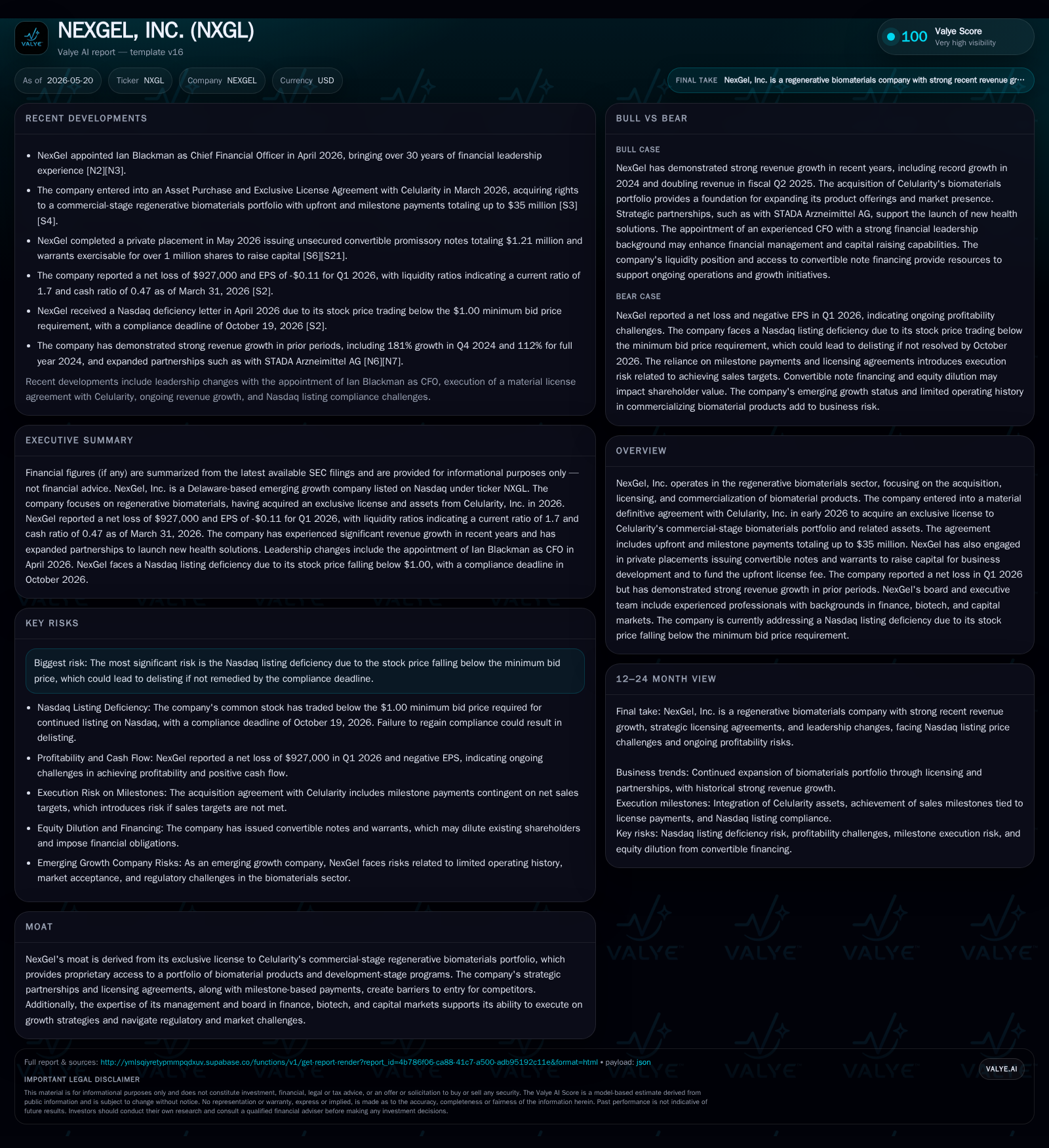
In Q1 2026, NexGel closed an exclusive licensing agreement for Celularity’s commercial-stage regenerative biomaterials portfolio, involving a $15 million upfront payment funded by newly issued convertible notes and warrants. This move transitions NexGel’s business model to one driven by milestone-based revenues tied to licensed biomaterials, supported by contract manufacturing arrangements. The regenerative biomaterials sector is nascent, and NexGel’s exclusive rights establish a meaningful moat but require successful commercialization and market adoption. Nasdaq listing compliance remains a material risk with the stock price below minimum bid thresholds. NexGel’s liquidity and manageable debt position support near-term execution but depend on further capital raises linked to licensing obligations and regulatory status.
Q1 2026 Operating Update Highlights License Acquisition and Capital Raises
NexGel has materially advanced its corporate strategy with the execution of an Asset Purchase and Exclusive License Agreement with Celularity in early March 2026 [S7]. This transaction grants NexGel exclusive rights to Celularity’s commercial-stage regenerative biomaterials portfolio alongside related development programs. The agreement stipulates an upfront cash payment of $15 million, which was conditioned upon securing financing — a threshold met through convertible note placements completed by mid-April [S4], [S26].
The company issued approximately $6.9 million in unsecured convertible promissory notes alongside warrants exercisable for common stock [S26]. Additional note issuances totaling around $6 million were agreed upon subsequently [S22], helping fund the license fee and working capital demands [S3]. Despite these positive developments in asset acquisition and financing, NexGel reported a continued net loss for Q1 2026 as it invests in commercial expansion efforts within its newly licensed portfolio [S2], [N1].
Business Model Overview: Exclusive Commercial-Stage Regenerative Biomaterials Portfolio
NexGel’s business model centers on monetizing exclusively licensed regenerative biomaterials technologies initially developed by Celularity [S1]. Through this licensing framework, revenue will be primarily milestone-based, correlating with net sales targets embedded in the agreement—up to an additional potential $20 million beyond the upfront fee [S7]. The approach significantly differs from traditional R&D-focused biotech models. Instead of early-stage drug development risks, NexGel leverages commercial-stage assets that are nearer-term revenue generators once market penetration accelerates.
Integral to this model are contract manufacturing agreements planned alongside the license deal, intended to ensure supply chain control and scalability of product distribution [S7]. These initiatives aim not only to bolster margins but also limit reliance on third-party providers, which can create bottlenecks or quality concerns in the sensitive biomaterials space.
The seasoned executive team combines expertise in financial markets and biotechnology product commercialization—critical capabilities given the complex path from licensing assets to generating sustainable revenue streams while navigating regulatory requirements [S1]
Industry and Competitive Context: Barriers Built by Licensing Amid Emerging Biomaterials Market
The regenerative biomaterials sector remains at a formative stage of market development. NexGel's exclusive license from Celularity presents a tangible economic moat by providing proprietary access to commercial-stage products inaccessible to competitors without similar agreements [S1]. Such exclusivity enhances switching costs for end customers and distributors who seek validated clinical-stage materials.
However, industry adoption is still emergent — widespread clinical acceptance and payer reimbursement structures are evolving. Competitors typically operate earlier in development or focus on niche subsegments lacking commercially available portfolios, underscoring NexGel’s positioning advantage through ready-to-commercialize assets.
Maintaining exclusivity combined with operational execution will be pivotal for NexGel as it attempts to convert a defensible market position into scalable revenue amid nascent demand drivers.
Growth Drivers: Milestone Revenue Potential and Strategic Partnerships
Growth prospects hinge heavily on achieving net sales milestones embedded within the licensing agreement between NexGel and Celularity [S7]. These milestones could generate up to an additional $20 million in revenue contingent upon commercial success.
Further acceleration may arise from contract manufacturing agreements allied with the licensed assets that enhance production capacity leverage and margin expansion potential [S7]. Strategic partnerships supporting clinical pipeline extension or distribution network enhancement could also unlock incremental growth opportunities over time.
Customer adoption patterns in regenerative biomaterials typically reflect structural drivers such as aging populations needing advanced wound care or orthopedic solutions, supporting sustained demand beyond cyclical fluctuations. Pricing power may become more durable if NexGel successfully integrates supply chain control and addresses clinical efficacy gaps relative to alternatives.
Risks and Constraints: Nasdaq Listing Deficiency and Execution Uncertainties
A salient risk lies in NexGel's Nasdaq listing status; it currently faces deficiency notices due to its share price falling below the minimum bid price requirement—a condition risking eventual delisting absent curing actions [S2], [N1].
Operationally, the milestone-dependent revenue model introduces variability; failing to meet sales targets would delay or reduce milestone income flows affecting liquidity. The company’s dependence on external financing heightens exposure to capital markets conditions affecting funding availability and terms.
Execution challenges may also emerge in transitioning licensed technologies to fully commercial scale under new supply arrangements — any delays or quality issues could impair customer retention or growth trajectories.
Key Milestones and Watchpoints Over Next 12 Months
Critical upcoming milestones include timing of net sales performance triggers unlocking milestone payments—key indicators of commercialization progress [S7]. Observers should monitor the pace and scale of contract manufacturing integration as it relates to capacity ramp-up.
Nasdaq compliance efforts warrant close attention; resolution mechanisms such as reverse stock splits or market-driven price recovery remain uncertain factors shaping trading continuity [N1]. Additionally, partnership announcements or expansions extending development pipelines could signal broader strategic momentum.
Capital raising activities also remain pivotal; given ongoing operating losses and upfront investment commitments, additional equity or debt funding rounds may be necessary within the next year to sustain operations.
Current Financial Position: Liquidity, Debt, and Investment Needs
As of Q1 2026 quarter-end, NexGel reported cash and equivalents around $0.94 million with total debt approximately $0.56 million yielding a current ratio of 1.7—reflecting adequate short-term liquidity coverage though at modest absolute levels [F1], [S2]. Interest expenses on recently issued convertible notes accrue at 10% annually with an 18-month term horizon; these carry standard covenants restricting certain corporate actions including incurrence of further indebtedness without consent [S26], [S3].
The company continues operating at a net loss while investing in integrating its new biomaterial asset base; sustaining this trajectory depends on executing milestones that will improve cash flow dynamics ultimately. Ongoing funding requirements relate both directly to license fee obligations as well as managing Nasdaq listing-related corporate governance costs.
This analysis has been prepared solely for informational purposes reflecting publicly available filings without providing investment advice or research views. Readers should consider NexGel's disclosed risks alongside their own due diligence when evaluating company developments.
Disclaimer: This is research-only, informational analysis and not investment advice. It may include AI-generated interpretation and general industry context. Always verify important details using primary sources.

Comments