
NexGel’s Licensing Strategy Drives Revenue Growth amid Convertible Debt and Liquidity Pressures
NexGel’s exclusive licensing of Celularity’s regenerative biomaterials under the BioNx brand underpins recent robust revenues but introduces integration and financial risks due to considerable convertible note issuance.
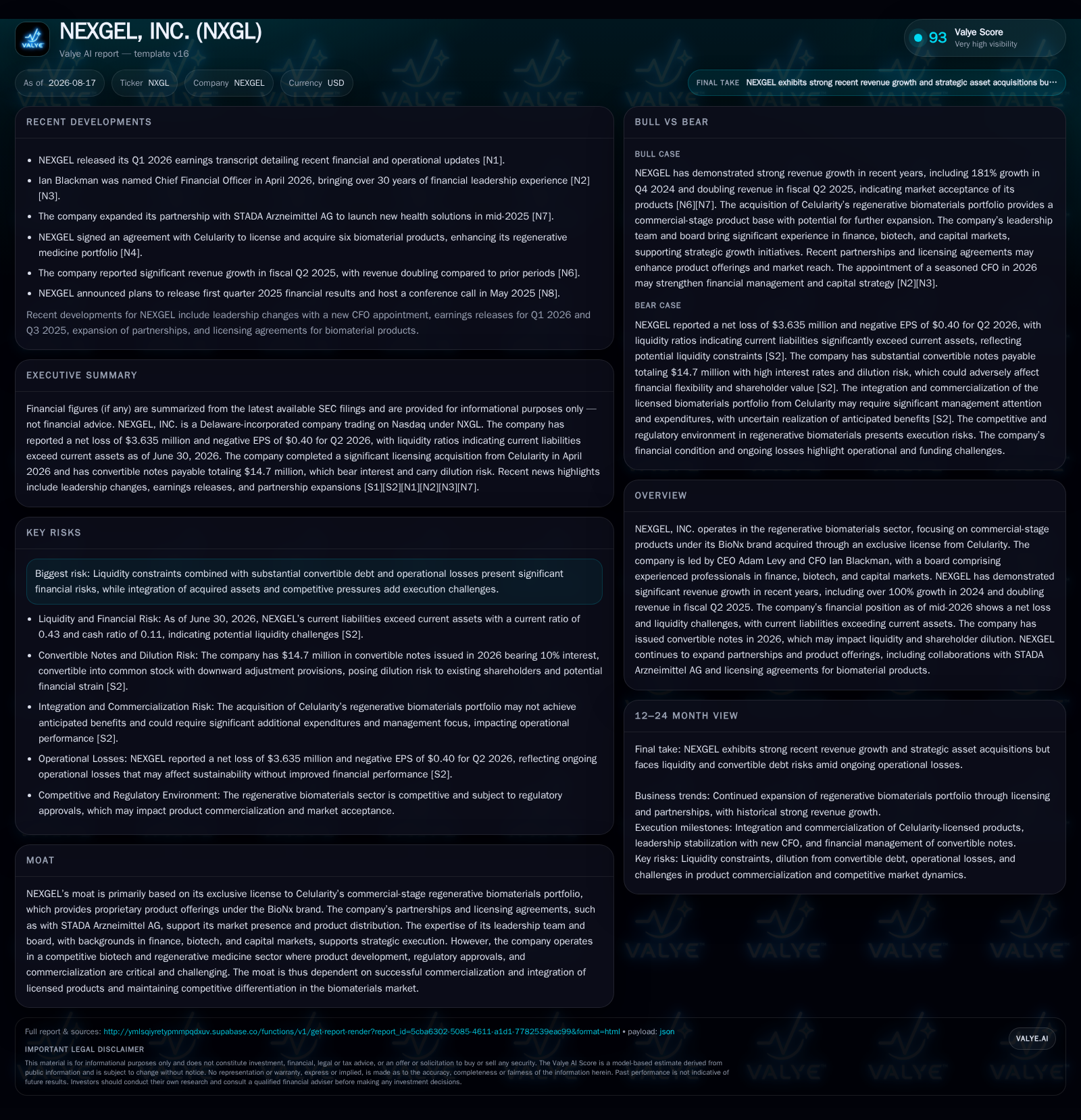
NexGel, Inc. has secured an exclusive license for Celularity’s commercial-stage regenerative biomaterials portfolio, driving strong revenue expansion through its BioNx brand. The company reported over 100% revenue growth in 2024 with continued momentum into 2025, reflecting successful commercialization progress. However, its rapid capital deployment includes substantial convertible note financings totaling $14.7 million as of mid-2026, raising liquidity and dilution risks. Integration challenges from the asset acquisition, combined with a weak current ratio of 0.43 and operational losses, pose execution hurdles as NexGel navigates commercialization in a competitive regenerative biomaterials landscape.
Recent Operating Update: Licensing Acquisition Fuels Commercial Expansion during Capital Raise
In its latest quarterly filing dated August 17, 2026, NexGel disclosed completion of an exclusive license acquisition from Celularity Inc. for their commercial-stage regenerative biomaterials portfolio at a total upfront consideration of $13.3 million paid in April 2026. This marked a material expansion of NexGel’s product portfolio under the BioNx brand [S2]. Concurrently, the company raised substantial capital via convertible promissory notes aggregating $14.7 million during the first half of 2026 through private placements bearing a high interest rate of 10% per annum and provisions for increased rates upon default. These notes are convertible at discounted prices with downward adjustments subject to market conditions, implying significant dilution to stockholders if converted [S2].
Business Model: Leveraging Exclusive Licensing to Commercialize Regenerative Biomaterials
NexGel operates primarily by licensing proprietary regenerative biomaterial technologies originally developed by Celularity Inc., then advancing them through commercialization under the BioNx brand name. The licensing agreement provides NexGel exclusive rights to Celularity’s commercial-stage portfolio encompassing advanced wound care and tissue repair products based on cellular and molecular science designed to support tissue regeneration. Revenue generation flows chiefly from direct product sales complemented by milestone payments tied to sales or regulatory achievements within licensing contracts.
The model depends critically on establishing robust market penetration for its biomaterials in healthcare channels targeting wound care providers and tissue repair specialists who demand validated clinical benefits supported by regulatory clearances. NexGel monetizes through negotiated contracts and distribution agreements bolstered by partnerships—evidenced by collaborations such as that with STADA Arzneimittel AG—designed to enhance geographic reach and customer access [S1].
Margins in this sector can improve with scale as fixed costs related to manufacturing scale-up spread across higher sales volumes; however, initial phases involve significant R&D costs associated with clinical validation and regulatory compliance contributing to net losses early on.
Industry Structure and Competitive Positioning
The regenerative biomaterials industry is characterized by mid-to-late-stage development firms who secure technology licenses from research institutions or biotech innovators before undertaking commercialization themselves or through partners. Companies tend to have portfolios focused on healing applications that leverage proprietary biological materials offering clinically differentiated outcomes compared with conventional therapies.
Peers such as Organogenesis Inc. and MiMedx Group Inc., while not directly comparable due to business size differences or specific product mixes, similarly operate within this complex ecosystem requiring regulatory approvals alongside scaling manufacturing and sales operations amid competitive pressures from alternative biomaterial providers.
NexGel’s moat hinges on exclusivity of the Celularity license which encompasses unique commercial-stage products enabling an acceleration beyond early-stage developmental risk that many biotech companies face. Nonetheless, sustainability depends heavily on successful market adoption rates backed by clinical efficacy data while navigating intense competition around intellectual property rights and evolving regulatory norms.
Growth Drivers
Key growth drivers include successful product roll-out under the BioNx brand leveraging existing commercial-stage assets from Celularity complemented by launching additional development-stage programs acquired under license securing new future revenue streams [S2]. Expanding strategic partnerships such as the one with STADA offers scalability potential into European markets—a critical dimension given the global demand for advanced wound care solutions.
Further milestones linked to regulatory clearance advancement facilitate product acceptance among clinicians who prioritize efficacy mediated through regulatory vetting—this increases clinical adoption rates essential for volume growth and improved gross margins over time.
Continuous investment into manufacturing capability upgrades enabling cost efficiencies can enhance cash generation potential once scale is achieved while broadening regional distribution networks supports geographically diverse demand capture.
Risks and Constraints
Liquidity presents acute risk given NexGel’s stretched working capital evidenced by current liabilities surpassing current assets by more than double at the last quarter-end [F1]. Coupled with net losses demonstrating continuing negative operating income trends preceding the latest period, NexGel must ensure consistent cash flow improvements or access refinancing avenues lest it jeopardizes operations.
The convertible notes issued carry onerous terms including high coupon rates and conversion pricing susceptible to downward adjustments leading potentially to material equity dilution upon conversion exercise—potentially impairing existing shareholders’ stakes significantly if debt conversion occurs en masse [S2]. Failure to meet interest or principal payments might trigger defaults accelerating financial distress.
Operationally, integrating newly licensed assets from Celularity involves organizational focus diversion risks and execution complexity—with management tasked simultaneously ensuring commercialization momentum while addressing supply chain robustness amidst scale-up challenges.
Sector-wide risks such as delayed or failed regulatory approvals can adversely affect timelines for realizing anticipated revenues from newly introduced products affecting cash flow forecasts negatively.
Competitive pressures exerted by alternative regenerative therapies require NexGel continuously innovate or secure superior clinical validation data sustaining differentiation in its product offerings.
What To Watch Next
Future quarters will be critical for observing:
- Revenue progression specifically tied to BioNx portfolio sales ramping aligned with milestone triggers stipulated in licensing agreements;
- Updates regarding milestone payment obligations evidencing achievement or delay affecting contingent liabilities;
- Any amendments or defaults related to convertible note agreements impacting liquidity status or triggering refinancing initiatives;
- Regulatory approval announcements expanding label indications which would support broader clinical adoption;
- Partnership expansions or new licensing deals that may broaden portfolio depth or geographic footprint;
- Management commentary dissecting integration progress post-Celularity acquisition highlighting operational synergies realized versus projected burdens;
- Movements in cash burn rate relative to liquidity levels providing insight into runway extension capabilities considering capital structure burdens.
Monitoring these markers offers visibility into NexGel’s balancing act between aggressive commercialization expenditures funded largely by borrowing-driven capital structure versus sustainable organic growth leading toward profitability.
Financial Profile Discussion
Total debt stood at approximately $563,000 reported March-end 2026 excluding convertible notes which constitute substantial off-balance-sheet obligations given their convertible nature increasing effective leverage risk once exercised [F1][S2]. Net debt calculations factoring cash equivalents suggest a modest net debt position before considering larger convertible note face values highlighting reliance on equity-linked instruments for funding rather than traditional debt structures.
Operating losses continue as demonstrated by negative operating income level around -$3.35 million recorded against full year ended December 31, 2025 indicating ongoing investments in R&D and commercialization outpacing revenues currently [F1][S1]. This trend underscores necessity for accelerating revenue scales combined with margin improvements critical to shift toward sustainability.
Leadership composition blending CEO Adam Levy’s capital markets expertise coupled with experienced biotech professionals on board supports strategic navigation through complex financial restructuring demanded by this sector environment characterized by high cash consumption cycles amidst nascent profitability prospects [S1]
Overall financial posture reflects typical emerging regenerative biomaterials firm dynamics reliant on licensing-driven portfolios supplemented by external capital injections bearing convertible features creating balancing risks between growth funding needs versus shareholder dilution potentials.
This analysis synthesizes NexGel’s publicly available SEC filings through August 2026 highlighting operational developments within its strategic licensing framework alongside financial implications inherent in its capital structure decisions amid competitive regenerative biomaterial industry dynamics. It does not constitute investment advice but aims to illuminate key business drivers relevant for stakeholders monitoring the company's trajectory.
Disclaimer: This is research-only, informational analysis and not investment advice. It may include AI-generated interpretation and general industry context. Always verify important details using primary sources.

Comments