
NextPlat Corp Advances E-Commerce and Healthcare Platforms Despite Financial Headwinds
NextPlat's latest quarterly report reveals timing-related receivables impacts amid strategic efforts to grow two capital-intensive segments.
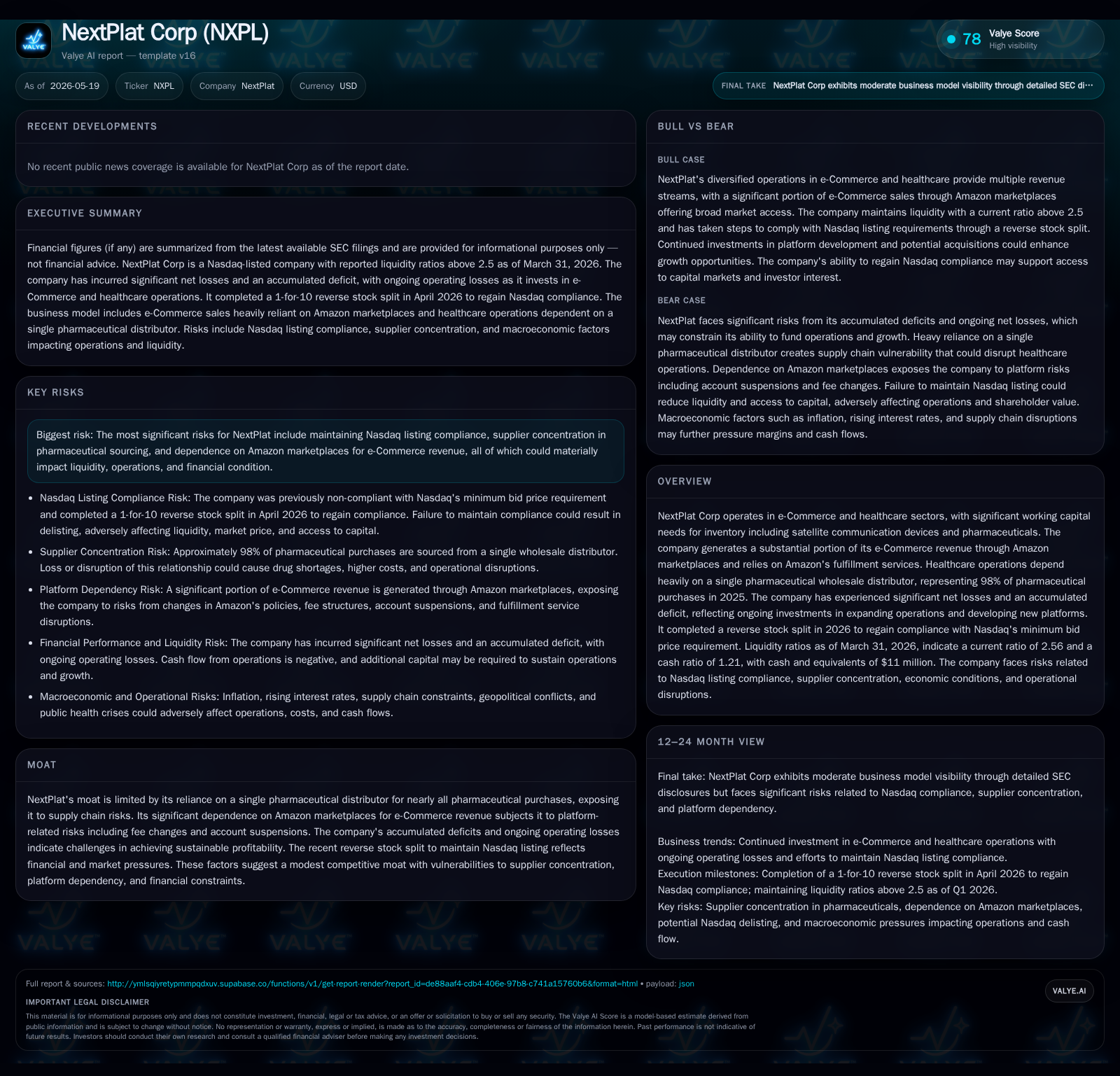
In its Q1 2026 filing, NextPlat Corp detailed operational cash flow fluctuations driven by receivable timing differences and lower inventory expenses, while expecting partial collection in Q2. The company's dual e-Commerce and healthcare business model hinges on Amazon marketplaces and a dominant pharmaceutical wholesaler, creating notable concentration risks. Despite ongoing net losses and an accumulated deficit surpassing $60 million, NextPlat pursues platform expansion and selective acquisitions aimed at long-term growth, facing critical constraints including Nasdaq listing compliance and supplier dependencies. Monitoring receivables recovery, liquidity stability, and strategic execution will be key to assessing future trajectory.
First-Quarter Operating Update: Cash Flows, Receivables, and Inventory Purchases
NextPlat Corp’s latest quarterly filing dated May 15, 2026 ([S2]) highlights a nuanced operational cash flow environment shaped by timing-related shifts in receivables collections. The company reported a deterioration in cash collected from both e-Commerce and Healthcare segments during Q1 2026 compared to prior periods — specifically citing a decrease of approximately $1.4 million from e-Commerce operations and a more pronounced $5.5 million decline from Healthcare operations driven by reduced revenues and delayed receivable collections.
Counterbalancing these headwinds was a significant $5 million reduction in cash paid for inventory purchases and other costs of revenue during the quarter. This points to improved inventory management or deferred procurement possibly aligned with shifting demand or working capital optimization efforts. Additionally, NextPlat lowered operational outlays such as salaries (down by about $0.8 million due to compensation cuts and workforce trimming) and other recurring costs reflecting tighter expense discipline.
Crucially, management anticipates that a portion of the outstanding receivables contributing to this temporary cash shortfall will be realized during Q2 2026; however, they caution that timing remains uncertain ([S2]). This dynamic establishes near-term liquidity as tethered to effective receivables collection.
NextPlat’s Dual-Sector Business Model: E-Commerce Meets Healthcare
Established as a hybrid operator straddling e-Commerce and healthcare sectors, NextPlat’s business model revolves around sales of satellite communication equipment alongside pharmaceutical distribution services ([S1], [F1]). Through its e-Commerce segment, the company offers satellite communication devices—including voice/data/tracking units—primarily via Amazon marketplaces where it leverages fulfillment services for order processing and delivery efficiency.
This setup delivers scalability benefits but also embeds dependency on Amazon’s platform governance and fee structures. The product portfolio entails recurring revenue components from satellite airtime connectivity plans adding dimension beyond hardware sales.
Concurrently, NextPlat’s healthcare segment sources prescription pharmaceuticals predominantly through a single wholesale distributor accounting for nearly all procurement volume (approximately 98%) ([S1]). This segment encompasses pharmacy services such as medication therapy management, long-term care support, participation in the federal 340B Drug Pricing Program through contract pharmacies, plus data analytics offerings through proprietary platforms.
The dual-sector model requires high working capital investment given substantial inventory needs—especially pharmaceuticals with regulated supply chains—and technology platform development supporting service innovation. Consequently, the business exhibits intrinsic capital intensity demanding tight financial controls alongside growth investments.
Supplier and Platform Dependencies: Concentration Risks in Pharmaceuticals and Marketplaces
NextPlat faces material operational exposure stemming from concentrated vendor relationships in both key segments ([S1], [F1]). Its healthcare business relies heavily on one pharmaceutical wholesaler controlling almost all inventory purchase volume. This supplier concentration raises risks related to pricing negotiation leverage, supply reliability under stress scenarios, regulatory compliance adherence by the distributor, and potential valuation impacts if alternate sources prove costly or unavailable.
Likewise, dependence on Amazon marketplaces for e-Commerce sales exposes NextPlat to platform-specific risks including changes in fee schedules that impact margins, sudden account restrictions or suspensions affecting revenue continuity, algorithmic visibility shifts altering customer acquisition cost dynamics, plus data-sharing limitations constraining user insights.
Together these factors confine NextPlat’s competitive moat—limiting pricing power elasticity and introducing vulnerability to external policy or market developments beyond company control.
Competitive Context and Industry Positioning: Limited Moat Amid Capital Needs
Examining NextPlat’s competitive stance without unsupported peer comparisons reveals structural challenges associated with limited differentiation coupled with substantial working capital demands ([S1], [F1]). Net losses approximating $10.5 million for calendar year 2025 indicate ongoing operating deficits despite efforts to scale operations strategically.
Accumulated deficit levels at about $60.1 million underscore historic investment burden presumably driven by platform build-outs and inventory procurement commitments necessary to serve complex markets across telecommunications hardware distribution and healthcare pharmacy services.
Financial market pressures are evidenced by the recent reverse stock split undertaken specifically to regain compliance with Nasdaq's minimum bid-price mandate ([S2]). Such actions reflect scrutiny on equity valuation metrics impacting liquidity access, shareholder engagement confidence, institutional investor appeal, and trading spreads.
Within this context, NextPlat must balance capital allocation prudently—fostering measured growth while managing dilution risk inherent in incremental financings needed to support its intensive asset base.
Growth Drivers: Platform Development, Selective Acquisitions, and Operational Efficiencies
Strategically, NextPlat emphasizes expansion within global e-Commerce distribution channels for satellite communications products encompassing voice/data hardware requiring specialized connectivity capabilities ([S1], [S2]). Enhanced platform functionalities encompass satellite airtime service plans designed to generate recurring revenues enhancing customer lifetime value.
Simultaneously, healthcare platform evolution through subsidiaries provides avenues for growth via diversified pharmacy services including improved medication adherence tools, long-term care pharmacy operations leveraging delivery logistics expertise, contract pharmacy engagements under the 340B program enhancing margins, plus ClearMetrX healthcare analytics facilitating data-driven clinical insights.
Management’s pursuit of selective acquisitions aims to complement organic expansion—broadening technology-enabled offerings while consolidating industry foothold—but these moves further extend timelines before profitability can be reliably realized given integration risks and upfront expenses ([S1], [S2]).
Efficiency gains targeted include streamlined supply chain processes reducing inventory holding costs without compromising service levels alongside workforce rationalization lowering fixed overheads noted in recent expense reductions ([S2]).
Risks and Constraints: Nasdaq Compliance, Supplier Concentration, and Profitability Challenges
A confluence of risks remain prominent within NextPlat’s operating landscape ([S1], [S2], [F1]). Single-source supplier risk pervades pharmaceutical procurement introducing cost escalation possibilities supply interruption danger regulatory dependency that could disproportionately affect gross margins or operational continuity if alternative suppliers are less favorable or slow to onboard.
Dependency on Amazon marketplaces similarly imparts business continuity risk—changes in algorithms fee structures account access policies or competitive positioning outside direct control can fluctuate revenue predictability bottom-line contribution margins additionally eroding financial flexibility.
Finally ongoing net losses signal underlying profitability challenges necessitating sustained capital inflow exerting pressure on share dilution potential borrowing capacity while emphasizing execution excellence is required to bridge monetization gaps amid competitive dynamics.
Outlook: Monitoring Receivables Collection, Liquidity, and Strategic Execution
Looking ahead into Q2 2026 and beyond key milestones revolve around actualizing anticipated collections from outstanding receivables which directly influence near-term liquidity solvency maneuverability ([S2], [S3]). Successfully drawing down these receivables would alleviate working capital strain enabling reinvestment opportunities aligned with stated growth agendas.
Additional watchpoints include diversification initiatives aimed at reducing overreliance on predominant suppliers or marketplaces—such measures may involve developing supplementary distribution channels negotiating multi-supplier arrangements enhancing platform adoption rates integrated acquisition completions delivering scaling synergies alongside progressive margin improvement trajectory.
Also critical is adherence to Nasdaq listing standards with ongoing evaluation ensuring share price maintenance governance compliance minimizing shareholder disruption risk while maintaining institutional access.
Operational metrics like adjusted gross margins inventory turn ratios expense-to-revenue percentages tracked meticulously will provide early signals regarding strengthening commercial positions execution discipline helping shape confidence levels regarding sustainable progress towards profitability inflection.
Financial Profile: Current Liquidity, Debt Position, and Cash Flow Trends
As of March 31, 2026 ([F1], [S2]), NextPlat maintained a cash balance near $11 million complemented by modest total debt approximating $1.15 million resulting in an estimated net cash position close to $9.85 million positive from a balance sheet perspective. However, operating activities continued generating negative cash flows around $2.6 million during Q1 reflecting persistent working capital consumption intrinsic to inventory accumulation payment cycles highlighting continued capital intensity despite cost curtailment moves such as payroll expense declines amounting approximately $0.8 million sequentially ([S2]).
No investing cash flows occurred this quarter contrasting with minor fleet vehicle acquisitions last year; financing outflows centered narrowly on note payable repayments totaling roughly $0.1 million underscoring prudent leverage management but limited external funding injection evident currently ([S2]).
This financial snapshot underscores a liquidity position adequate for short-term operational sustainability contingent upon successful receivable collections controlling operating loss curves advancing growth catalysts within stipulated resource envelopes.
Disclaimer: This is research-only, informational analysis and not investment advice. It may include AI-generated interpretation and general industry context. Always verify important details using primary sources.

Comments