
Oceaneering’s Q1 2026 Operating Dynamics Reflect Energy Segment Challenges and Defense Stability
First quarter results highlight mixed energy market demand, strong defense contributions, and solid liquidity.
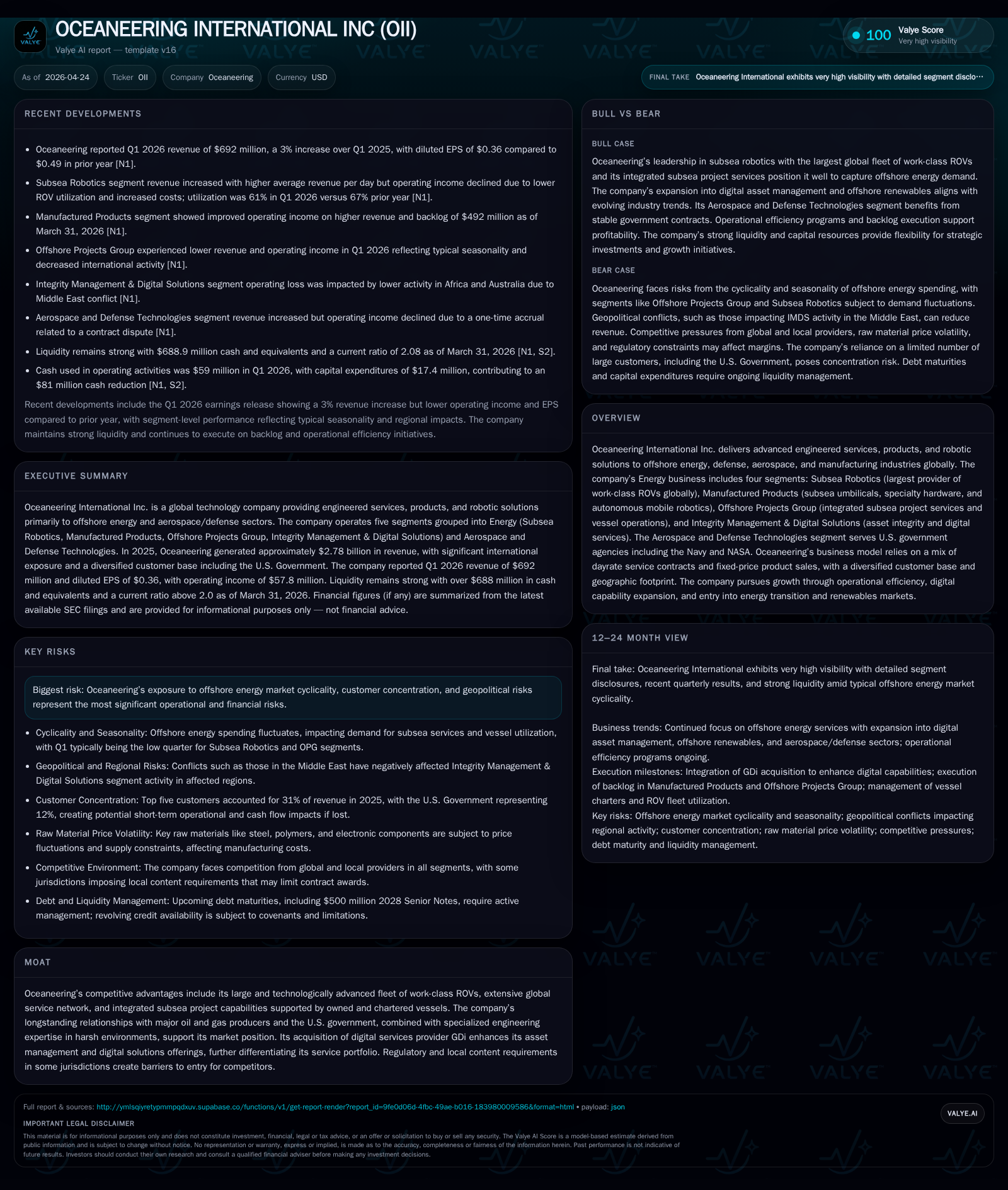
Oceaneering International Inc.'s Q1 2026 report shows a 3% revenue increase but a 21% decline in operating profit compared to the prior year. Reduced utilization of ROVs in the U.S. Gulf weighed on subsea robotics, while Aerospace & Defense Technologies posted robust activity levels. The company maintains a strong liquidity position with $607 million in cash and $215 million available on its revolving credit facility, adequately supporting operations and growth initiatives. Strategic investments in digital asset management and diversification into defense underpin longer-term growth amidst offshore energy market cyclicality.
Recent Operating Update
Oceaneering International's latest quarterly filing ([S2]) dated April 23, 2026, provides a nuanced snapshot of the company's operational performance in Q1 2026. Despite a reported revenue increase of approximately 3% (to about $692 million) relative to Q1 2025, operating income experienced a contraction of roughly 21%, reflecting pressure from diminished utilization of remotely operated vehicles (ROVs), especially in the U.S. Gulf region where usage fell notably year-over-year.
Fleet utilization slid from 67% in Q1 2025 to 61% in Q1 2026, marking meaningful softness primarily driven by subdued subsea activity in this key geographic area. Notably, within the ROV operations, there's been an evolution towards higher deployment for drill support purposes (67% of fleet use versus 62% prior year), possibly implying more specialized or technically demanding engagements offsetting some volume losses elsewhere.
Cash flow dynamics reveal continued operational cash burn; net cash used in operating activities was $59.1 million for the quarter—an improved outflow compared to $80.7 million in the same period last year but indicative of ongoing working capital absorption and timing differences related to project milestones and collections ([S9]). This aligns with typical offshore service sector seasonality yet underscores the need for efficient capital management.
The Integrity Management & Digital Solutions (IMDS) segment faced tangible impact from geopolitical instability linked to Middle East conflicts ([S2]), adding short-term growth constraints despite steady underlying demand drivers in asset integrity and digital solutions.
Business Model Analysis
Oceaneering’s business model centers on providing highly engineered subsea robotics, manufactured products, integrated offshore project services, and digital asset management predominantly to offshore energy customers globally alongside substantial aerospace and defense contracting activities primarily for U.S. government entities ([S1]). Revenue streams comprise dayrate contracts that provide recurring service income tied directly to equipment utilization days — notably for the Subsea Robotics division — paired with fixed-price manufacturing contracts catering to specialty subsea hardware and autonomous mobile robotics.
The company's strategic strength lies chiefly in its extensive fleet of about 250 work-class ROVs worldwide, representing one of the largest and most technologically sophisticated global fleets ([S2]). This fleet supports diverse applications including drill support, subsea installation, construction assistance, inspection maintenance repair (IMR) tasks, and pipeline surveying. Such specialization fosters switching costs and high barriers for competitors given capital intensity and operational expertise required.
Complementing this physical asset base is Oceaneering's investment into digital capabilities following its acquisition of Global Design Innovation Ltd. (GDi) in October 2024 ([S1]). GDi's suite encompassing Vision software enables enhanced remote visual inspection using advanced data analytics and point cloud imaging—distinctive capabilities that integrate with Oceaneering's engineering teams to optimize asset integrity management solutions across hydrocarbons and utilities sectors.
The Aerospace & Defense Technologies (ADTech) segment serves principally U.S. Navy and NASA clients delivering engineering design work, prototype build services, repairs, and maintenance on naval submarines/surface ships as well as space exploration systems ([S1]). This ballast provides countercyclical stability given government contract funding patterns contrasting offshore energy volatility.
Industry Structure and Competitive Position
In offshore subsea markets, Oceaneering operates within a competitive oligopoly characterized by a few large players possessing advanced technical fleets combined with extensive vessel support networks (). The company’s vertically integrated service delivery—from robotic tools to vessel operation—creates substantial competitive moats supported by longstanding customer relationships with O&G majors as well as governmental agencies.
Regulatory environments enforcing local content requirements coupled with challenging offshore conditions accentuate entry barriers for newcomers. Oceaneering's diversified geographic footprint—with significant revenues generated internationally from Africa, UK, Norway, Brazil, Asia, and Australia—mitigates localized demand slowdowns ([S12]).
Emerging pressure arises from cyclical offshore capex patterns influenced by fluctuating oil prices and evolving energy transition trends which pivot industry spending towards renewables and cleaner hydrocarbons while underpinning ongoing commodity-driven exploration needs.
Growth Drivers and Constraints
Structural growth hinges on several vectors:
- Continued deepwater exploration requiring sophisticated ROV services;
- Expansion of subsea infrastructure installations;
- Increasing adoption of digital asset management solutions enhancing operational safety and efficiency;
- Strengthening aerospace/defense contracts buoyed by sustained government expenditure;
- New mobility robotic applications penetrating adjacent industrial markets through Manufactured Products.
However, constraints appear rooted in:
- Cyclicality inherent to oil & gas capital investments influencing dayrate pricing power;
- Regional geopolitical risks (e.g., Middle East conflicts dampening IMDS demand);
- Supply chain volatility affecting raw materials such as steel and electronic components necessary for manufacturing subsea hardware ([S16]);
- Capacity availability for chartered vessels impacting Offshore Projects Group operations;
- Competitive pressure potentially compressing margins if demand weakens substantially.
Hence demand signals should be viewed cautiously amid industry cycles though technological differentiation and integration into digitalized workflows offer tailwinds for long-term resilience.
What to Watch Next
Key milestones that could inform near-term performance include:
- Recovery or further deterioration in ROV fleet utilization metrics especially outside the U.S. Gulf region;
- Trajectory of global offshore rig counts vis-à-vis subsea project deferrals or accelerations;
- Order backlog development particularly within Manufactured Products segment as an early revenue predictor ([S2]);
- Integration progress on digital solutions platform advancing cross-segment synergies;
- Capital expenditure levels maintaining balance between sustaining current assets versus deploying new technologies;
- Updates regarding credit facility usage or debt refinancing ahead of senior note maturity in early 2028 ([S9]);
- Fiscal guidance or outlook revisions provided during next quarterly earnings announcements expected mid-2026.
Monitoring geopolitical issues influencing IMDS revenues also remains critical given recent impacts.
Financial Profile Summary
Historical performance (annual)
| FY | Rev ($bn) | CFO ($mm) | OpInc ($mm) | Capex ($mm) | Rev YoY |
|---|---|---|---|---|---|
| 2025 | 2.8 | 319 | 305 | 111 | +4.6% |
| 2024 | 2.7 | 203 | 246 | 107 | +9.8% |
| 2023 | 2.4 | 210 | 181 | 101 | +17.4% |
| 2022 | 2.1 | 121 | 111 | 81 |
Source: SEC companyfacts cache [F1].
Capital returns and efficiency (annual)
| FY | Buybacks ($mm) | FCF ($mm) |
|---|---|---|
| 2025 | 40 | 208 |
| 2024 | 20 | 96 |
| 2023 | 109 | |
| 2022 | 40 |
Source: SEC companyfacts cache [F1].
Oceaneering’s financial stance as of March 31, 2026 reflects prudent liquidity management:
- Cash & equivalents stood at approximately $607 million with working capital totaling about $788 million supporting operational flexibility ([F1],[S15]).
- The company enjoys undrawn commitments amounting to $215 million on its senior secured revolving credit facility due April 2027; all covenant tests are currently met without exceptions ([S2],[S20]).
- Total long-term debt measured around $487 million (2028 Senior Notes) with no outstanding borrowings under revolving lines at quarter-end ([F1],[S2]).
- Capital expenditures reached about $17.4 million during Q1 comprising both maintenance (
$8M) and growth-oriented investments ($9.4M), aligned with strategic technology deployment goals ([S2]). - Despite negative operating cash flow during the quarter ($59 million outflow), this is an improvement over prior year reflecting better working capital management but warrants continued focus especially amid growth investments ([S9]).
- Share repurchases were paused during Q1 after moderate buybacks totaling ~$40 million executed last full fiscal year reflecting balanced capital allocation philosophy ([F1],[S20]).
Historical annual performance highlights robust topline growth averaging ~4.6% CAGR over recent years fueled by improving pricing trends across segments; operating income expanded ~23.7% year-over-year through fiscal 2025 signaling margin gains attributable largely to scale efficiencies and enhanced service mix ([F1]).
Overall, Oceaneering navigates cyclical industry dynamics leveraging technological leadership, diversified end markets including defense stability, substantial liquidity buffers, and targeted investments into higher value-added digital offerings which collectively suggest durability albeit contingent on upstream market recovery trajectories.
This analysis is based strictly on disclosed regulatory filings as cited without investment recommendations.
Disclaimer: This is research-only, informational analysis and not investment advice. It may include AI-generated interpretation and general industry context. Always verify important details using primary sources.

Comments