
Okta Expands AI Identity Security Amid Rising Integration and Platform Adoption
Okta's latest quarter highlights growth in AI agent identity management and sustained customer platform expansion.
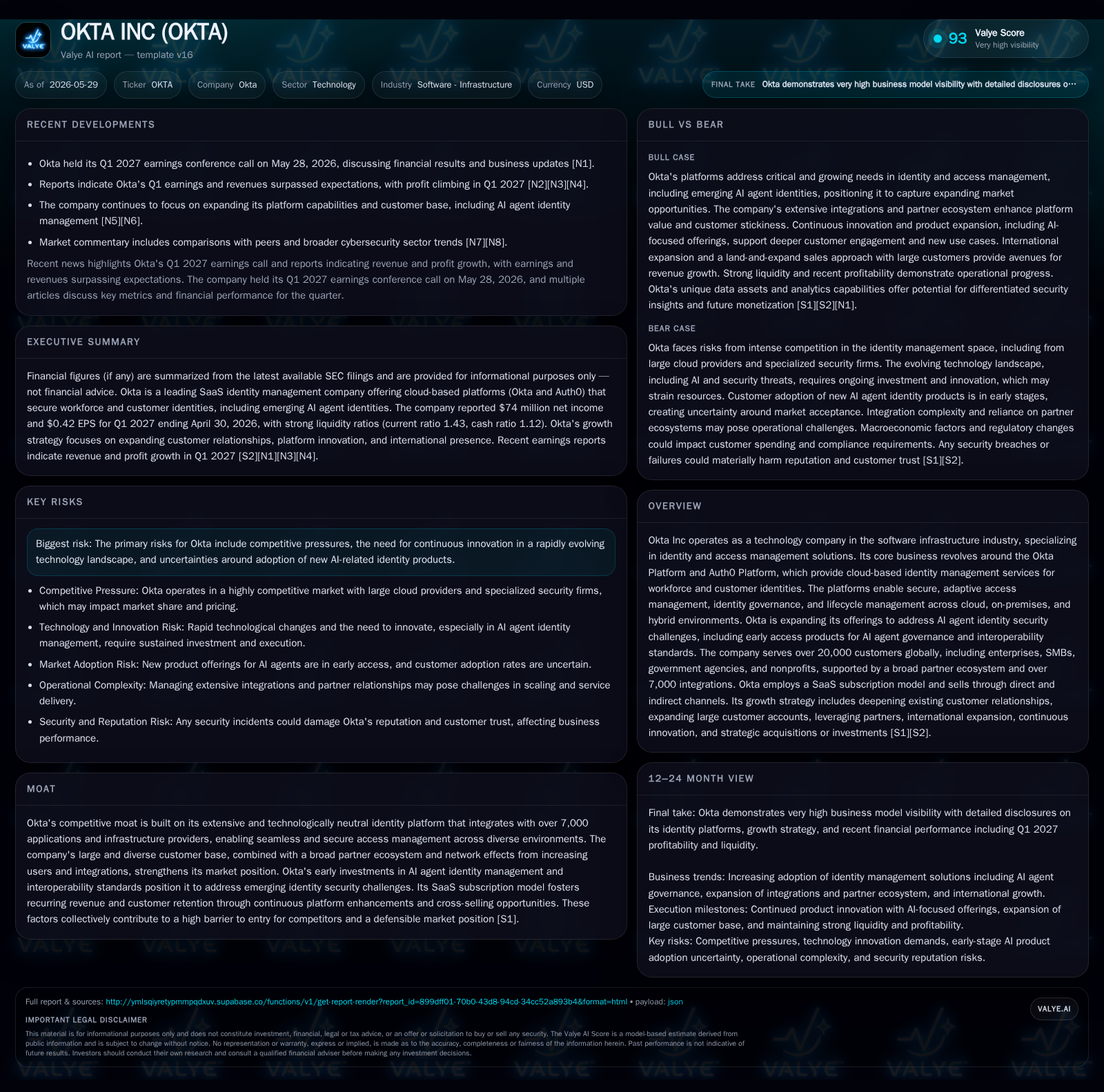
In its Q1 2027 filing, Okta reported steady progress in extending its identity platform to address emerging AI agent security needs, alongside broad customer base growth and integration expansion. The company’s SaaS subscription model and robust partner ecosystem underpin recurring revenue, while new early access products signal focus on future identity governance challenges. Competitive pressures remain elevated, primarily from Microsoft and other established players, but Okta’s technological neutrality and extensive application integration network bolster its market position. Key risks include macroeconomic demand fluctuations, rapid technology evolution, and AI product adoption uncertainties.
Recent Operating Update: Q1 Fiscal 2027
Okta's latest quarterly report for the period ended April 30, 2026 ([S2], [S3]) underscores the company's strategic pivot toward securing not only human identities but also emerging non-human identities (NHIs) such as AI agents. The company introduced early-access products like Okta for AI Agents and Cross App Access (an interoperability extension aligned with the Model Context Protocol standard) that collectively tackle the scalability and governance challenges presented by these new digital identities. These offerings are nested within Okta's core platforms — Okta Platform focused on workforce identities and Auth0 Platform geared toward developer-heavy customer identity use cases.
This quarterly disclosure reflects no material changes to risk factors previously detailed in the annual report ([S1], [S2]), but it emphasizes continued operational execution around platform innovation and penetration within existing customers.
Business Model Analysis
Okta monetizes primarily through a multi-year Software-as-a-Service (SaaS) subscription model where revenue is driven by user seat counts (employees, contractors, partners), API usage for customer-facing applications, and increasingly through advanced offerings like lifecycle governance or adaptive multifactor authentication (MFA). The company's platforms act as centralized control planes governing authentication, access management, policy enforcement, and identity lifecycle across heterogeneous IT environments — cloud-native apps, legacy on-prem technologies, hybrid setups.
A defining feature of Okta’s business model is technological neutrality which allows seamless integration with over 7,000 third-party applications and infrastructure services ([S4], [S6], [S9]). This dense integration fabric fuels network effects: as more customers adopt the platform(s), more integrations become viable which in turn enhances the platform's value proposition. Moreover, Okta sells both direct via salaried inside/field sales teams as well as through indirect channels including system integrators and cloud marketplaces — enabling broad distribution reach.
Product differentiation arises from offering an intuitive consumer-like user experience coupled with robust enterprise-grade security certifications (SOC 2 Type II, FedRAMP) that facilitate trust among regulated industries. Developer empowerment is central to the Auth0 Platform strategy that supports extensibility via APIs and SDKs enabling rapid embedding of secure identity into diverse applications — crucial as deployment evolves beyond humans to agentic AI systems ([S10], [S16], [S22]).
Industry Structure and Competitive Position
Okta occupies a prominent position in the software infrastructure sector focusing on digital identity management — an increasingly critical layer in cybersecurity architectures driven by Zero Trust paradigms. The market is dominated by a handful of large incumbents such as Microsoft that bundle identity solutions within broader enterprise suites. Unlike many competitors with bundled or closed platforms facilitating lock-in but reduced flexibility ([S5]), Okta’s open architecture supports heterogeneous environments allowing easier adoption alongside existing IT investments.
Competitive threats arise not just from scale but also innovation velocity where startups or tech giants invest heavily in augmenting identity capabilities with AI-driven analytics or integrated security features. Okta counters these pressures with ongoing R&D investments aimed at maintaining leadership in adaptive access controls while pioneering governance models tailored to AI agents that require massively scalable non-human identity frameworks ([S12], [S16]).
Strategically important too is the expansive partner ecosystem composed of global system integrators who extend Okta’s reach into enterprise accounts along with technology alliances enriching integration depth. These extensions foster switching costs by embedding Okta’s capabilities deeply into enterprise workflows.
Growth Drivers
AI Agent Identity Management: As organizations deploy generative AI tools internally or offer agent-driven customer interactions externally, managing these NHIs securely becomes paramount. Okta’s early access products targeting this niche anticipate rising demand from regulated sectors needing granular authorization controls at scale.
Zero Trust Security Shift: The pivot away from perimeter-based network security toward adaptive contextual authentication boosts demand for platforms capable of risk-based access evaluation—Okta’s adaptive MFA exemplifies this transition.
Platform Expansion Within Existing Customers: Land-and-expand adoption patterns permit upselling complementary modules such as lifecycle management or API access controls enhancing wallet share per client.
International Market Growth: With roughly a fifth of revenue generated outside the U.S., expanding cloud adoption globally presents incremental opportunity especially where regulatory compliance drives cloud-native security solutions ([S20]).
Developer Ecosystem Scaling: Empowering developers via Auth0 accelerates secure application rollout cycles thereby increasing end-user base served by Okta technologies.
Risks / Watchpoints / Growth Constraints
Intense Competition: The presence of larger well-resourced competitors able to bundle identity solutions or aggressively price create margin pressure risks ([S5], [S18]).
Innovation Pace & Technology Change: Okta must continuously anticipate rapidly evolving standards including those governing AI agent interactions or new cryptographic methods lest it lose relevance.
Adoption Uncertainty for AI Identity Products: While strategically promising, early-stage adoption entails risks if deployment cycles lengthen or regulatory uncertainty delays uptake.
Economic Sensitivity: Slower IT spending environment or constrained budgets among target customers may temper subscription growth.
Security Incident Exposure: Though highly certified operationally ([S9]), breaches could impact reputation severely given reliance on trust to secure sensitive identities across thousands of customers.
What to Watch Next
Upcoming performance markers include signs of accelerating adoption for AI-tailored identity governance capabilities currently in early access stages. Monitoring net retention rates reflecting upsell success within existing clients provides insight into platform stickiness. Expansion of integrations beyond the current 7,000 offers a tangible metric indicating ecosystem vitality. Lastly, engagement metrics from large enterprise deals notably in regulated verticals should reveal progress against top competitors.
Financial Profile Snapshot
Okta maintains healthy liquidity with $762 million in cash equivalents as of April 30, 2026 alongside a current ratio of approximately 1.43 ([F1]). This balance supports sustained R&D spending critical for product innovation initiatives around AI-focused offerings and continued go-to-market investments targeting deepened customer penetration. Operating income figures available up to January-end indicate profitable trends consistent with scaling SaaS operations albeit subject to competitive pricing pressures.[F1]
This analysis is based solely on publicly filed information without rendering any investment advice or research view. All forward-looking statements contained herein are subject to risks detailed in company disclosures.
Disclaimer: This is research-only, informational analysis and not investment advice. It may include AI-generated interpretation and general industry context. Always verify important details using primary sources.

Comments