
Oppenheimer Holdings' Strong Turnaround: Growth, Capital Discipline, and Legal Risks in Focus
Significant profitability improvement in 2025 underscores Oppenheimer's operational momentum alongside measured capital returns amid ongoing regulatory scrutiny.
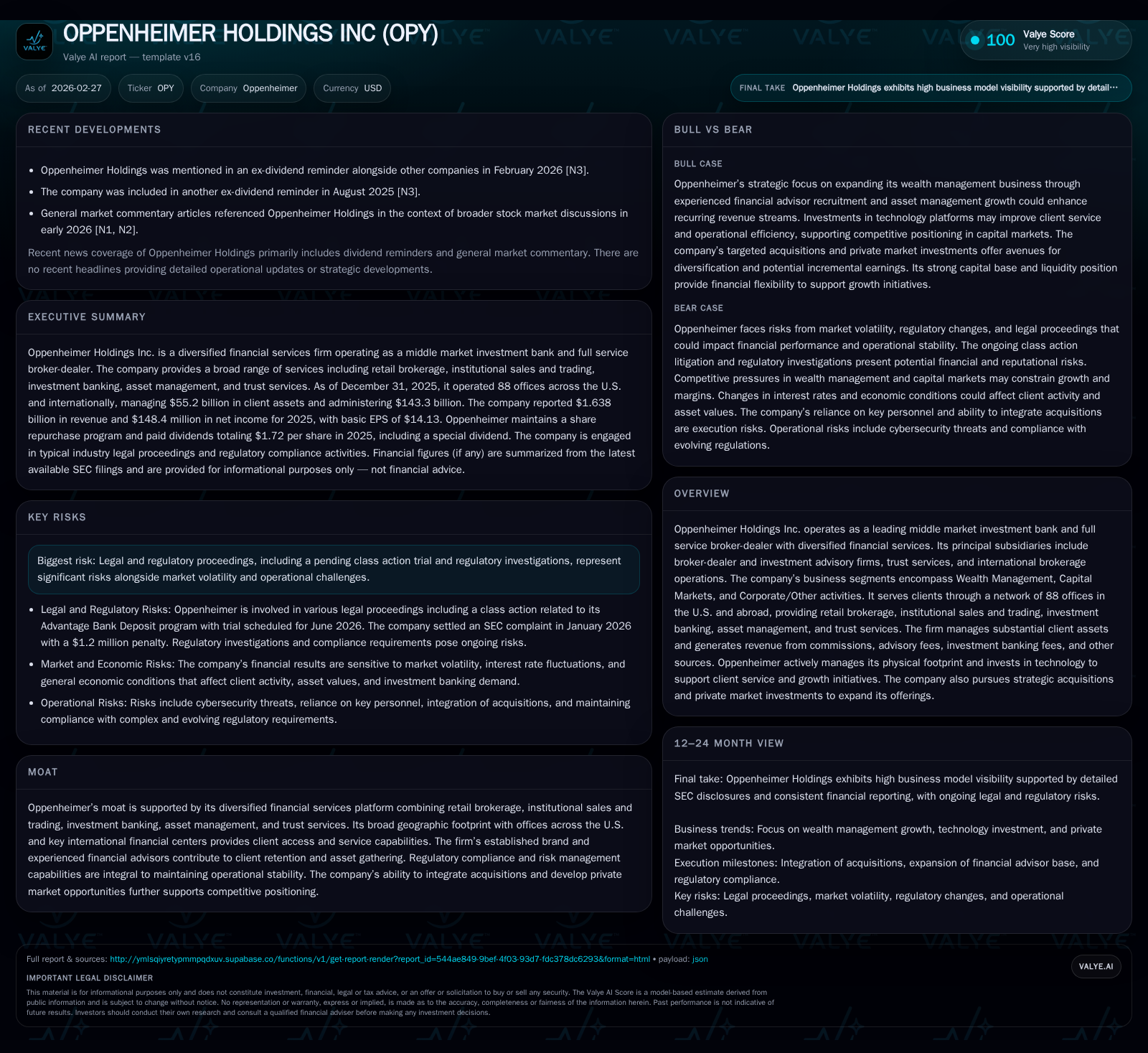
Oppenheimer Holdings delivered a near doubling of operating income and net income in fiscal 2025, driven by revenue growth of 14.4%, as its diversified financial services platform gained traction. The firm’s strategic capital allocation balanced dividend hikes and share repurchases scaled back amid litigation uncertainties. Emerging legal proceedings—especially class actions and regulatory investigations—pose uncertain downside risk but have not materially impacted financials yet. Upcoming regulatory amendments and industry dynamics will shape operational demands and margin sustainability going forward.
Magnitude of Recent Financial Growth and Its Catalysts
Oppenheimer Holdings registered a compelling financial turnaround in FY2025, nearly doubling operating income to $211.2 million—a 99.7% year-over-year increase on the back of a 14.4% rise in revenue to approximately $1.64 billion [F1]. Net income leapt 107%, reaching $148.4 million, underscoring marked operational leverage within its business model. The firm’s operating cash flow rebounded sharply from a negative outflow of $108.2 million in FY2024 to a robust positive inflow of $188.8 million in FY2025, indicative of improved working capital management and earnings quality.
This growth narrative contrasts sharply with previous years when profitability was constrained despite rising top-line figures: revenue expanded steadily from $1.11 billion in FY2022 through FY2024 but earnings advances remained modest until this inflection.
Capex remained stable at approximately $5.2 million in FY2025, a flat spend versus prior year suggesting capital efficiency amid growth phases [F1]. This backdrop signals that operational execution improvements—likely encompassing cost controls, enhanced fee capture, and mix shifts favoring higher-margin segments—drove earnings acceleration beyond revenue gains.
Historical performance (annual)
| FY | Rev ($mm) | Net ($mm) | CFO ($mm) | OpInc ($mm) | Rev YoY | Net YoY |
|---|---|---|---|---|---|---|
| 2025 | 1638 | 148 | 189 | 211 | +14.4% | +107.4% |
| 2024 | 1432 | 72 | -108 | 106 | +14.7% | +137.1% |
| 2023 | 1249 | 30 | -19 | 47 | +12.4% | -6.7% |
| 2022 | 1111 | 32 | 64 | 46 |
Source: SEC companyfacts cache [F1].
Capital returns and efficiency (annual)
| FY | Div ($mm) | Buybacks ($mm) | FCF ($mm) |
|---|---|---|---|
| 2025 | 8 | 3 | 184 |
| 2024 | 7 | 10 | -113 |
| 2023 | 6 | 35 | -36 |
| 2022 | 7 | 61 | 48 |
Source: SEC companyfacts cache [F1].
All financial figures sourced from [F1]
Emerging Legal and Regulatory Hurdles: Quantifying Risk to Business Stability
Oppenheimer confronts notable legal exposure including the Liberty Capital Group class action alleging insufficient interest payments on customer cash balances in its Advantage Bank Deposit program [S10][S13][S17][S18]. While certain claims were dismissed for non-advisory clients, other claims remain certified for advisory clients creating ongoing litigation risk with indeterminate damage amounts.
The Company also settled an SEC enforcement action regarding municipal securities disclosures with a civil penalty paid early January 2026 totaling $1.2 million [S10][S13][S17]. Further regulatory reviews by FINRA and other bodies persist though no material reserves have been established for these pending matters.
Management estimates potential aggregate loss ranges attributable to unresolved legal proceedings at up to $253 million above recognized accruals but considers these risks unlikely to produce material adverse effects on consolidated results based on current assessments [S10][S13]. The inherent uncertainty around timing and quantum of any contingent liabilities necessitates monitoring but has not impaired the current balance sheet or cash flow profiles.
Strategic Capital Allocation: Share Repurchases, Dividends, and Cash Flow Health
Fiscal year 2025 witnessed prudent capital return execution amid litigation concerns: Oppenheimer repurchased shares totaling approximately $3 million—a noticeable scale-back from prior year’s $9.6 million buyback activity—and paid dividends aggregating approximately $7.6 million representing a per share payout of $0.72 versus $0.66 previously [F1][S4][S5]. A special dividend of $1 per share was also declared post-year-end, delivering episodic shareholder value enhancement.
Such moderation in repurchase cadence aligns with conservative capital stewardship strategies balancing growth investments against contingent legal costs uncertainties while sustaining attractive dividend yield progression.
The firm generated roughly $183.6 million free cash flow (operating cash flow minus capex), reflecting resilient underlying business cash conversion supporting continued financial flexibility [F1].
Return on equity approximated a healthy ~15%, indicating effective use of equity base for profit generation amid recovery trajectory [F1].
Liquidity and Balance Sheet Strength: Navigating Debt, Loans, and Short-Term Funding
Oppenheimer's liquidity framework rests on substantial internally generated funds complemented by diverse collateralized borrowings including bank call loans ($76.8 million outstanding end-2025), securities lending balances ($370 million), reverse repurchase agreements (~$176 million gross), and repurchase agreements exceeding $1 billion [S6][S7][S8][S15]. These facilities enable funding for securities inventory positions, client margin financing, matched-book arrangements, and clearing operations.
The company's liquidity management includes daily gross balance volatility requiring active oversight of call loan usage relative to deposit inflows [S6][S8]. Internal stress testing supports contingency plans targeting asset liquidation paths that limit external funding dependence under market duress scenarios [S8].
Operating lease obligations total approximately $155 million with near-term maturities reflecting real estate footprint optimization initiatives responsive to hybrid work environments [S6].
Liquid assets held at overseas subsidiaries are subject to local regulatory capital requirements limiting immediate repatriation but remain reinvested strategically for regional expansion [S14].
Future Outlook: Regulatory Changes and Industry Dynamics
Starting mid-2026, amended SEC Rule 15c3-3 requires daily computation of customer reserve obligations for firms exceeding specified credit thresholds [N2][N3][S2], likely increasing operational staffing needs and administrative costs.
Tax code changes effective in calendar year 2027 expand Section 162(m) limitations on deductible executive compensation expenses potentially elevating effective tax rates depending on personnel compensation mix [S2].
Milestones and Indicators to Watch for Sustainable Profit Momentum
Key upcoming milestones include:
- Resolution outcomes of pending class actions impacting financial contingencies or reputational standing,
- Client assets under management trends within Wealth Management signaling fee revenue stability,
- Timely compliance with SEC daily reserve computation requirements,
- Continued disciplined capital allocation balancing shareholder returns against risk buffers amidst evolving regulatory costs.
Disclaimer: This analysis is prepared solely for informational purposes based on publicly available data as of February 27, 2026; it does not constitute investment advice or recommendations.
Disclaimer: This is research-only, informational analysis and not investment advice. It may include AI-generated interpretation and general industry context. Always verify important details using primary sources.

Comments