
Ormat Technologies’ Expansion in Geothermal and Energy Storage Confronts Capital Intensity and Market Risks
Ormat continues to leverage its vertically integrated model to grow its renewable portfolio while managing leverage and geographic risk exposures.
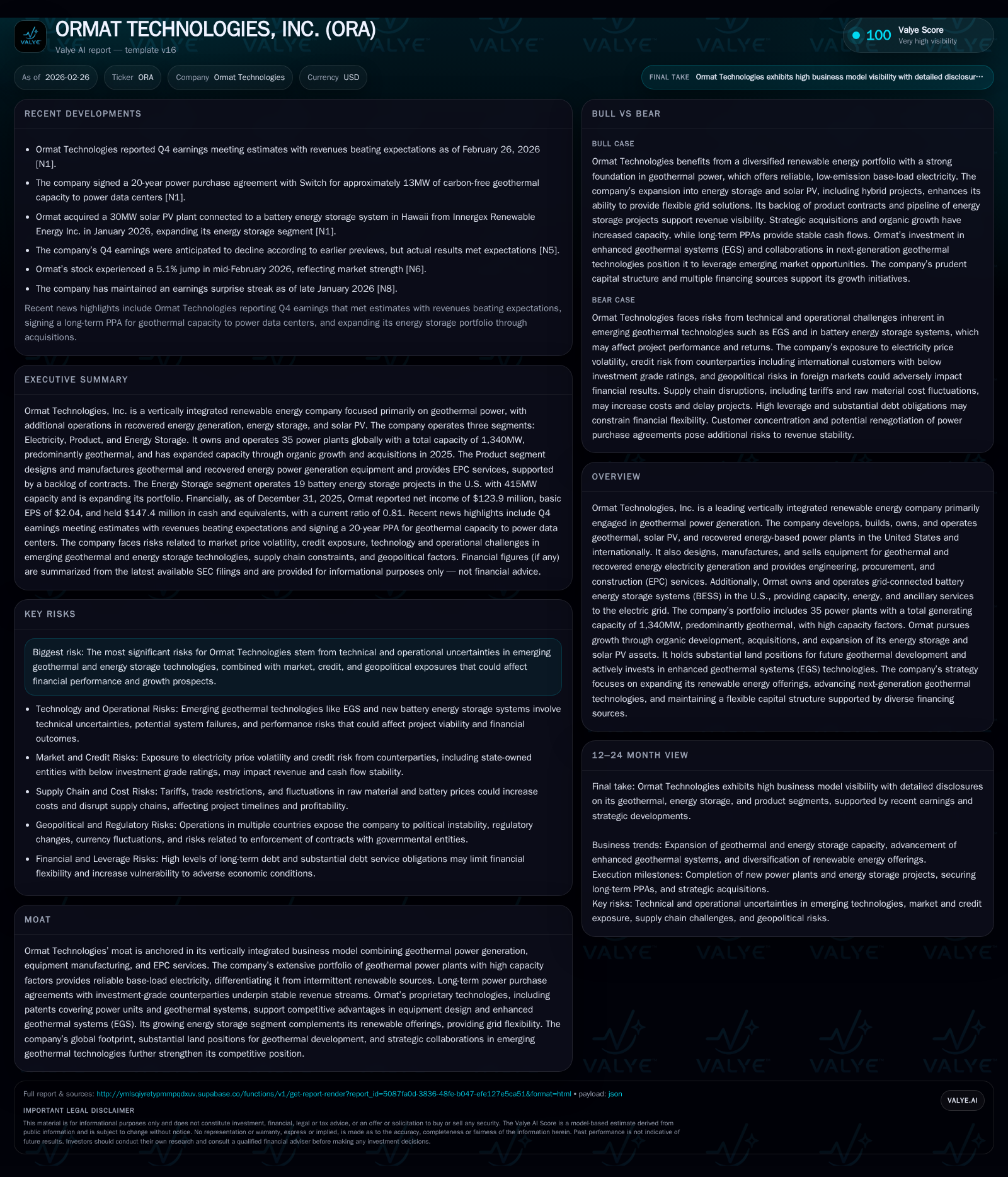
Ormats Technologies, Inc. reported relatively stable financial results for 2025 with net income holding steady and modest Adjusted EBITDA growth despite a declining revenue trend. Its core geothermal assets with high capacity factors sustain steady operating income, supplemented by recent expansions in solar PV and battery energy storage systems (BESS). The company’s strategic initiatives prioritize organic development, acquisitions, and technology advancement in enhanced geothermal systems alongside growing battery storage operations. However, capital expenditures surged sharply due to expansion projects, resulting in negative free cash flow and heightened leverage. Ormat faces operational risks from geological uncertainties, customer concentration, geopolitical exposures, and emerging technology integration challenges. Near-term milestones include commissioning additional power capacities and realising backlog conversions while maintaining prudent capital structure amid fluctuating commodity prices and regulatory environments.
Historical Performance Overview
Ormat Technologies’ financial performance through 2025 reveals consistent profitability amid cyclical revenue pressures typical of the capital-intensive renewable power sector. The latest fiscal year closed with net income of roughly $124 million, virtually flat versus the prior year, while revenues declined by nearly 7% compared to pre-pandemic levels noted in earlier years [F1]. Operating income registered a slight dip from $172 million in 2024 to $169 million in 2025 (-1.9%), reflecting cost management against inflationary headwinds.
Meanwhile, Adjusted EBITDA increased by approximately 5.7% year-over-year to $582 million driven by sustained high capacity utilization rates—geothermal plants reported around an impressive 84% capacity factor—and operational scaling of newly commissioned solar PV plus energy storage plants [S1][F1]. These metrics underscore Ormat’s strength in generating reliable base-load power contrasting intermittent renewables.
Historical performance (annual)
| FY | Net ($mm) | CFO ($mm) | OpInc ($mm) | Capex ($mm) | Net YoY |
|---|---|---|---|---|---|
| 2025 | 124 | 335 | 169 | 620 | +0.1% |
| 2024 | 124 | 411 | 172 | 488 | -0.5% |
| 2023 | 124 | 309 | 167 | 618 | +88.9% |
| 2022 | 66 | 281 | 153 | 563 |
Source: SEC companyfacts cache [F1].
Capital returns and efficiency (annual)
| FY | Div ($mm) | Buybacks ($mm) | FCF ($mm) |
|---|---|---|---|
| 2025 | -285 | ||
| 2024 | 0 | -77 | |
| 2023 | 28 | 0 | -309 |
| 2022 | 27 | 18 | -283 |
Source: SEC companyfacts cache [F1].
Note: Revenue figure unavailable for latest filings; focus on profitability and cash flow indicators.
Although cash flow from operations decreased by approximately -18.5%, reflecting timing effects and working capital changes amid rising capex (+27%), the company’s underlying earnings quality remains intact [F1]. Free cash flow was negative for the first time recently (~-$285 million), principally due to elevated investments gearing towards near- and medium-term growth.
Business Segments & Portfolio
Ormat operates through three main segments:
Electricity Segment: Constitutes ownership and operation of geothermal power plants primarily across the U.S., Kenya, Guatemala, Honduras, Indonesia, New Zealand, and Guadeloupe [S4][S19]. The majority (~81%) of the total electricity segment’s capacity (about 1,031 MW of geothermal out of total ~1,340 MW) is dedicated to geothermal generation backed by long-term PPAs mostly with investment-grade counterparts ensuring stable cash flows [S19]. Recent organic growth additions include repowering projects like Beowawe (6MW) alongside strategic acquisitions such as Blue Mountain geothermal plant (20MW) and solar-plus-storage assets totaling ~30MW+ [S4][S24].
Product Segment: This includes design, manufacturing, sales of proprietary power units for geothermal and recovered energy generation as well as EPC services [S5]. The backlog surged notably with new contracts worth about $103.5 million secured during calendar year 2025 plus nearly $100 million from the New Zealand TOPP2 project expected to contribute revenues early Q1-2026 [S5]. International sales dominate here (~95%), primarily servicing markets rich in geothermal reservoirs such as New Zealand.
Energy Storage Segment: Growth here is a distinct strategic priority where Ormat owns standalone In Front of the Meter (IFM) Battery Energy Storage Systems that provide ancillary grid services across California (CAISO), Texas (ERCOT), and PJM markets on the East Coast [S4][S24]. Currently operating a fleet totaling roughly 415MW capacity paired with more than one gigawatt-hour (GWh) of storage capability enables monetization via merchant sales plus capacity contracts [S4]. Several recent facilities were commissioned including sizable new additions connected with solar PV plants boosting hybridity.
Future Growth Prospects & Strategic Initiatives
Ormats’ growth strategy hinges on leveraging vertical integration advantages coupled with diversifying renewable offerings while expanding geographically:
Geothermal Expansion & EGS Pilots: Maintaining leadership through enhanced geothermal system R&D aimed at unlocking untapped geothermal resources beyond traditional reservoirs is core to long-run value creation but involves upfront capital demands along with subsurface uncertainty [S14][S25]. Existing land positions covering multiple prospects across continents represent optionality.
Battery Energy Storage Scaling: With increasing grid integration needs for flexibility amid rising renewables penetration, Ormat is aggressively expanding BESS footprint via organic development combined with accretive acquisitions such as the January ’26 purchase of a Hawaii-based solar-plus-storage system from Innergex Renewable Energy Inc [N13][S4][S24].
Product Sales & EPC Backlog Conversion: Enriched order pipeline targeting completion over next two years supports near-term revenue visibility from equipment sales and contracting activities including turnkey plant construction projects.
Customer Base Diversification: Although government-owned utilities still constitute major take-or-pay counterparties securing long-duration PPAs underpinning revenues (~70% electricity segment revenues), initiatives are underway evaluating direct commercial engagements (hyperscalers/datacenters) though these remain nascent [S13].
Potential Constraints:
- Geological risks inherent to geothermal production variability continue to challenge resource sustainability potentially increasing operational costs or causing output declines requiring intensive reservoir management [S6][S14].
- Concentration risks attributable to key customers such as Kenya Power & Lighting Company (KPLC) representing nearly a dozen percent revenues where payment delays arose impacting collections into early ’26 require active credit monitoring [S10]. Similar exposures exist to Honduras' ENEE utility and SCPPA municipal buyers.
- Regulatory environment shifts including tax implications resulting from OECD Pillar II global minimum taxation rules may affect effective rates though current assessments deem impact minimal [S12].
- Geopolitical instability especially impacting Israeli operations supplying product segment manufacturing poses risks to supply chain continuity amidst regional conflicts [S20].
- Market price volatility affects merchant sales principally within energy storage operations while majority fixed-rate PPA protections mitigate exposure for traditional electricity generation segments [S18]. Lastly,
- Rising raw material costs especially lithium and metals tied to battery production accompanied by trade restrictions/tariffs pose supply-side pressures [S22].
Financial Forecasts & Milestones to Watch
To date Ormat has not issued specific near-term earnings guidance publicly beyond broad strategic milestones communicated around capacity growth targets [N13][S13]. Investors should monitor:
- Progress toward commissioning planned power plants totaling between an estimated additional ~310 MW–410 MW by end-'28 elevating total installed base closer to ~1.7 GW.
- Realization rates against Product segment backlog particularly accounting for recognition expected Q1 '26 TOPP2 project revenues.
- Operational metrics including capacity factors maintaining >80% across geothermal portfolio reflecting stability vs resource cooling risks.
- Development milestones achieved within EGS pilots could be pivotal given nascent commercial stage technology implications.
- Debt refinancing outcomes given ~$2.66 billion principal outstanding concentrated maturities across several years ahead which might impact interest expense dynamics or liquidity position if market conditions tighten [S7][S9][S15].
Capital Allocation & Returns Context
Ormats’ capital deployment intensely favors growth investments balancing cash-flow generation:
The company recorded approximately $620 million capex during FY25 reflecting aggressive asset additions including greenfield developments plus acquisitions significantly above prior year levels (+27%) impacting free cash flow negatively at about -$285 million despite strong operating cash flows [$335 million] supported by established PPAs revenues [F1].
Dividend payouts have been fairly consistent historically (~$27–28 million annually), though no buyback activity occurred in recent years signaling retained capital focused on reinvestment rather than shareholder returns last filed periods suggest tight liquidity management amid expansion phase [F1][S13].
Equity has grown steadily supporting solidity on balance sheet; latest equity approximates $2.54 billion implying trailing ROE near mid-single digits (~5%) owing mainly to capital-heavy business model requiring scale before elevated return improvements emerge.
Debt structure remains predominantly fixed-rate (>84%) insulating interest charges from short-term rate volatility albeit refinancing risk exists approaching bond maturity windows; ongoing access to diverse finance sources including green bonds plays critical role maintaining flexibility for forthcoming development pipelines [S15][S21].
Conclusion
Ormats’ standing as a vertically integrated renewable leader anchored in geothermal power generation provides it a differentiated niche offering high predictability relative to intermittent renewables. Recent portfolio expansions incorporating solar PV hybrids plus advancing battery storage installations align well with grid decarbonization trends demanding both baseload stability and flexibility solutions.
Nevertheless this scaleup comes coupled with intensified capital needs reflected in rising capex outlays compressing free cash flow presently while elevated leverage invokes need for continued prudence amid macroeconomic uncertainties including inflation pass-throughs and geopolitical headwinds affecting supply chains particularly Israel-based manufacturing nodes.
Risks sprout from customer concentration challenges notably state-owned utilities with variable credit profiles outside primary U.S. markets alongside emerging technology uncertainties linked especially to EGS development timelines and success probabilities which remain unproven commercially at scale.
Monitoring progress on commissioning new plants together with backlog conversion velocity will offer important signposts regarding growth trajectory realization whereas effective capital structure management will influence long-term financial resilience amidst evolving market conditions.
This analysis synthesizes publicly disclosed SEC filings["10-K" Filed Feb ‘26], recent news releases[NASDAQ February ‘26], and validated numeric financial data without offering investment advice or price targets.
Disclaimer: This is research-only, informational analysis and not investment advice. It may include AI-generated interpretation and general industry context. Always verify important details using primary sources.

Comments