
Oramed Pharmaceuticals Shifts Strategy with Lifeward Stake and Oral Insulin Trial Management
Oramed restructures its oral biologics delivery business through a major equity partnership while advancing clinical development via OraTech.
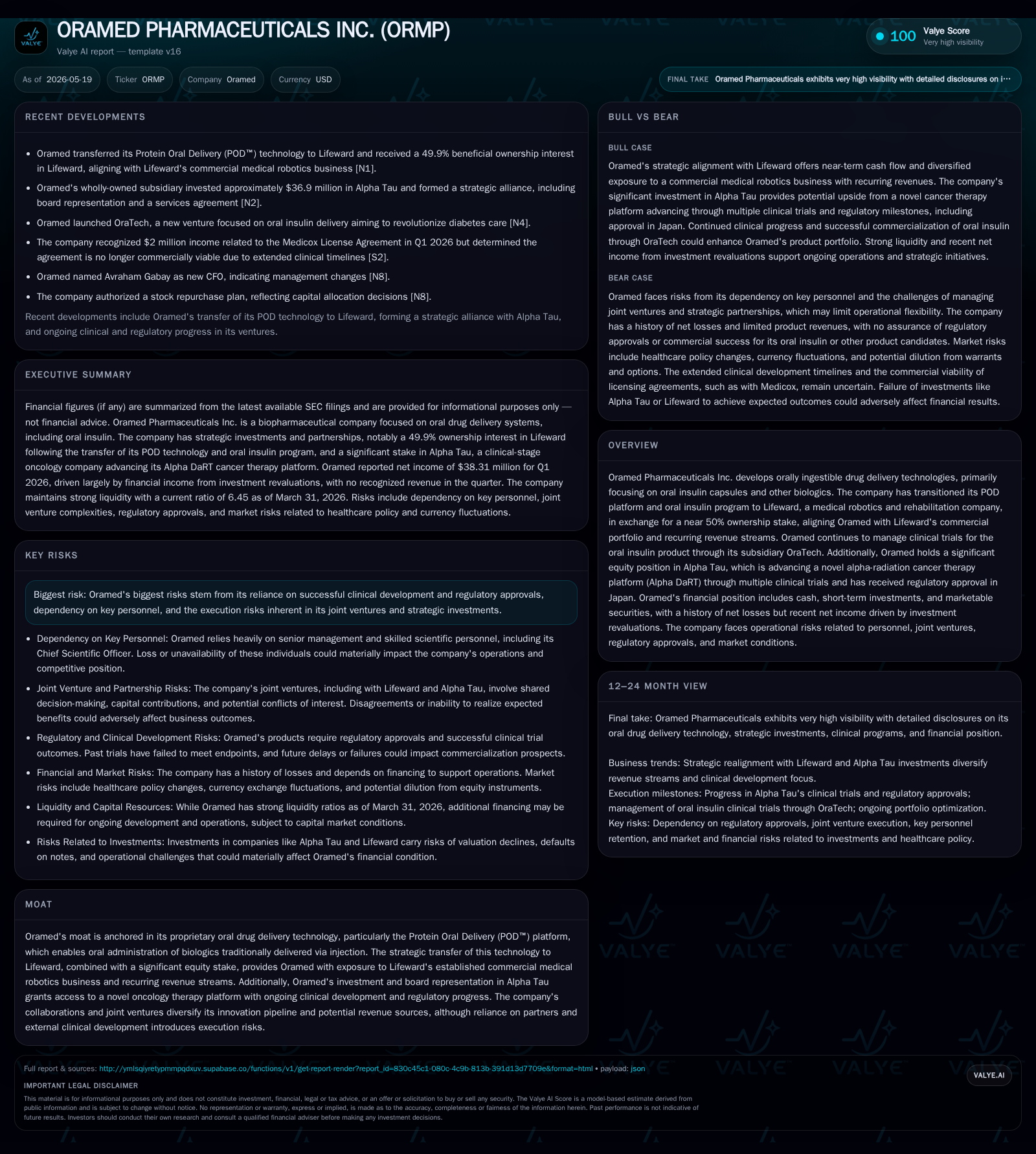
In Q1 2026, Oramed Pharmaceuticals completed a strategic transition of its oral drug delivery platform and oral insulin program to Lifeward Ltd., acquiring near 50% ownership in the medical device firm and aligning with their commercial portfolio. The company now focuses on managing clinical trials for its oral insulin capsule through subsidiary OraTech under a new agreement. Oramed also maintains significant equity in Alpha Tau Oncology, diversifying exposure into oncology therapeutics. While Oramed’s core innovation lies in oral biologics delivery technology, near-term growth depends on Lifeward’s execution and successful regulatory progress in clinical trials. Risks remain high due to ongoing development challenges, reliance on partnerships, and limited operating scale.
Recent Operating Update
Oramed Pharmaceuticals’ latest quarterly report filed May 19, 2026, confirms a pivotal operational shift completed earlier that year: the transfer of its proprietary Protein Oral Delivery (POD™) platform and oral insulin program into Lifeward Ltd., a medical robotics and rehabilitation company [S2][S3]. In exchange for these assets, Oramed received a substantial equity stake equal to nearly half of Lifeward's fully diluted shares post-closing. This deal strategically aligns Oramed with a firm holding an established commercial portfolio and recurring revenue streams outside purely pharmaceutical R&D [S3].
This transition marks a fundamental change from direct drug development toward an investment and alliance model. Going forward, Oramed's wholly owned subsidiary OraTech will exclusively manage the clinical trial activities related to the oral insulin capsule product via a Clinical Trial Management Agreement with Lifeward/OraTech [S15]. This arrangement fixes the operational responsibility for trial management within Oramed's control but outsources the broader commercial risk and development activities to Lifeward’s domain
Despite this transition away from owning the POD platform outright, Oramed retains critical ongoing roles by overseeing clinical operations for this key product candidate.
Furthermore, Oramed continues to hold a significant equity position in Alpha Tau Medical Ltd., an oncology therapeutics company specializing in a novel alpha-radiation cancer therapy (Alpha DaRT), which has received regulatory clearance for use in Japan [S1]. This diversification offers exposure beyond diabetes therapeutics into innovative cancer modalities with active clinical programs.
Financially, as of March 31, 2026, Oramed held cash and equivalents of approximately $13.2 million and total current assets of roughly $68.1 million against current liabilities close to $10.6 million — yielding an ample current ratio above 6x [F1][S2]. This supports ongoing operations including clinical trial management through OraTech for at least the coming year barring unforeseen capital needs [S9]. However, total debt reported remains elevated around $74.5 million (last noted September 2023), translating into net debt exceeding $61 million when factoring cash balances [F1].
While revenue recognition remains limited — no revenues were recorded in Q1 2026 following expiration/performance completion of prior license agreements — net income was positive primarily due to non-recurring other income related to transactions with Lifeward [S2]. Net operating losses persist reflecting R&D investments and administrative costs.
Business Model
Oramed historically developed orally ingestible pharmaceutical technologies enabling systemic delivery of biologic drugs traditionally requiring injection. Their flagship innovation is the Protein Oral Delivery (POD™) platform designed to protect proteins like insulin from degradation in the digestive tract.
The business model before early 2026 was centered on advancing orally delivered insulin through clinical trials toward regulatory approval and eventual marketing either independently or through licensing arrangements. Revenues primarily came from collaboration licensing fees rather than product sales given early-stage pipeline status.
Post-transaction, Oramed’s role shifted considerably:
- The direct ownership and commercialization responsibility for POD™ technology and associated oral insulin programs was ceded to Lifeward.
- Oramed secured nearly half ownership of Lifeward’s equity capital, thus gaining indirect exposure to the potential commercial success of these assets plus existing device products.
- Clinical trial operations remain managed by Oramed's subsidiary OraTech under contractual terms reimbursing expenses but not generating traditional product revenue.
- The company maintains an investment approach supplemented by board representation in Lifeward and Alpha Tau allowing influence without full operational burden.
This hybrid investment-operating model reduces upfront product development risk but introduces dependency on Lifeward's ability to execute successfully on commercialization and further trials.
Industry Structure and Competitive Position
Oral delivery of biologics sits at a challenging intersection between pharmaceutical innovation and drug formulation science. Biologics like insulin typically require parenteral administration due to enzymatic degradation in the gut lining; developing reliable oral formulations requires advanced protective and absorption-enhancing technologies.
Competitors within this space include both established pharma companies pursuing oral peptide delivery technologies (e.g., Novo Nordisk developing oral semaglutide) and biotech firms innovating delivery mechanisms. Significant barriers include extensive clinical validation requirements, regulatory hurdles due to safety/efficacy standards for systemic protein delivery via oral route, manufacturing complexity, and scalability challenges.
Beyond technology hurdles lies commercialization risk: pharmaceutical sales demand strong partnerships or internal capabilities for global marketing and distribution—areas where smaller firms often seek alliances or licensing deals.
By transferring POD technology into Lifeward—a company already generating recurring device revenues—Oramed has positioned itself within a broader industrial ecosystem that includes medical devices alongside pharmaceuticals. This diversification could mitigate pure biotech risks but creates cross-sector complexity.
Alpha Tau's oncology platform operates in another highly competitive domain: targeted cancer radiotherapies aiming at localized tumor ablation using alpha radiation physics. Regulatory approvals in Japan mark important validation milestones amid global competition with other radiotherapeutic modalities.
Growth Drivers
- Lifeward Collaboration Upside: Successful commercial rollout of POD-enabled therapeutics through Lifeward could generate significant diversified revenue streams tied not only to drug delivery but also adjacent rehabilitation/medical robotics markets where Lifeward is active [S3].
- Clinical Trial Progress: Advancement of the Phase 3 oral insulin trial managed by OraTech is crucial; positive data or FDA acceptance would enable further development steps including label expansion or commercialization partnerships [S15].
- Alpha Tau Equity Exposure: Progression through regulatory milestones in multiple markets elevates potential returns from Alpha Tau investment as oncology therapies move closer to commercialization phases [S1].
- Strategic Partnerships: Future collaborations—potentially with larger pharma companies possessing sales infrastructure—could accelerate market access if product candidates advance favorably.
- Intellectual Property & Technology Innovation: Maintaining patent protection over POD technology sustains barriers against competitors attempting similar oral biologics formulations [S11].
Risks / Growth Constraints
- Clinical Trial Uncertainty: Prior Phase 3 oral insulin trial failures underscore persistent risks inherent in demonstrating efficacy/safety for novel delivery mechanisms [S12][S22]. Delays or negative results could derail progress definitively.
- Regulatory Approval Challenges: Navigating complex FDA or international regulatory environments requires time and resources; failure or delays impact timelines materially.
- Dependency on Partners: Strategic shifts have created reliance on Lifeward’s developmental execution and commercial strategy effectiveness; any deterioration impacts Oramed’s indirect stakes sharply [S21].
- Limited Direct Revenue Streams: With no product revenues currently recognized from own efforts apart from milestone/license fees earned previously, stable cash flow generation is constrained.
- Financial Leverage: Elevated gross debt levels imply interest obligations; tight liquidity could restrict operational flexibility if financing markets tighten unexpectedly [F1][S9].
- Intellectual Property Risks: Patent enforcement complexities are nontrivial; infringement claims or failure to protect key patents affects competitive advantage [S11].
- Market Competition: Rapid technological advances among biotech/pharma incumbents challenge ongoing differentiation through continuous innovation [S25].
- Key Personnel Retention: Smaller firms face intense talent competition; loss of experienced management/scientific staff could hinder progress significantly [S7][S11].
- Healthcare Policy Pressures: Changes such as pricing reforms or reimbursement adjustments could reduce future revenue potentials within regulated healthcare markets [S18][S20].
What To Watch Next
- Milestones around data release from OraTech-managed Phase 3 oral insulin trial (ORA-D-013-3), including patient enrollment figures, interim analyses, or FDA feedback.
- Operational updates from Lifeward concerning commercialization success or setbacks related to POD-related products.
- Regulatory developments regarding Alpha Tau’s oncology therapies across key global regions beyond Japan.
- Financial performance indicators including cash burn rate trends against cash reserves;securing additional financing if needed would be critical during sustained R&D phases.
- New partnership announcements or license deals expanding reach or de-risking pipeline advancement steps.
- Intellectual property developments such as patent grants/extensions or litigation outcomes impacting core technologies.
Financial Profile Briefly Contextualized
For Q1 2026 ending March 31, Oramed reported zero revenues compared with $2 million recognized in Q1 prior year related mainly to license fees that have since expired [S2][F1]. Operating loss narrowed slightly year-over-year due to reduced R&D spending ($1.59M vs $2.21M) as early-phase development scaled down pending strategic shifts; general & administrative costs remained stable around $2 million [S2].
Net income swung positive strongly (+$38 million vs loss prior year quarter) mostly reflecting one-time gains tied to transactions with Lifeward including recording fair value increments on equity warrants received as part of the Share Purchase Agreement [S2]. Cash flows reflect a decrease in cash holdings from about $45 million at year-end down to $13 million reflecting expenditures related mainly to transitions costs and dividends paid but balanced by financial inflows from financing activities [S9][F1].
Debt levels persist high relative to cash reserves; net debt remains elevated above $60 million implying leverage concerns absent near-term profitable operations or capital raises [F1]. Overall liquidity remains sufficient per current ratio metrics but careful monitoring is warranted given operating losses continue outside one-off accounting items [F1].
This analysis is based solely on information publicly available including SEC filings dated up to May 2026. It does not constitute investment advice or research views.
Disclaimer: This is research-only, informational analysis and not investment advice. It may include AI-generated interpretation and general industry context. Always verify important details using primary sources.

Comments