
OneStream's Pathway from Rapid Growth to Sustainable Profitability
A detailed analysis of OneStream’s expansion through AI-powered finance software highlighting growth dynamics and profitability challenges.
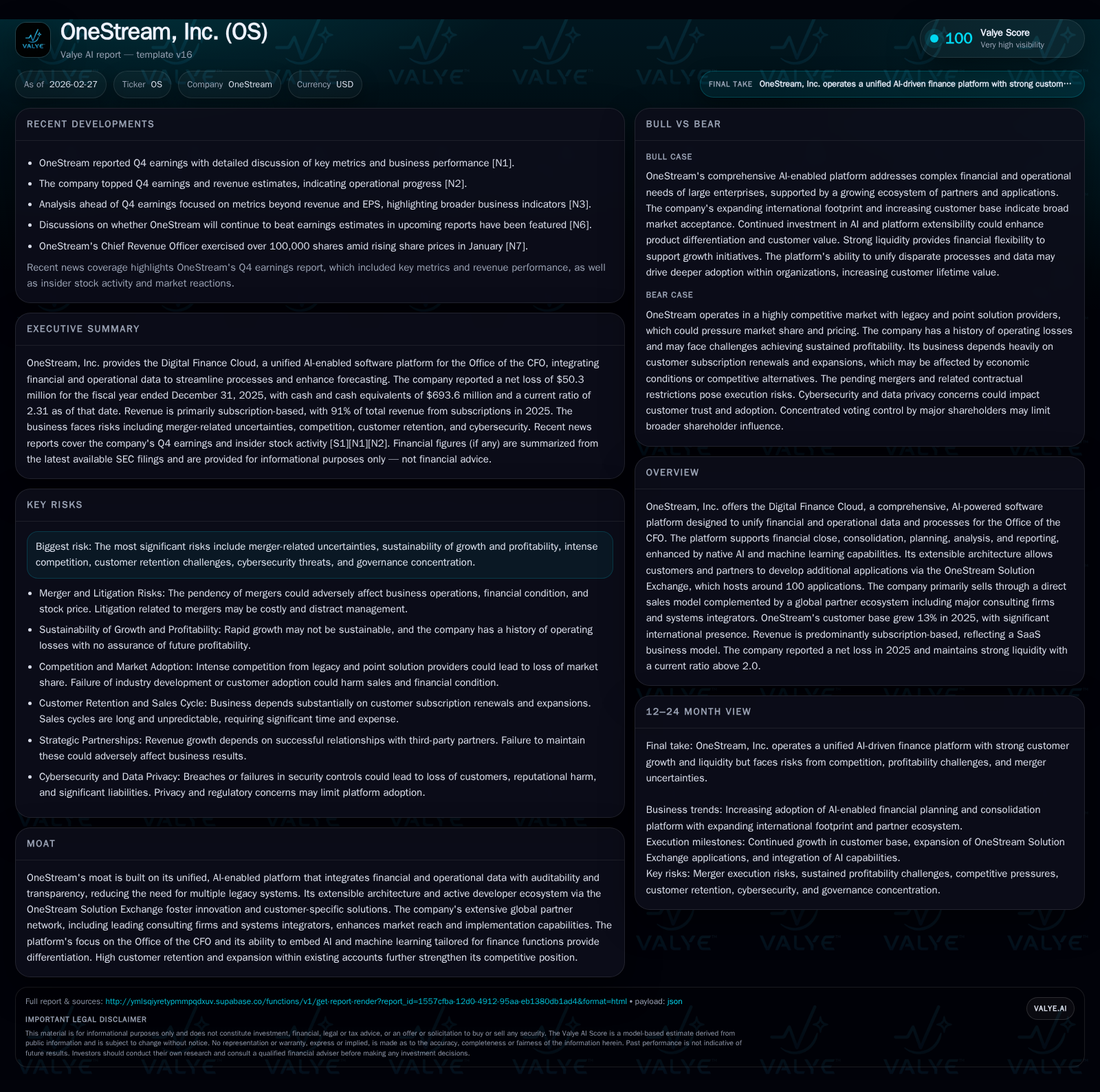
OneStream, Inc. has leveraged its AI-enhanced Digital Finance Cloud platform to achieve significant revenue growth and a 13% increase in customers in 2025, broadening its international footprint and partner ecosystem. Despite these advances, the company continues to face operating losses stemming largely from ongoing investments in sales, marketing, and R&D, alongside complexities inherent in SaaS revenue recognition. With a strong liquidity position backed by robust operating cash flow and limited capital expenditure, OneStream is positioned to sustain investments crucial for scaling while working toward profitability. Key risks include pending mergers affecting strategic flexibility, competitive pressures within the financial software space, customer retention hurdles, and cybersecurity threats.
Harnessing AI for Financial Data Unity: OneStream’s Business Model Evolution
OneStream has positioned itself distinctly within the financial software market through its Digital Finance Cloud — an AI-powered SaaS platform that consolidates critical finance functions such as financial close, consolidation, planning, performing analysis, and reporting into a unified system designed explicitly for the Office of the CFO [S23]. This unified approach inherently reduces reliance on disparate legacy systems common among mid-to-large enterprises struggling with data silos. The platform’s extensible architecture facilitates customization and innovation via the OneStream Solution Exchange hosting roughly 100 native or partner-built applications [S23].
Noteworthy is OneStream's embedded use of AI and machine learning directly aimed at finance workflows for auditability, transparency, and operational efficiency [S23]. The digital cloud delivery model underpins recurring subscription revenues — which now compose the bulk of revenue (91% subscription in 2025) — shifting the company away from term licenses toward a more predictable SaaS revenue stream [S16].
The company’s go-to-market strategy is multifaceted: a direct sales force with deep domain expertise combined with an extensive global partner ecosystem including specialists and major consulting firms like Accenture, IBM, KPMG, PwC — collectively underpinning both lead generation and platform implementation [S23]. This layered approach accelerates adoption amidst long enterprise sales cycles characteristic of EPM (Enterprise Performance Management) software markets.
Revenue Surge and Expanding Customer Footprint: The Drivers Behind OneStream’s Growth
OneStream demonstrated considerable operational progress in fiscal year 2025 propelled largely by expanding product adoption, strengthened international presence (34% of revenue outside the US), and a widening partner network [F1][S4][S16][N1]. The customer base increased from approximately 1,601 to 1,805 entities representing a healthy 13% growth rate last year [S17]. This expanding footprint reflects successful penetration into large midsize corporations seeking to replace costly multi-vendor stacks.
The financial metrics corroborate notable trends: Operating income loss narrowed sharply by over 70%, improving from -$319.5 million in FY2024 to -$94.8 million in FY2025; net losses shrank by nearly 77% during the same period to -$50.3 million [F1]. Operating cash flow rose robustly by approximately 58%, reaching $96.7 million as scale gains started materializing through improved subscription renewals and measured operating leverage [F1]. Capital expenditures were kept minimal (down roughly -60%), consistent with SaaS economics prioritizing software development over heavy physical asset investment [F1][S7].
Historical performance (annual)
| FY | Net ($mm) | CFO ($mm) | OpInc ($mm) | Capex ($mm) | Net YoY |
|---|---|---|---|---|---|
| 2025 | -50 | 97 | -95 | 1 | +76.7% |
| 2024 | -216 | 61 | -320 | 3 |
Source: SEC companyfacts cache [F1].
Capital returns and efficiency (annual)
| FY | FCF ($mm) | ROE% |
|---|---|---|
| 2025 | 96 | -10.0 |
| 2024 | 59 | -56.0 |
Source: SEC companyfacts cache [F1].
Table: Historical Financial Performance Summary; values sourced from [F1]
This pattern evidences increasing traction yet points to ongoing heavy reinvestment phases integral for scaling premium SaaS platforms—particularly when entering international markets where localized data center capacity and regulatory compliance are critical.
Transitioning Challenges: Profitability Headwinds and Operating Loss Improvement
Despite material improvement in profitability metrics year-over-year, OneStream remains unprofitable at the operating income level [F1]. Key cost components pressuring margins include substantial outlays on sales & marketing staff compensation (including equity-based remuneration), research & development initiatives focused on AI enhancements amid rapid product evolution, and partner enablement programs supporting implementation scalability [S7][S1][S2].
Subscription revenue recognition practices also induce temporal volatility; revenues are recognized ratably over contract life spans typically ranging three years or more—even as upfront acquisition costs hit current period P&L—which complicates near-term margin expansion clarity [S1][S2]. The company reported an approximate ROE of negative 10%, reflecting these losses relative to shareholder equity that increased concurrently to $504.7 million at year-end driven largely by equity financing activities [F1].
Lean capital expenditure—typical for cloud-first SaaS vendors—further highlights that most incremental spend is directed toward personnel-intensive functions critical for sustaining competitive differentiation rather than fixed asset accumulation [F1][S7]. Maintaining a balance between aggressive growth funding while systematically improving profitability outcomes remains a central management challenge.
International Expansion and Partner Ecosystem as Growth Catalysts
Geographically diversified revenues—one-third coming from outside the United States—affirm that OneStream's platform meets complex multinational enterprise requirements worldwide [S4][S16]. Physical presence across Australia, Europe, and Singapore supports local support services alongside digital deployment capabilities. Expanding internationally also opens opportunities within regulated verticals such as healthcare and manufacturing where tailored solutions delivered via the Solution Exchange add value beyond generic platforms.
Strategic alliances with around 300 global partners range from boutique specialists exclusively focusing on OneStream implementations to full-scale teams embedded within large consulting firms offering certified deployment expertise [S17][S23]. These partnerships expand indirect sales channels while providing scalability advantages through distributed service delivery models. Integration partnerships with technology titans like Microsoft enhance platform compatibility within customers' broader IT ecosystems.
This synergistic ecosystem not only bolsters lead generation but also drives higher customer retention via quicker onboarding times, proficiency certification programs for implementers, and a continuous feedback loop enhancing product roadmaps [S23]. The 'Office of CFO' focus combined with dedicated partners skilled in navigating regulatory complexity solidifies OneStream’s moat against competing standalone EPM tools.
Strategic Capital Allocation: Cash Flow Strength Amid Continued Investments
OneStream finished FY2025 holding $693.6 million in cash and equivalents—a strong liquidity cushion facilitating strategic flexibility amid persistent operational losses [F1][S10][S22]. Operating cash flow increased meaningfully (+58%) which when paired with sharply reduced capex resulted in free cash flow approximating $95.6 million (operating cash flow minus capex) indicating positive underlying cash generation capacity despite accounting losses [F1].
The capital-light nature aligns well with general SaaS sector characteristics yet the elevated cash reserves underscore prudent capital management likely intended to fuel continued investments into product innovation (notably AI capabilities), geographic expansion efforts including data center buildouts where needed, and partner ecosystem development [F1][S7]. No dividends or share buybacks were declared reflecting a prioritization of reinvestment over returning capital at this stage.
This position allows OneStream to remain nimble when responding to market dynamics or accelerating selected strategic initiatives without immediate external financing pressures.
Key Risks: Merger Uncertainties, Competition, and Customer Retention
A prominent near-term risk stems from merger-related activities currently pending which impose contractual restrictions limiting decision-making agility across business operations including responses to competitive moves or market changes [S1][S2]. Legal disputes associated with these transactions create potential distraction for management teams while imposing additional costs or limiting strategic alternatives.
Competitive dynamics persistently high given entrenched incumbents like Oracle and SAP alongside niche point providers such as Anaplan present varied threats across functionality breadths; OneStream’s ability to innovate rapidly through its AI-embedded unified platform partially mitigates this but does not eliminate market share pressure risks [S11][S12].
Long sales cycles characteristic of enterprise software deployments require sustained resource commitments before new logos convert fully impacting quarterly results unpredictably [S1][S2]. Equally critical is recurring revenue dependency—customer renewals on favorable terms plus incremental expansion within existing accounts underpin long-term growth—with churn or contraction posing risks especially if economic uncertainties delay IT spend budgets [S24].
Cybersecurity exposures represent a growing vector of risk as breaches could damage reputation or lead to costly liabilities impacting customer confidence particularly given the sensitive nature of integrated financial datasets managed on their platform [S15][S25]. Governance concentration adds related concerns about boardroom resilience amid ongoing legal proceedings triggering derivative actions or shareholder litigation around disclosures tied to secondary offerings [S26][S27].
This analysis synthesizes publicly available regulatory filings complemented by recent news reports serving as factual basis only and does not constitute investment advice or promises regarding future performance. Readers should consider company disclosures alongside broader enterprise SaaS sector factors when interpreting these insights.
Disclaimer: This is research-only, informational analysis and not investment advice. It may include AI-generated interpretation and general industry context. Always verify important details using primary sources.

Comments