
abrdn Palladium ETF Trust’s Physical Metal Strategy Challenges Commodity Price Volatility and Market Liquidity
The abrdn Palladium ETF Trust (PALL) uniquely offers direct physical palladium exposure, balancing operational simplicity with intrinsic commodity market risks.
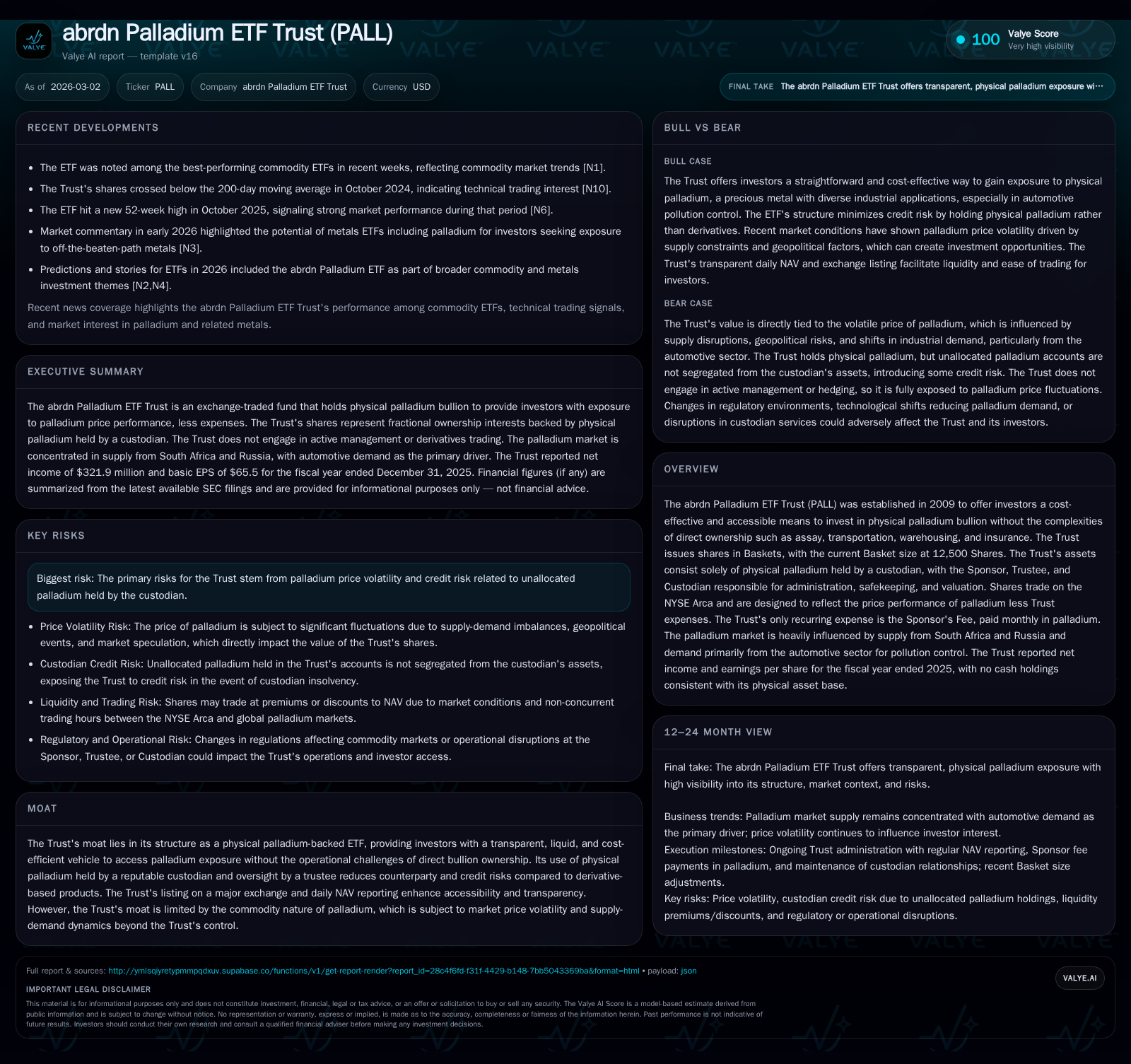
Established in 2009, abrdn Palladium ETF Trust is a physically-backed palladium investment vehicle that facilitates investor access to the palladium market by holding actual bullion, thereby removing complexities of direct bullion ownership. Its growth historically ties closely to palladium price movements driven by automotive demand and supply constraints from major producers like Russia and South Africa. While it provides transparency and cost efficiency over derivative-based products, its returns are directly exposed to palladium’s inherent price volatility and liquidity challenges of the underlying metal market. Investors should watch for palladium market dynamics, automotive industry trends, and the Trust’s operational parameters such as Basket creation size.
Company Overview
The abrdn Palladium ETF Trust (ticker: PALL) was formed in December 2009 with a distinctive investment objective: to provide investors accessible exposure to physical palladium bullion without the traditional obstacles involved with holding physical metal such as assay verification, secure transport, warehousing, and insurance. The Trust’s shares represent fractional undivided interests in actual physical palladium maintained by the custodian, ICBC Standard Bank Plc, under the oversight of BNY Mellon serving as Trustee. Shares trade on the NYSE Arca with daily NAV reporting designed to mirror the performance of the LBMA Palladium Price PM benchmark less Trust expenses [S1][S5].
Its structure contrasts markedly with derivative-based products that expose investors to counterparty credit risk and complexity. The use of physical metal mitigates such concerns but transfers all commodity price risk directly to shareholders [S5][S10].
Historical Growth and Performance Drivers
While the Trust’s operations revolve strictly around holding physical metal rather than active management or corporate profitability drivers, its financial results reflect the underlying dynamics of the global palladium market and associated price movements.
From FY2022 through FY2024, the Trust reported consecutive net losses (FY2022: -$60.5M; FY2023: -$111.4M; FY2024: -$67.6M), aligning with depressed palladium prices influenced by softened automotive demand and supply uncertainties [F1][S1]. In 2025, however, improved fundamentals led to a sharp rebound with net income soaring to $322M, marking a nearly 576% year-over-year improvement supported by rising spot prices and narrowing deficits in supply-demand balance [F1][S18].
Capital structure remained straightforward without cash reserves or dividend distributions. Equity grew correspondingly from $295M at end-2022 to over $1 billion at end-2025 reflecting increased asset value [F1]. No share buybacks or dividend payouts were reported during this period, consistent with an ETF model focused on underlying asset appreciation [F1][S5].
Financial Summary Table
Historical performance (annual)
| FY | Net ($mm) | Net YoY |
|---|---|---|
| 2025 | 322 | +575.9% |
| 2024 | -68 | +39.3% |
| 2023 | -111 | -84.2% |
| 2022 | -60 |
Source: SEC companyfacts cache [F1].
Capital returns and efficiency (annual)
| FY | ROE% |
|---|---|
| 2025 | 31.1 |
| 2024 | -19.1 |
| 2023 | -50.8 |
| 2022 | -20.5 |
Source: SEC companyfacts cache [F1].
Net income swings exhibit correlation with volatile commodity pricing rather than operational changes.
Industry Context & Future Growth Prospects
Palladium's primary uses center on autocatalysts within the global automotive industry—accounting for approximately 85% of demand as of recent data—and pollution control applications. The supply side is heavily concentrated geographically; South Africa and Russia collectively produce over three-quarters of global mined palladium [S6][S11]. This concentration exposes the supply chain to geopolitical risks, mining disruptions, and regulatory impacts.
Demand prospects are closely tied to automotive production mix trends. While internal combustion engine vehicles continue using palladium for emissions control catalysts, accelerating adoption of electric vehicles (EVs) may gradually depress demand unless offset by hybrid variants maintaining palladium requirements [S18][S1]. The cessation of certain EV tax credits has led manufacturers temporarily back toward fossil fuel engines using more palladium [S18].
Secondary supply from recycling complements mined supply but fluctuates widely with scrap availability and market prices.
The OTC and futures markets facilitate substantial volume but remain sensitive to speculative flows which have amplified spot price swings recently [S18][S25]. Price volatility remains a central growth constraint due to its impact on investor appetite for holding physical metal exposure.
Operational Mechanics & Structure Highlights
Shares are issued in Baskets exclusively — large blocks composed currently of 12,500 shares after multiple reductions from initial sizes (50,000 down to current) made since inception. Authorized Participants—typically broker-dealers or financial institutions—can create or redeem Baskets solely by delivering or receiving equivalent amounts of physical palladium based on NAV at transaction time [S5][S9]. This mechanism fosters liquidity but imposes practical minimum trading units affecting smaller investors’ participation.
The Sponsor receives a monthly fee paid in physical palladium rather than cash, effectively unwinding some held metal over time but aligning sponsor incentive with preservation of asset value [S1][S5].
Physical custodianship rests in London vaults under English law jurisdiction—a standard practice ensuring recognized Good Delivery standards but accompanied by legal enforcement complexities detailed under risk disclosures [S15][S20]. The trust is not regulated as an investment company nor registered under Commodity Exchange Act provisions; shareholders lack several statutory protections typical in mutual funds or regulated commodity pools [S19], shifting some legal risk burdens onto investors.
Risks & Considerations
Palladium Price Volatility: The primary risk factor identified is material price volatility triggered by underlying market forces including mining output adjustments, changes in automotive demand especially related to EV adoption trajectories, geopolitical events affecting Russian or South African supply chains, and speculative trading behavior [S1][S13][S18].
Liquidity Premiums/Discounts: Share trading prices can deviate significantly from NAV because of timing mismatches between NYSE Arca trading hours and global OT C market hours where physical pricing benchmarks are set. This can result in wider bid-ask spreads or temporary premiums/discounts impacting investors’ realized execution value [S13].
Custodial Risk: Although physical holding reduces counterparty risk typical for derivatives-based instruments, unallocated bullion accounts present credit exposure as such holdings are not individually segregated from custodian assets. Legal limitations on shareholders' rights versus custodianship arrangements also complicate recovery in adverse scenarios [S15][S20].
Regulatory & Legal Framework: Lack of Investment Company Act registration precludes governance frameworks typical of mutual funds; similarly absence from Commodity Futures regulation means that protections available through those frameworks do not apply here—investors must accept these structural limitations upfront [S19].
Market Impact: Creation/redemption activity can affect spot market prices temporarily due to required physical palladium purchases or sales correlating with basket adjustments causing short-term NAV fluctuations independent from broader market movements [S13][S25].
What To Watch Going Forward (Analysis)
Key variables shaping PALL’s performance will be:
- Trends in automotive sector production mix globally including pace of EV penetration vs hybrids/fossil fuel propulsion.
- Stability and output levels from key mining jurisdictions especially South Africa and Russia considering geopolitical tensions.
- Developments around EV-related government policy subsidies impacting demand economics.
- Changes in investor sentiment toward precious metals amid inflationary environments or macroeconomic shocks.
- The evolving regulatory landscape surrounding precious metals custody which may affect operational costs or legal enforceability.
- Trading volumes on NYSE Arca reflecting investor adoption versus liquidity provider participation influencing premium/discount dynamics.
Capital Allocation & Returns Profile
As an ETF-like trust backed wholly by physical assets, abrdn Palladium ETF Trust's capital allocation decisions are limited—there is no reinvestment strategy beyond potential adjustments linked to creation/redemption activities handled by Authorized Participants [S9]. There are no dividends or share repurchases; returns derive almost entirely from changes in palladium market value minus operating fees settled via monthly specie distribution. This design results in high correlation between ROE and underlying commodity price changes rather than fundamental business profitability metrics.
For reference, latest fiscal year ROE stands at roughly 31%, largely driven by resource revaluation gains during commodity price appreciation phases rather than operational earnings growth [F1]. No cash flow generation exists beyond incidental fee collections as phantom income given the non-operational nature of the trust.
Conclusion
The abrdn Palladium ETF Trust occupies a niche role providing direct access for investors seeking pure-play exposure to physical palladium bullion without ownership hassle. Its transparent structure minimizes counterparty credit risk common among derivative substitutes yet leaves participants fully exposed to inherent commodity cycle volatility shaped predominantly by concentrated geographic supply sources and automotive demand trends.
Structural features such as Basket composition adjustments enhance secondary market liquidity conditions but underline minimum investment thresholds potentially limiting retail participation fluidity. The absence of regulatory oversight akin to mutual funds or commodity pools translates into notable legal and custodial risks that require careful consideration prior to investment.
Sharply cyclical financial outcomes evidenced since inception underscore pivotal influence exerted by broader secular shifts in autos electrification policies alongside geopolitical variables dominating sourcing routes for platinum group metals globally.
Investors engaging with PALL must balance benefits of physical backing against episodic dislocations manifested through premium/discount oscillations tied principally to marketplace timing mismatches beyond the Sponsor’s control. Monitoring macro automotive evolution alongside mine production updates will be critical indicators informing future valuation trajectories.
This analysis was prepared solely for informational purposes without any recommendation regarding purchasing or disposing any securities.
Disclaimer: This is research-only, informational analysis and not investment advice. It may include AI-generated interpretation and general industry context. Always verify important details using primary sources.

Comments