
Prosperity Bancshares Reaches Regional Scale with Strategic Acquisitions and Stable Community Banking Model
Prosperity Bancshares leverages its growing Texas and Oklahoma footprint through acquisitions, prudent credit practices, and a diversified loan portfolio.
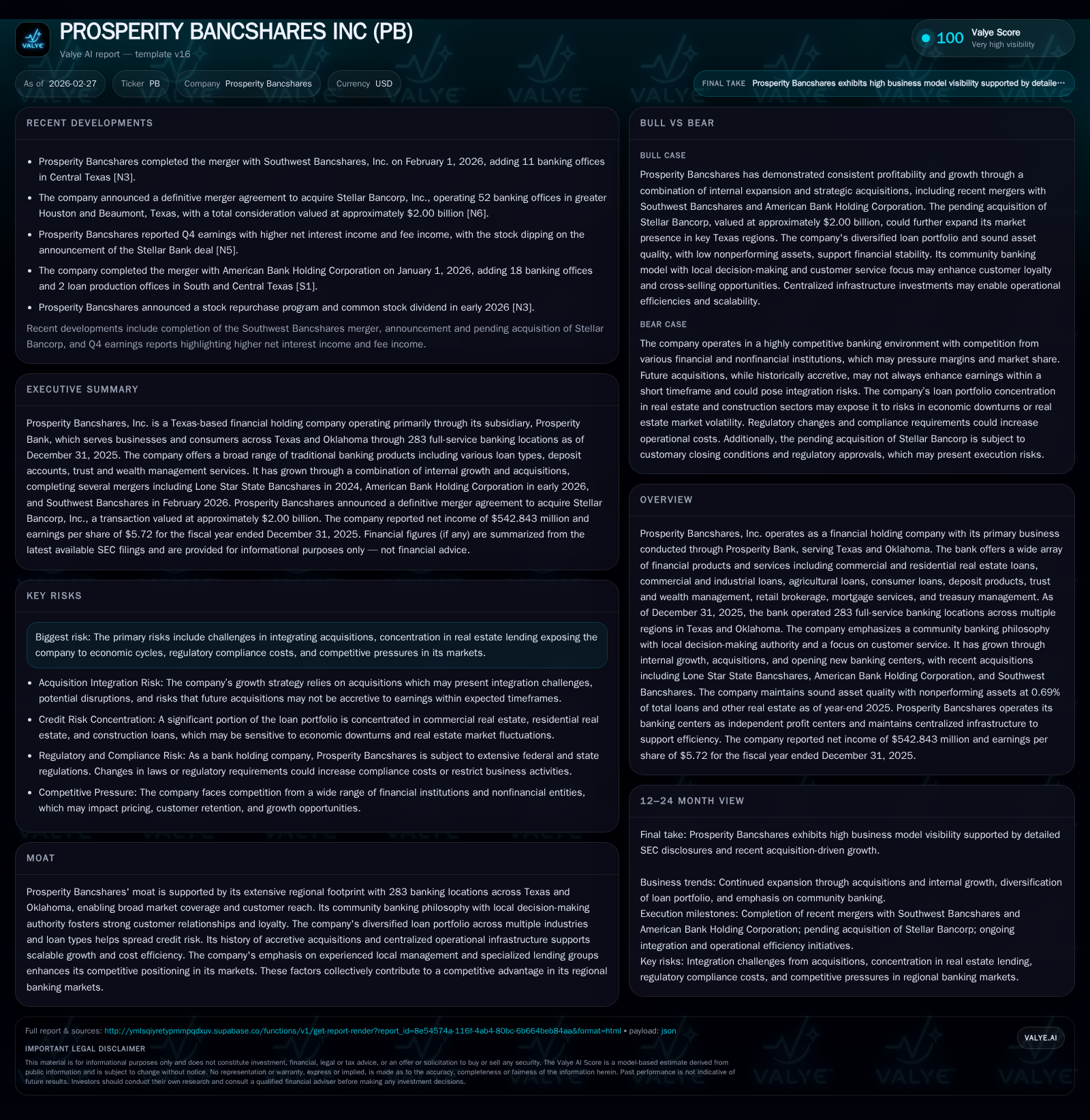
Prosperity Bancshares, operating primarily through Prosperity Bank, has steadily grown by combining internal expansion with selective acquisitions, culminating in 283 branches across Texas and Oklahoma as of end-2025. Its business model centers on community banking with local decision-making, enabling stable customer relationships and low funding costs. The company maintains a diversified loan portfolio heavily weighted in real estate but also including commercial, industrial, and agricultural loans. Despite a slight loan portfolio contraction in 2025, net income rose 13.2% year-over-year to $543 million. Capital ratios remain robust, supporting dividend growth and share repurchases. Going forward, acquisition integration execution, regional economic conditions, and regulatory landscapes will shape growth and risk outcomes.
Company Overview
Prosperity Bancshares, Inc., through its primary subsidiary Prosperity Bank, operates as a financial holding company centered on community banking across Texas and Oklahoma [S1]. As of December 31, 2025, the bank network includes 283 full-service branches distributed over major metropolitan areas such as Houston (62 branches), Dallas/Fort Worth (61), Austin/San Antonio (31), West Texas (45), South Texas (33), plus smaller markets including Oklahoma City and Tulsa [S1]. This broad regional footprint underpins the company's competitive moat by allowing deep local market penetration and diversified industry exposure.
The origins trace back to acquiring the former Allied Bank in Edna, Texas—originally chartered in 1949—and since then the company has combined organic growth with an active acquisition strategy [S1][S23]. Key acquisitions since 2016 have included Tradition Bancshares (7 banking centers), LegacyTexas Financial Group (42 centers), First Bancshares of Texas (16 centers), Lone Star State Bancshares (5 centers in 2024), and most recently Southwest Bancshares which was completed in February 2026 extending the branch network further [S23][N9].
The company staffs branch centers with experienced local bankers empowered to make pricing and credit decisions autonomously but benefits from centralized infrastructure for loan processing, compliance, risk oversight, audit functions, and technology services—which creates scalability without surrendering community connection [S4].
Historical Growth and Performance
Prosperity Bancshares' financial trajectory since FY2022 shows steady profitable growth fueled by moderate expansion in deposits and loans along with operational efficiency [F1]. Net income increased from $524.5 million in FY2022 to $542.8 million in FY2025 despite a slight dip in loan balances in the latest period [F1]. Operating cash flow similarly increased from $506.5 million to $549.5 million over this timeframe.
Historical performance (annual)
| FY | Net ($mm) | CFO ($mm) | Capex ($mm) | Net YoY |
|---|---|---|---|---|
| 2025 | 543 | 550 | 33 | +13.2% |
| 2024 | 479 | 473 | 21 | +14.3% |
| 2023 | 419 | 646 | 34 | -20.1% |
| 2022 | 525 | 507 | 42 |
Source: SEC companyfacts cache [F1].
Capital returns and efficiency (annual)
| FY | Div ($mm) | Buybacks ($mm) | FCF ($mm) |
|---|---|---|---|
| 2025 | 221 | 157 | 517 |
| 2024 | 214 | 75 | 452 |
| 2023 | 206 | 72 | 612 |
| 2022 | 193 | 66 | 464 |
Source: SEC companyfacts cache [F1].
Loan portfolio stood at approximately $21.8 billion at December 31, 2025, reflecting a decrease of about 1.6% from the prior year attributed to cautious credit management amid uncertain economic signals within core Texas markets [S5][S14]. The portfolio remains diversified across sectors: commercial real estate loans contribute roughly one-quarter of total loans (26.5%), one-to-four family residential loans around one-third (34%), construction/land development about ~12%, warehouse purchase program loans about ~6%, commercial & industrial loans roughly ~10%, with agricultural and consumer loans filling out the remainder [S14][S19].
Asset quality metrics indicate prudent risk management with nonperforming assets held at about 0.69% of total loans excluding warehouse purchase program exposures which recorded no delinquencies [S14].
Future Growth Prospects
Growth prospects rely on balancing internal expansion through new banking centers plus cross-selling initiatives alongside accretive acquisitions focused primarily on contiguous geographic areas or strategic market segments [S4][N10]. The recent merger with Southwest Bancshares finalized in early February adds scale with new branches deepening presence particularly westward [N9]. Earlier deals like Lone Star State Bancshares continue integration efforts.
Management emphasizes community banking principles with empowered local decision-making supported by centralized systems to preserve customer intimacy while scaling operations efficiently [S4]. Cross-selling initiatives incentivize associate teams to deepen client relationships across wealth management, treasury solutions, mortgage services, and retail brokerage—diversifying fee-based revenues beyond net interest margins.
Loan portfolio growth may face constraints if macroeconomic conditions including interest rate volatility or tightening credit environments suppress borrower activity especially within commercial real estate segments known for cyclicality risk [N8][S2]. Regulatory landscapes evolve notably around capital requirements and consumer protection rules enforced by CFPB given the institution's asset size above $10 billion alongside cybersecurity mandates—all influencing operational costs going forward [S22][S24].
Forecasts / Milestones / Expectations
While explicit external guidance is limited,[N3][N4] recent earnings transcripts express confidence in modest net interest income improvements driven by deposit growth and funding cost management alongside fee revenue enhancement through cross-selling efforts.
Operational milestones include successful integration of Southwest Bancshares followed by anticipated branch network rationalizations where overlaps exist plus executing localized marketing to maximize new market penetration [N9]. Monitoring deposit cost trends relative to loan yields will be critical given historically low average deposit cost near ~1.37% excluding borrowings [S14], supporting margin resilience amidst competition.
Asset quality indicators warrant close monitoring due to real estate concentration risks as well as regulatory developments regarding CRA modernization which currently face delays but could impact acquisition approvals or branching strategies [S20].
Returns / Capital Allocation
Return on equity based on FY2025 data approximates ~7%, calculated as net income divided by total equity reported at year-end—reflecting consistent profitability within balanced risk tolerances typical for mid-size regional banks managing cyclical exposures cautiously [F1].
Free cash flow for FY2025 stood near $517 million derived from operating cash flow less capital expenditures; capital investments reflect technology infrastructure enhancements plus branch refurbishments aimed at sustaining growth platforms [F1].
Dividends paid totaled approximately $221 million in FY2025 representing incremental increases aligned with earnings growth consistent with Federal Reserve Board policy discouraging dividends that impair capital strength or subsidiary support ability [S9][F1]. Share repurchases more than doubled year-over-year reaching $157 million demonstrating active capital return discipline while preserving balance sheet flexibility post significant acquisitions [F1][N9].
Regulatory capital ratios remain strong: common equity Tier 1 ratio at about 17.55%, total capital ratio around 18.80%, leverage ratio near ~11.93%, all comfortably exceeding minimum requirements ensuring buffers for organic growth and mergers/acquisitions [S11][S17]. These positions underpin regulatory approval for continued dividends and buybacks contingent on earnings performance.
Risks and Challenges
Key risks include cyclicality inherent in commercial real estate lending comprising about one-quarter of the loan book; downturns affecting borrower creditworthiness could strain asset quality despite conservative underwriting standards historically observed [S14][S10]. Integration risks follow sizable recent mergers requiring harmonizing systems, cultures, personnel retention, brand consistency while realizing expected synergies [N9][N11].
Regulatory scrutiny intensifies around consumer protection laws under CFPB jurisdiction for institutions above $10 billion assets including anti-money laundering frameworks alongside extensive reporting/disclosure mandates increasing operational overheads [S22][S27]. Competitive pressures from larger regional banks leveraging scale/technology investments plus fintech entrants innovating payment or lending products impose ongoing challenges requiring continued investment.
Cybersecurity risks inherent with widespread digital banking usage necessitate substantial ongoing investments addressing evolving threats plus regulatory expectations underscoring importance of resilient IT governance consistent with federal guidance [S24].
Conclusion
Prosperity Bancshares' profile as a large regional financial institution grounded in Texas-Oklahoma community banking has evolved through steady internal growth supplemented by strategic acquisitions expanding physical scope to nearly three hundred branches across diverse economic zones [S1][N9]. Stable profitability backed by disciplined credit policies supports healthy dividends alongside progressive share repurchases illustrating effective capital stewardship [F1][S9].
Success depends on deftly managing integration complexities from recent deals while vigilantly monitoring credit risks concentrated in cyclical real estate portfolios amplified by shifting economic conditions [N9][S14]. Regulatory navigation involving capital adequacy requirements and compliance cost controls pose ongoing imperatives [S22]. The company's dual emphasis on empowered local relationship managers backed by centralized technology platforms provides structural advantages navigating competition mixing traditional community bank strengths with scalable efficiencies [S4].
Investors should track quarterly updates related to asset quality trends—especially nonperforming loans within commercial real estate segments—as well as progress assimilating acquired institutions into unified profitable operations [N3][N4]. Capital allocation behavior remains an important barometer reflecting balance between shareholder returns via dividends/buybacks against reinvestment needed for sustainable long-term growth [F1].
This overview synthesizes recent SEC filings up to February 2026 coupled with contemporaneous news releases covering acquisition closings and quarterly results relevant for understanding Prosperity’s current strategic positioning without extrapolating undisclosed forecasts or operational projections.
This analysis is intended exclusively for informational purposes highlighting company historical performance and industry context without constituting investment advice or specific recommendations.
Disclaimer: This is research-only, informational analysis and not investment advice. It may include AI-generated interpretation and general industry context. Always verify important details using primary sources.

Comments