
Vera Therapeutics Faces Financial Strain as FDA Review of Atacicept Approaches
The company’s expanding net losses and heavy R&D spending underscore the critical dependency on upcoming regulatory milestones.
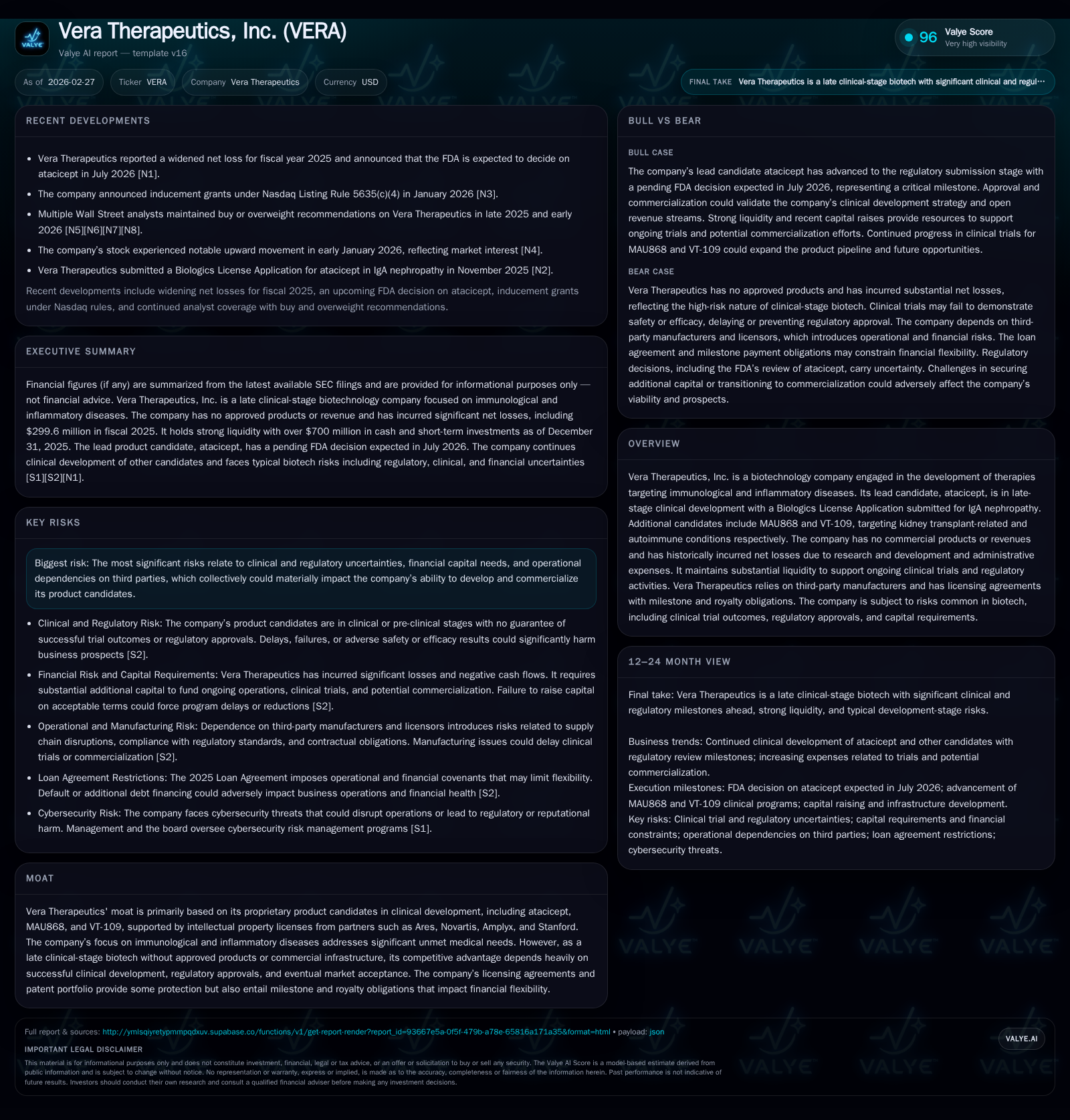
Vera Therapeutics, a late-stage biotech developing therapies for immunological and inflammatory diseases, reported widening net losses in 2025 driven by escalating research and development expenses. Its lead candidate, atacicept, is under FDA review with a decision expected in July 2026, representing a pivotal milestone for the firm’s future. Despite substantial liquidity and a strong current ratio, Vera has no commercial revenues and continues to face typical biotech risks such as clinical setbacks, regulatory uncertainty, and capital needs. The company’s capital allocation remains focused on sustaining clinical programs with no dividends or significant buybacks. Monitoring the FDA’s decision on atacicept and subsequent commercialization readiness will be key to assessing Vera’s trajectory.
Company Overview
Vera Therapeutics is a biotechnology company specializing in treatments addressing immunological and inflammatory diseases. Its lead product candidate is atacicept, a biologic targeting IgA nephropathy—a chronic kidney disease characterized by immune system dysregulation. The company has submitted a Biologics License Application (BLA) for atacicept to the U.S. Food and Drug Administration (FDA), with a regulatory verdict anticipated in July 2026. Additional pipeline products include MAU868 and VT-109 aimed at kidney transplant-related complications and autoimmune disorders respectively. None of these candidates are commercially approved yet; thus, Vera operates with no product-generated revenue.
Historical Financial Performance
Since its inception, Vera has focused heavily on advancing its drug candidates through preclinical and clinical phases which has translated into sustained operating losses due to high research and development (R&D) expenditures combined with requisite administrative expenses inherent to biotech companies transitioning to commercialization stages.
Historical performance (annual)
| FY | Net ($mm) | CFO ($mm) | OpInc ($mm) | Capex ($) | Net YoY |
|---|---|---|---|---|---|
| 2025 | -300 | -241 | -315 | 630000 | -96.9% |
| 2024 | -152 | -135 | -167 | 972000 | -58.5% |
| 2023 | -96 | -92 | -102 | 63000 | -7.8% |
| 2022 | -89 | -68 | -91 | 62000 |
Source: SEC companyfacts cache [F1].
Capital returns and efficiency (annual)
| FY | Buybacks ($) | FCF ($mm) | ROE% |
|---|---|---|---|
| 2025 | 0 | -242 | -49.6 |
| 2024 | 13000 | -136 | -26.4 |
| 2023 | -92 | -94.4 | |
| 2022 | -68 | -115.8 |
Source: SEC companyfacts cache [F1].
Note: Revenue figures are not listed as the company did not generate revenues during these years.
Operating income has plunged sharply by almost 89% year-over-year through FY25 reflecting heightened investment across clinical trials primarily focused on atacicept’s late-stage development. Net losses nearly doubled in FY25 reaching approximately $300 million, consistent with deepened expenditures preparing for product launch contingent on regulatory approval. The operating cash flow position worsened significantly reflecting higher cash burn from R&D activities without offsetting inflows from product sales.
Assets held strongly support ongoing operations with cash & equivalents around $355 million at end FY25 ensuring liquidity amid rapid expenditure growth. The current ratio exceeds an exceptionally healthy 13x, confirming short-term financial stability despite steep losses.
Future Growth Prospects
Vera’s value proposition hinges predominantly upon the successful approval of atacicept for IgA nephropathy. Regulatory reviews culminate in a PDUFA decision date set for July 2026 according to management disclosures. Approval would mark Vera’s transition from development-stage entity toward a revenue-generating biopharmaceutical enterprise.
Additionally, MAU868 and VT-109 represent earlier stage assets providing optionality targeting significant unmet medical needs within kidney transplantation immunology and autoimmunity respectively. While specific timelines regarding their progression were not disclosed explicitly in filings or news releases available up to February 2026,[N1][S1] these programs could underpin longer-term growth beyond the near-term catalyst related to atacicept.
On the commercialization front, Vera lacks internal commercial infrastructure currently; hence partnerships or outsourcing arrangements will likely be required to support sales efforts if approval is obtained. This will introduce strategic complexities including royalty sharing schemes due to licensed intellectual property agreements from collaborators such as Ares Management, Novartis Institutes for BioMedical Research GmbH & Co KG, Amplyx Pharmaceuticals Inc., and Stanford University licensing programs.[S1]
Milestone payments embedded within these license agreements carry inherent financial obligations that will impact net margins post-commercial launch potentially constraining free cash flow generation.
Guidance and Milestones To Watch
Explicit forward guidance was not provided beyond announcements concerning FDA decision timing.[N1][S3] Market participants should monitor:
- The July 2026 FDA determination on atacicept — approval would unlock potential commercialization revenue streams;
- Clinical data readouts or progress updates from MAU868 and VT-109 trials;
- Partnering arrangements that may affect commercialization strategy;
- Regulatory developments internationally as expansion plans emerge post-U.S. approval.
Capital Allocation and Returns
Given its development-stage status without revenue inflows,[F1] Vera has concentrated capital allocation overwhelmingly towards sustaining R&D efforts rather than shareholder returns. There have been no dividends declared nor material share repurchase activities noted across the past four fiscal years.[F1]
Approximate return on equity (ROE) based on latest annual net loss against equity stands negative near -50%, which aligns with expectations for clinical-stage biotechnology firms investing heavily ahead of marketable products.[F1]
Free cash flow remains deeply negative due to the significant operating cash outflows dwarfing minimal capital expenditure requirements associated primarily with corporate facilities rather than manufacturing infrastructure.[F1]
Financial strategy focuses largely on preserving sufficient liquidity—currently about $355 million in cash reserves—to fund ongoing clinical trials, regulatory submissions, manufacturing scale-up agreements via third parties, legal obligations related to intellectual property licenses including milestone fees plus contingency against regulatory or operational risks detailed below.[S1]
Industry Context & Regulatory Risks (Analysis)
Development of biologics addressing immune-mediated diseases involves complex multi-year clinical programs that carry significant attrition risk at each stage from Phase I safety through pivotal Phase III efficacy evaluations culminating in regulatory filings.
Regulatory agencies worldwide enforce stringent standards around safety profile data consistency alongside manufacturing quality practices per Current Good Manufacturing Practice (cGMP). Failures or delays can stall launches for extended durations incurring costs without revenue offsets.
Moreover reimbursement landscapes undergo ongoing reform pressures notably in U.S., EU and other leading healthcare payer jurisdictions where negotiation regimes increasingly challenge pricing power for novel therapeutics especially those aimed at chronic illnesses requiring long-term treatment commitments.[S12][S16][S20]
Compliance risk extends also to interactions with healthcare professionals due to federal anti-kickback statutes,[S18] transparency rules,[S5] data privacy regulations (e.g., HIPAA/CCPA) imposing rigorous safeguards around personal health information collected during clinical studies,[S21] alongside geopolitical cybersecurity threats requiring board-level oversight given sensitivity of proprietary biological data as described by their Cybersecurity Risk Management Committee.[S26]
Classical biotech challenges also include intense IP litigation risk which could imperil exclusivity windows threatening competitive positioning if patents are invalidated or encumbered.[S19][S25]
Summary
Vera Therapeutics remains fundamentally reliant on impending regulatory milestones tied chiefly to atacicept's FDA review slated for mid-2026. Historical financials illustrate rising investment intensity marked by widening net losses approaching $300 million in fiscal year ended December 2025 while simultaneously preserving strong liquidity buffers sufficient to support advancement of multiple clinical programs shortly ahead.
While promising therapeutic candidates strategically target underserved conditions within immunology nephrology domains backed by partnered IP licenses amplifying competitive moats somewhat, considerable uncertainties persist tied primarily to trial outcomes regulatory approvals pricing environment compliance complexity plus capital acquisition prospects post-approval exit scenario.[N1][S2]
Investors and stakeholders should therefore maintain scrutiny towards Vera’s execution along these key inflection points without presuming outcome certainty given volatile biopharma developmental contexts.
Disclaimer: This analysis does not constitute investment advice or recommendations. It is based solely on publicly available information as of February 27, 2026.
Disclaimer: This is research-only, informational analysis and not investment advice. It may include AI-generated interpretation and general industry context. Always verify important details using primary sources.

Comments