
Standard Motor Products Expands European Footprint While Managing Supply Chain and Financing Risks
SMP's acquisition enhances product diversity and geographic reach, but supply chain financing and restructuring create operational challenges.
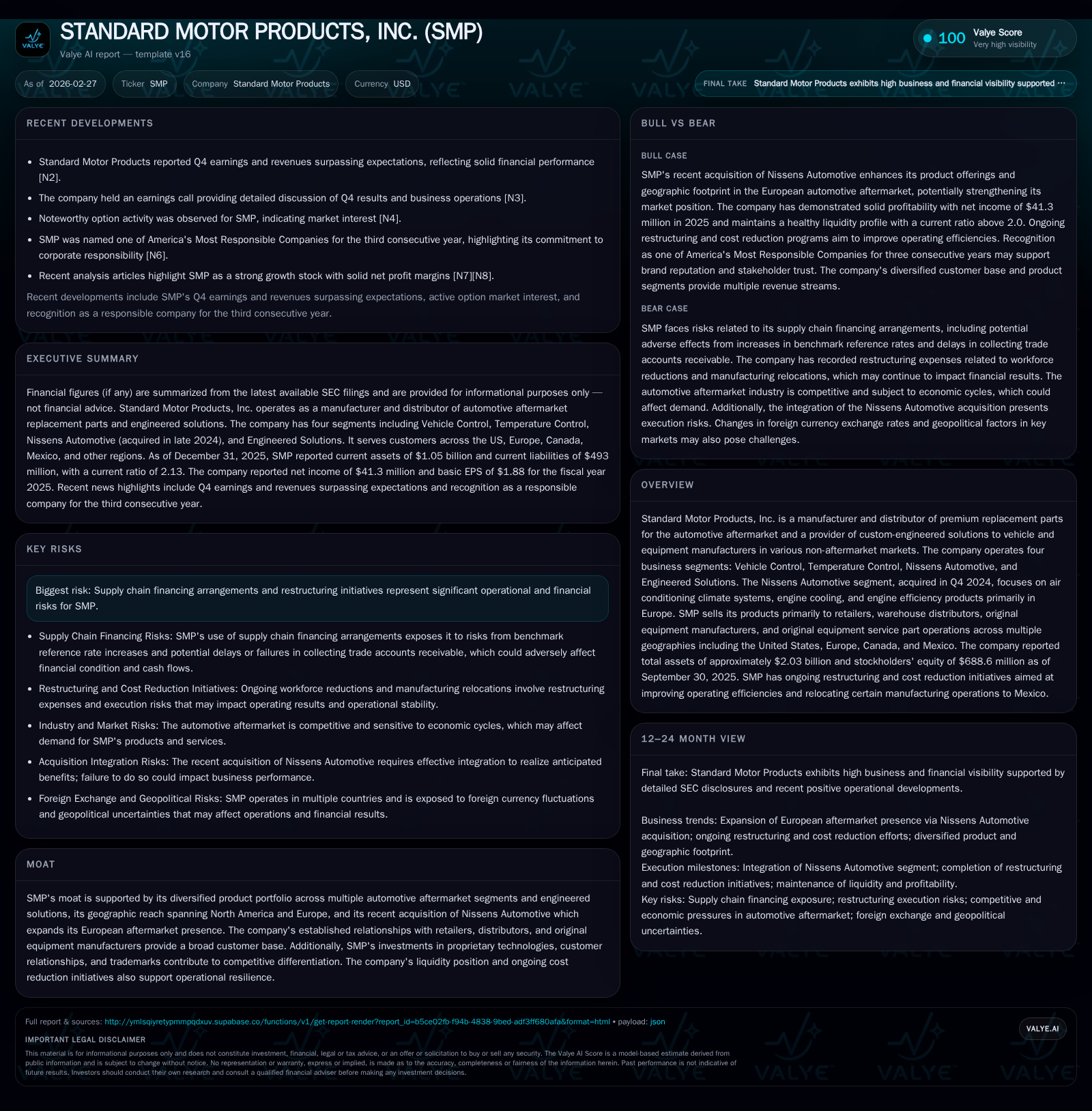
Standard Motor Products, Inc. (SMP) has grown through diversification of its automotive aftermarket segments and a significant acquisition in Europe, strengthening its competitive moat. Despite reporting a decline in revenue for fiscal 2025 compared to 2024, SMP achieved marked improvement in operating income and net income. The company’s operational strategy centers on leveraging its proprietary technologies and broad customer relationships while navigating risks related to supply chain financing and restructuring initiatives. Capital allocation shows consistent dividends but no share repurchases in 2025, with positive free cash flow reflecting ongoing operational cash generation.
Past Growth and Historical Performance
Standard Motor Products has demonstrated steady revenue generation over the past several years with relatively flat top-line figures hovering near the $970 million mark since at least 2013 [F1]. Notably, revenue dipped slightly by approximately 0.9% in fiscal year 2025 relative to 2024 despite the strategic acquisition of the European automotive aftermarket supplier Nissens Automotive late in 2024 [S19]. This acquisition was expected to bolster SMP’s European footprint by adding a diverse portfolio of products focused on air conditioning climate systems, engine cooling, and engine efficiency — a significant complement to its existing segments.
At the same time, SMP recorded substantial growth in operating income for FY2025 — up roughly 69% year-over-year to about $136.5 million [F1]. This jump indicates effective cost management and improved operational efficiencies offsetting top-line pressures. Net income followed suit with a nearly 50% increase to $41.3 million last year [F1].
Despite this profitability uptick, operating cash flows weakened considerably (-25%) to around $57.4 million amidst increased working capital demands or other operational shifts [F1]. Capital expenditures decreased by approximately 12%, coming in at roughly $38.7 million, which helped support about $18.7 million in free cash flow during FY2025 — a meaningful signal that SMP still generates positive cash conversion from operations [F1].
Historical performance (annual)
| FY | Net ($mm) | CFO ($mm) | OpInc ($mm) | Capex ($mm) | Net YoY |
|---|---|---|---|---|---|
| 2025 | 41 | 57 | 137 | 39 | +50.3% |
| 2024 | 28 | 77 | 81 | 44 | -19.5% |
| 2023 | 34 | 144 | 93 | 29 | -38.3% |
| 2022 | 55 | -28 | 104 | 26 |
Source: SEC companyfacts cache [F1].
Capital returns and efficiency (annual)
| FY | Div ($mm) | Buybacks ($mm) | FCF ($mm) |
|---|---|---|---|
| 2025 | 27 | 0 | 19 |
| 2024 | 25 | 10 | 33 |
| 2023 | 25 | 0 | 116 |
| 2022 | 23 | 30 | -53 |
Source: SEC companyfacts cache [F1].
This table summarizes SMP’s key financial metrics from FY2019 through FY2022; revenue stabilized around $970-$980 million with fluctuating earnings largely influenced by market cycles.
Business Segments & Geographic Reach
SMP organizes its operations into four primary business segments:
- Vehicle Control
- Temperature Control
- Nissens Automotive (acquired October–December quarter of FY2024)
- Engineered Solutions
The recent addition of Nissens Automotive signals a deliberate push into the European automotive aftermarket, broadening both product assortment and geographic presence significantly [S19][N1]. Nissens’ product specialization includes components critical for vehicle comfort and performance such as AC climate systems and engine cooling solutions, areas that enjoy stable demand in Europe given both regulatory standards and consumer preferences.
Major customers include retailers, warehouse distributors, OEMs (original equipment manufacturers), and OEM service parts operations dispersed across North America, Europe, Canada, and Mexico [S19]. This multi-channel distribution coupled with geographic diversification supports SMP’s competitive advantage — creating resilience against regional market fluctuations.
Future Growth Prospects
Looking forward, SMP's growth trajectory hinges on further leveraging its expanded European footprint post-Nissens acquisition along with continued penetration in North American markets [N1][S19]. Additionally, proprietary technologies embedded within their products provide differentiation amid a fragmented aftermarket industry.
However, growth may be constrained by:
- Dependence on supply chain financing mechanisms whose costs fluctuate with interest rates; if costs rise and are not passed through to customers efficiently, margins could compress [S4][S15].
- Operational complexities related to restructuring efforts aimed at cost reduction but potentially disrupting production or delivery schedules [S12].
- Competitive dynamics within automotive aftermarket sectors where OEMs aggressively compete on price and innovation.
Given these factors, the company must balance aggressive expansion efforts with prudent risk management.
Forecasts and Milestones
Management has yet to release formal forward-looking revenue or profit guidance publicly coinciding with the recent quarterly results as of early 2026 [N1][S3]. Market watchers will likely monitor quarterly updates for clarity on integration progress regarding Nissens Automotive as well as developments in restructuring initiatives.
Operational milestones worth observing:
- Effectiveness of cost-cutting programs from restructuring efforts impacting gross margins.
- Impact of supply chain financing cost fluctuations relative to benchmark rates such as Term SOFR and EURIBOR referenced under their debt agreements [S9][S11].
- Incremental revenue attributable to cross-selling opportunities enabled by diversified product sets across geographies.
Returns and Capital Allocation Strategy
For FY2025, SMP generated an approximate return on equity near 6%, calculated by dividing net income ($41 million) by shareholders' equity ($684 million) reported year-end [F1]. This moderate ROE reflects ongoing investments required for acquisitions and restructuring offsetting earnings growth.
Cash flow trends indicate positive operating cash flow that comfortably covers capital expenditures — yielding an estimated free cash flow near $18.7 million last fiscal year [F1]. Dividend distributions remained consistent at about $27 million annually without any share repurchases executed during FY2025 after resuming buybacks briefly in prior years [$10 million repurchased in FY2024] [F1][S23].
Leveraging its credit facilities totaling approximately $636 million outstanding debt at mid-2025 with manageable maturities extending beyond five years provides liquidity flexibility but requires monitoring given increased interest rate variability affecting funding costs [S7][S15].
The company maintains compliance with debt covenants under its multi-currency revolving credit agreement — supported by a healthy current ratio above two times indicating solid short-term liquidity [F1][S8].
Operational Risks
Significant attention remains warranted towards supply chain financing arrangements where SMP sells customer trade receivables to third-party financial institutions at prevailing discount rates based on benchmark references such as Term SOFR or EURIBOR [S4][S15]. An uptick in these underlying rates not matched proportionally by pricing adjustments could squeeze margins materially.
Additionally, ongoing restructuring programs targeting productivity enhancements bear inherent execution risk including employee severance costs and potential disruptions during transition phases that could depress near-term profitability despite longer-term savings goals [S12][N3]. Regulatory scrutiny or litigation concerns appear limited based on current public disclosures but should be tracked given industry cyclicality [S6].
Conclusion
Standard Motor Products navigates an evolving competitive landscape via selective expansion into new geographies through acquisitions like Nissens Automotive while maintaining core aftermarket business strength across multiple segments servicing North America and Europe. Their recent financial results reflect successful margin improvement amid flat revenues while highlighting stress points including supply chain financing costs and restructuring efforts that collectively shape future performance prospects. Ongoing investor focus will rest on integration effectiveness of newly acquired operations, carrying out productivity improvements without operational disruption, managing debt costs amid variable benchmark rates, and sustaining steady capital returns through dividends.
This analysis is based solely on public SEC filings as of February 27, 2026 ([F1]-[S29]) and relevant news articles ([N1]-[N6]). No projections or investment recommendations are made herein.
Disclaimer: This is research-only, informational analysis and not investment advice. It may include AI-generated interpretation and general industry context. Always verify important details using primary sources.

Comments