Pegasystems Inc.: Navigating Growth and Risk Amid Proprietary Innovation and Legal Challenges
Pegasystems melds strong financial performance with strategic consulting and technology, counterbalanced by persistent legal and operational risks.
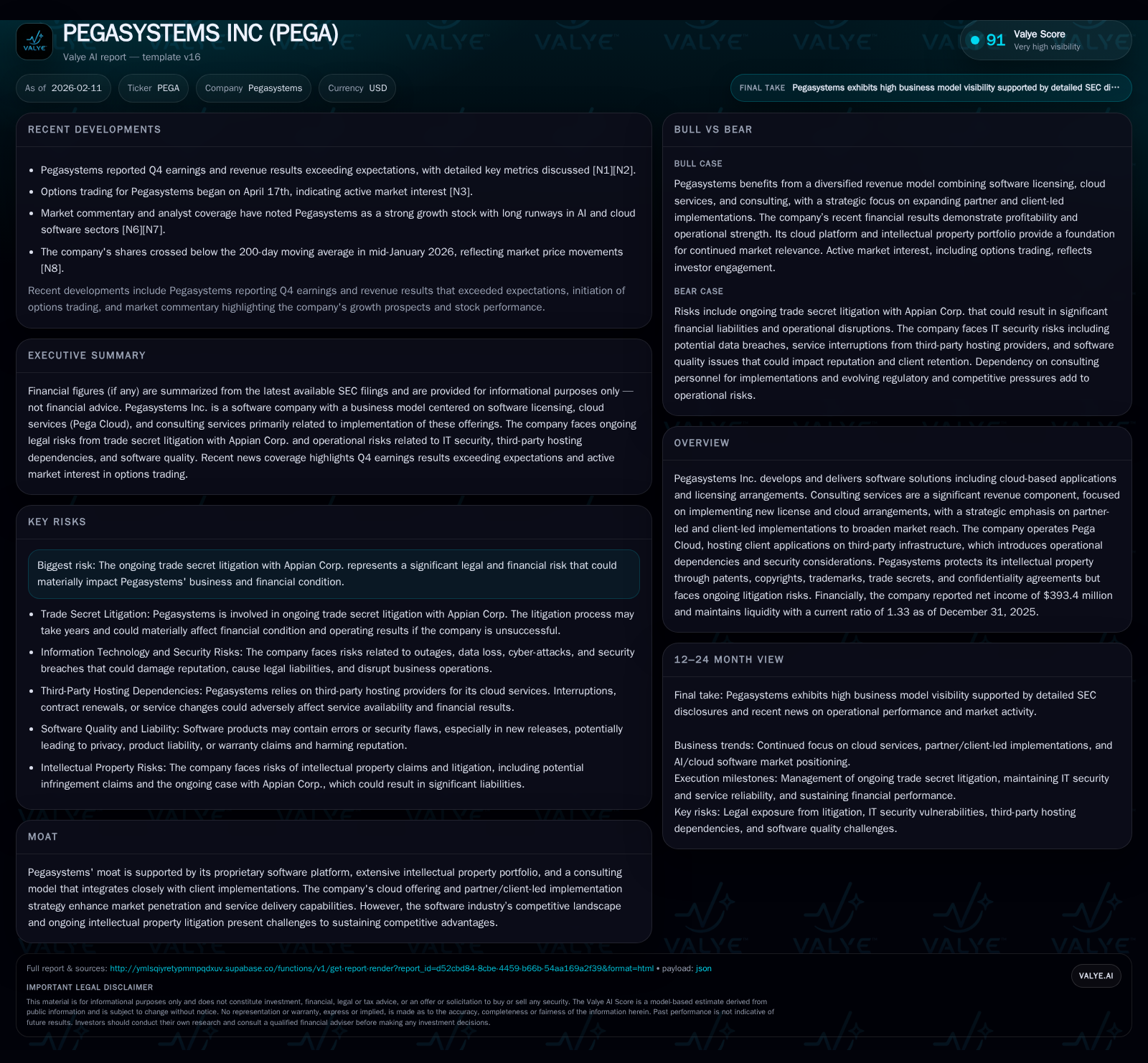
Pegasystems Inc. delivered a strong quarterly earnings beat and reported healthy liquidity metrics, underscoring operational resilience despite ongoing trade secret litigation with Appian Corp. The company’s proprietary software platform and extensive intellectual property portfolio underpin a consulting-led growth model that leverages cloud deployments hosted on third-party infrastructure. While this approach expands market reach through partner- and client-led implementations, it also introduces operational dependencies and security considerations. The protracted Appian litigation represents a significant overhang with potential financial and reputational implications. Meanwhile, Pegasystems maintains rigorous cybersecurity standards and pursues strategic differentiation in an intensely competitive AI and cloud market landscape.
A Financial Beat Amid Uncertainty
Pegasystems entered 2026 on a solid footing following its latest quarterly disclosure that notably surpassed analyst consensus estimates for both earnings and revenue metrics [N1][N2]. These results underscore continued momentum in the company’s core offerings—license sales paired with cloud-based applications—anchored by consulting engagements essential for new implementations. Financial disclosures reveal a net income of $393.4 million for fiscal year ending December 31, 2025 alongside healthy liquidity [F1], evidenced by a current ratio of approximately 1.33 indicating sound short-term solvency.
Yet beneath this encouraging financial surface lies a persistent uncertainty stemming from ongoing legal disputes that could materially affect operating results going forward. This duality frames an investment landscape where optimism for operational execution must be tempered with risk management vigilance.
The Engineering Backbone: Proprietary Software and Intellectual Property
Central to Pegasystems' competitive edge is its proprietary software platform buttressed by an extensive portfolio of intellectual property assets including patents, copyrights, trademarks, trade secrets, and tightly held confidential processes [valye_report_excerpt][S1]. This platform underlies the company's ability to deliver sophisticated enterprise applications tailored for digital workflow automation and customer engagement.
The strategic integration of these software capabilities with consulting personnel offers differentiated value — consultants do not merely sell licenses but facilitate complex implementations ensuring client systems realize full operational benefits. Such close coupling between technology and service delivery creates a barrier to entry for competitors but simultaneously places Pegasystems at the crossroads of potential IP infringement litigations.
Consulting-Led Growth and Partner Expansion Strategy
Consulting services form a substantial component of Pegasystems’ revenues as these experts shepherd customers through deployments of new licenses or cloud arrangements [valye_report_excerpt][S1]. Historically reliant on internal consultants to execute these projects end-to-end, Pegasystems recognizes the scaling limitations this model entails.
To broaden its market coverage without proportionally inflating employee headcount costs or diluting expertise quality, Pegasystems is actively supporting 'partner-led' and 'client-led' implementation modes. This expansion strategy effectively extends the company’s reach via third-party system integrators or empowered client teams trained to implement Pega solutions independently. While this diversification of delivery channels can accelerate adoption rates amid growing cloud demand, it requires meticulous governance to ensure consistent service quality and protect proprietary methodologies.
Balancing these internal-external implementation dynamics remains a nuanced leadership challenge as any diminution in consulting personnel involvement could materially depress consulting revenues or customer satisfaction levels.
Cloud Hosting Dynamics and Operational Dependencies
Pega Cloud offers clients scalable hosting for Pega applications but relies on third-party cloud infrastructure providers such as Amazon Web Services (AWS), Google Cloud Platform (GCP), and Microsoft Azure [valye_report_excerpt][S1]. Leveraging these hyperscale platforms provides rapid elasticity to accommodate surging user traffic typical in digital transformation projects.
However, the reliance on external cloud service providers introduces specific risks: operational interruptions at these providers can cascade into service outages affecting Pega’s customers; geographic data residency requirements impose compliance complexities; cyber threats targeting underlying infrastructure require collaborative mitigation efforts.
The necessity for high operational resilience has led Pegasystems to implement rigorous business continuity plans aligned with ISO 22301 certification standards alongside continuous performance monitoring. Still, such dependencies remain intrinsic vulnerabilities within its service delivery chain.
Navigating the Legal Labyrinth: The Appian Trade Secret Case
Perhaps no single issue casts a longer shadow over Pegasystems’ outlook than its protracted trade secret litigation against Appian Corp. The saga includes an initial judgment against Pegasystems exceeding $2 billion plus post-judgment interest but was subsequently reversed by the Court of Appeals of Virginia mandating a retrial following evidentiary reassessment [valye_report_excerpt][S1]. In early 2026, the Supreme Court of Virginia affirmed this reversal signaling continued judicial scrutiny.
The litigation timeline is expected to extend over multiple years given potential retrials and appellate proceedings. While Pegasystems firmly denies any misappropriation claims citing absence of causation linking product sales to alleged trade secret misuse, the uncertainty regarding both timing and outcome injects material risk into future financial statements.
There is also reputational risk borne from extended public attention that could influence customer confidence or partner relations.
Financially, should unfavorable outcomes materialize beyond current reserves or insurance coverage limits, Pegasystems may need to access debt markets or equity financings under non-ideal terms potentially dilutive to shareholders.
Cybersecurity: Standards, Certifications, and Imperatives
Given its cloud-based delivery model hosting sensitive enterprise workloads alongside advanced artificial intelligence products certified under ISO/IEC 42001:2023 for responsible AI governance [S1], cybersecurity forms a cornerstone of Pegasystems' operational priorities.
The company’s cyber risk management program adheres to internationally recognized frameworks including ISO 27001 for information security management systems (ISMS) as well as NIST standards (SP 800-37 / SP 800-53). Initiatives span across:
- Aggregated governance via Security Quality Steering Group (SQSG)
- Comprehensive annual risk assessments incorporating external threat intelligence and internal audits
- Technical safeguards regularly updated through penetration testing programs such as Verified By Veracode participation
- Vendor Cybersecurity Risk Management Program (VCRMP) assessing third-party providers whose security posture affects Pega Cloud operations
- Mandatory employee cybersecurity awareness including phishing simulations and secure software development training
- Formalized incident response plans integrated into business continuity testing cycles.
This multi-layered approach is critical not only for regulatory compliance but also sustaining stakeholder trust amid escalating cyber threats targeting SaaS platforms globally.
Market Positioning within an Intensely Competitive Landscape
The global software landscape supporting automation workflows has witnessed intensifying competition amid macro-level shifts towards AI-infused solutions. Peers like UiPath have garnered market attention through aggressive investments in 'agentic AI' capabilities aimed at improving platform operating leverage [N4]. Similarly cloud-centric competitors exploit economies of scale accelerating feature innovation cycles.
Against this backdrop, Pegasystems’ emphasis on its tightly integrated software-consulting-cloud triad combined with targeted partner-client implementation expansion seeks to differentiate its go-to-market approach [valye_report_excerpt].
Its established intellectual property moat still provides defensible territory even as AI advances create opportunities for sophisticated product enhancements that require cyclical R&D investments. Analysts continue identifying cloud/AI segments as areas with long runway potential albeit tempered by execution challenges shared broadly across sector incumbents [N5].
Risks Hidden in the Balance Sheet and Capital Strategy
As of December 31, 2025 filings reveal Pegasystems’ current assets totaling roughly $978 million against current liabilities near $738 million yielding a current ratio of about 1.33 – indicative of adequate short-term financial health [F1]. Cash and equivalents stood approximately at $212 million providing liquidity buffers for routine operating needs or opportunistic investments.
Nonetheless, lingering risks exist if adverse litigation rulings necessitate large payments or if organic revenue growth slows compressing cash flow generation capacity. In such scenarios management acknowledges possible recourse to raising debt or issuing equity securities which might occur under less favorable market conditions thereby impacting capital costs or shareholder dilution metrics [S1].
Proactive financial planning will be necessary should unfavorable contingencies arise considering increasing implementation complexity tied to new license deals or cloud migrations raising working capital pressure.
Options Activity and Investor Sentiment Signals
Data observed from recent derivatives markets indicates an uptick in trading volume around PEGA-related options including newly introduced contracts expiring April 17th suggesting heightened investor activity possibly driven by event speculation or hedging tactics [N6]. Strategies involving yield enhancement using options structures have gained traction among retail investors targeting returns up to ~15% annualized amid perceived stability balanced against downside protection needs [N7].
At the same time technical indicators noted include shares crossing below the critical 200-day moving average which often signals bearish sentiment or profit-taking phases on momentum-driven trades [N8][N9]. Combined relative strength alerts juxtaposed against options volume spikes point toward nuanced market positioning whereby investors weigh robust fundamental earnings deliveries against elevated legal uncertainties.
These signals are emblematic of complex risk-return assessments imposed by protracted litigation overlaying steady business fundamentals suggesting that market participants remain attentive but cautious.
Disclaimer: This analysis reflects publicly available information as of February 2026 combined with industry context for detailed understanding; it does not constitute investment advice or recommendations to buy or sell securities. Investors should conduct independent due diligence considering their individual objectives and risk tolerance.
Disclaimer: This is research-only, informational analysis and not investment advice. It may include AI-generated interpretation and general industry context. Always verify important details using primary sources.

Comments