
Penumbra Inc (PEN) Equity Analysis: Innovation-Driven Thrombectomy at a Strategic Inflection Point
Penumbra’s leadership in thrombectomy technologies and broad vascular disease portfolio position it well for growth amid intense competition and merger-related uncertainties. Understanding its business model, competitive moat, and execution risks is key to assessing future value.
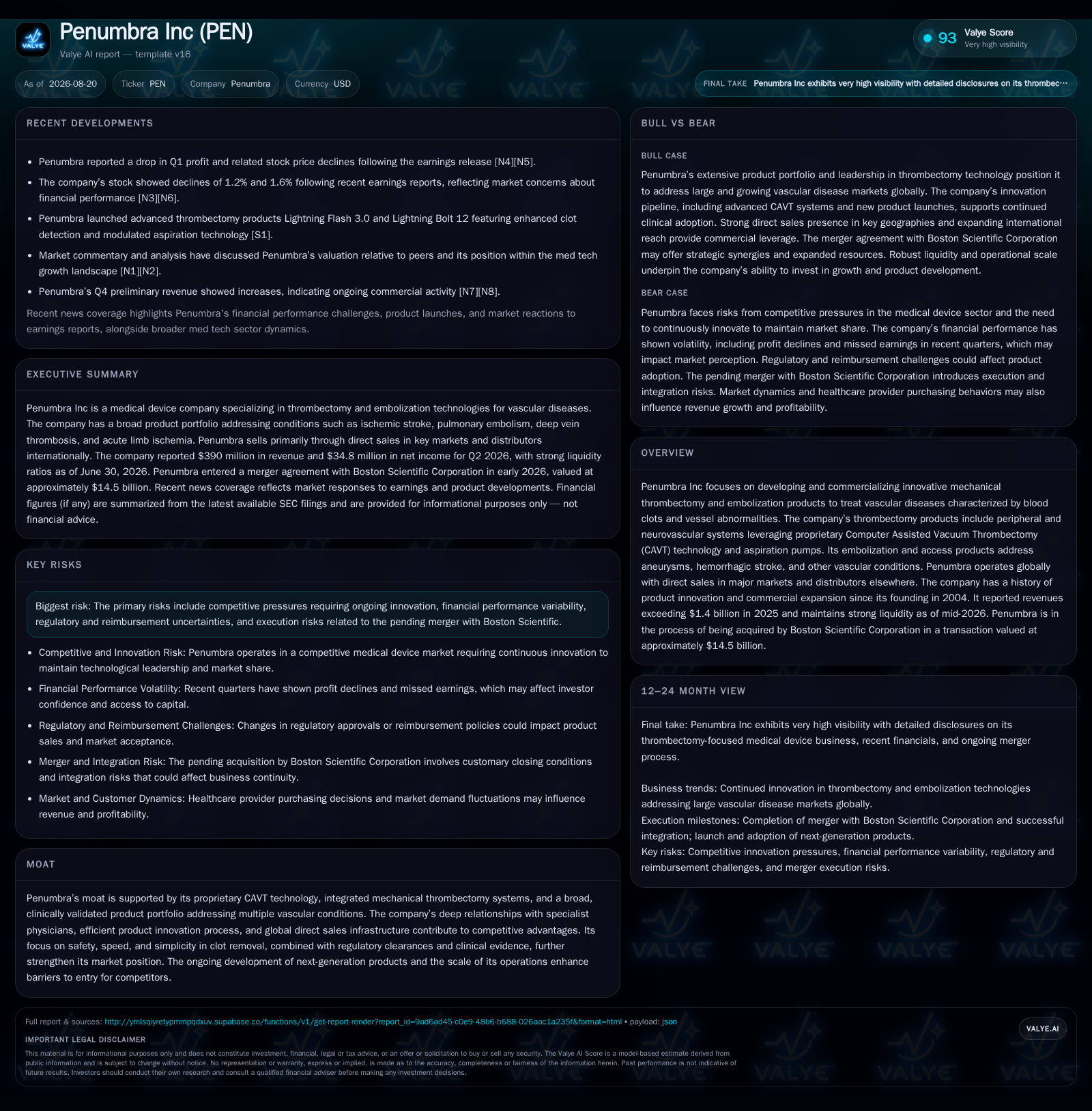
Penumbra Inc is a medical device company specializing in thrombectomy and embolization systems addressing large vascular disease markets. With $1.4 billion revenue in 2025 and innovative CAVT-based products, it has strong direct sales and international reach. The pending $14.5 billion acquisition by Boston Scientific introduces strategic upside but also integration risks. Penumbra’s economics rely on specialized, consumable-driven device sales with operating leverage from scale and innovation. Competitive dynamics and regulatory factors pose challenges, making product pipeline execution and merger closure critical near-term milestones.
Penumbra Inc operates at the forefront of mechanical thrombectomy and embolization, delivering critical devices that remove blood clots and treat vascular diseases such as ischemic stroke and pulmonary embolism. With a reported $1.4 billion revenue base in 2025, Penumbra’s innovative Computer Assisted Vacuum Thrombectomy (CAVT) technology underpins its differentiated product portfolio. The company’s global sales reach is anchored by a direct sales force in major markets, complemented by distributors internationally. In early 2026, Penumbra agreed to be acquired by Boston Scientific Corporation in a deal valued at roughly $14.5 billion, a transaction that could reshape its growth trajectory. However, recent profit declines and market skepticism highlight the delicate balance between innovation, competition, and financial execution heading into this pivotal transition [S1][S2].
Latest Operating Snapshot
Penumbra reported revenues of $390 million and net income of $34.8 million in Q2 2026, with basic and diluted EPS of $0.88, reflecting stable profitability amid some recent volatility [S2]. The company’s liquidity remains robust, holding $205.3 million in cash and equivalents and a strong current ratio of 5.75, indicating solid short-term financial health [S2]. Notably, thrombectomy products contributed $947.9 million to total 2025 revenues of $1.4 billion, underscoring the core role of consumables and systems targeting vascular occlusions [S1].
Strategically, Penumbra entered a merger agreement with Boston Scientific Corporation in January 2026, valued at approximately $14.5 billion, with expected closing by year-end subject to regulatory approvals [S1]. Recent market reactions to earnings releases have been mixed, with profit declines in Q1 and minor stock price drops post-earnings, reflecting investor caution around growth and margin sustainability [N3][N4][N5]. Meanwhile, new product launches such as Lightning Flash 3.0 and Lightning Bolt 12 featuring advanced CAVT technology highlight ongoing innovation efforts [S1].
Business Model and Unit Economics
Penumbra generates revenue primarily through sales of thrombectomy and embolization devices targeting vascular diseases characterized by blood clots and vessel abnormalities. The business model is largely volume-driven, relying on consumable device sales that physicians use in acute clinical interventions. Pricing is influenced by product complexity, clinical efficacy, and reimbursement environment, but competitive pressures moderate pricing power. Mix benefits may arise from premium, next-generation devices such as those employing proprietary CAVT technology [S1].
Fixed costs are significant due to R&D, manufacturing, and a global direct sales organization that penetrates major markets including the US, Europe, Canada, Australia, and Singapore. Variable costs scale with device volume, especially consumables and component sourcing. Operating leverage could emerge as scale increases and new product launches gain adoption, improving gross margins if fixed costs are absorbed. However, capital intensity remains moderate compared to implantable device peers, and investment in innovation cycles is continuous to sustain technological advantage. The fee-for-service nature of hospital purchasing means volume and reimbursement changes can materially impact unit economics.
Moat, Competition and Counterforces
Penumbra’s moat centers on its proprietary CAVT technology and integrated thrombectomy systems that combine aspiration pumps with specialized catheters, delivering clinically validated outcomes emphasizing speed, safety, and simplicity. Its broad product portfolio spanning neurovascular and peripheral vascular categories, supported by regulatory clearances and clinical evidence, reinforces competitive differentiation [S1]. Deep relationships with specialist physicians via a direct sales force enhance adoption and create switching frictions, while a disciplined innovation pipeline supports ongoing product evolution.
However, the medical device thrombectomy market is intensely competitive, with established peers (including Boston Scientific itself) and emerging players investing heavily in innovation. Competitive pressure may erode pricing and market share if Penumbra fails to sustain technological leadership. Regulatory and reimbursement shifts could also alter adoption dynamics. Additionally, dependence on distributors in some international markets introduces margin dilution and potential channel conflicts. The pending merger introduces integration risks that could disrupt sales momentum or R&D focus, thus weakening the moat if not executed smoothly.
Bull Case
In the bull scenario, Penumbra leverages its leadership in thrombectomy technology and broad vascular disease portfolio to capture expanding global markets driven by rising vascular disease incidence and increasing clinical adoption. The company’s next-generation CAVT-enabled products, such as Lightning Flash 3.0 and Lightning Bolt 12, gain rapid acceptance due to clear clinical advantages in clot removal efficiency and procedural simplicity [S1]. Penumbra’s direct sales force efficiently penetrates high-potential geographies while distributor channels expand international reach, fostering sustained volume growth.
The merger with Boston Scientific, once closed, delivers strategic synergies including expanded sales networks, combined R&D capabilities, and cost efficiencies, accelerating Penumbra’s innovation cadence and global commercial scale. reported liquidity position and operational execution enable ongoing investment in pipeline and market development. Confirmation would come from sequential revenue growth, margin expansion, and positive integration milestones. The bull thesis would be falsified if new product launches fail to achieve meaningful adoption or merger integration materially disrupts operations.
Base Case
The base case envisions Penumbra maintaining a stable position as a leading thrombectomy device provider with moderate revenue growth driven by incremental product adoption and geographic expansion. The company continues to invest in innovation but faces pressure from competitors developing alternative technologies. Pricing remains under some downward pressure, offset partially by volume increases and product mix improvements. The direct sales model sustains physician relationships and supports steady, if unspectacular, share gains in core markets.
The merger with Boston Scientific closes as anticipated, but integration unfolds gradually without major disruption or immediate scale benefits. Financial performance stabilizes after recent profit volatility, and liquidity remains sufficient for ongoing operations and R&D. Regulatory and reimbursement environments remain stable, though reimbursement growth is modest. This scenario is confirmed by consistent but unspectacular quarterly revenue and earnings trends and partially successful product launches. It would be challenged if significant competitive incursions or regulatory setbacks occur.
Bear Case
In a downside scenario, Penumbra struggles to sustain its innovation edge amid intensifying competition from established med tech incumbents and new entrants developing alternative thrombectomy and embolization modalities. Pricing erosion accelerates as hospitals seek cost containment, and reimbursement cuts hamper procedure volumes. Recent profit declines and missed earnings forecasts reflect weakening operational execution and margin pressure [N4][N5].
The pending merger with Boston Scientific encounters regulatory hurdles or integration challenges that distract management, delay synergies, or lead to customer attrition. Disruptions to the direct sales force or R&D pipeline slow new product introductions, ceding share to competitors. International distributor dynamics further constrain margins. Confirmation of this downside would include continued negative earnings surprises, declining device volumes, and publicized integration difficulties. A reversal would be signaled by renewed innovation success or improved operational metrics.
What Matters Next
Key near-term milestones include the successful closing of the Boston Scientific acquisition, which will materially influence Penumbra’s strategic direction and resource access. Investors should monitor integration progress and any updates on anticipated synergies or restructuring plans. Product adoption metrics for newly launched CAVT-enabled devices such as Lightning Flash 3.0 and Lightning Bolt 12 are critical to gauge commercial traction and potential margin expansion.
Additional KPIs to watch include quarterly revenue growth rates segmented by thrombectomy and embolization/access products, gross and operating margin trends reflecting cost control and pricing power, and R&D investment levels indicating innovation commitment. Reimbursement environment developments and regulatory approvals or challenges, especially in international markets, also warrant close attention. Finally, sales force productivity and channel dynamics, particularly the balance of direct versus distributor sales internationally, will impact Penumbra’s competitive positioning and financial performance.
Disclaimer: This is research-only, informational analysis and not investment advice. It may include AI-generated interpretation and general industry context. Always verify important details using primary sources.

Comments