
Planet Fitness Reinforces Growth with Franchise Expansion and Membership Gains
Planet Fitness leverages its franchise model and Judgement Free Zone brand to deliver sustained financial growth and network expansion.
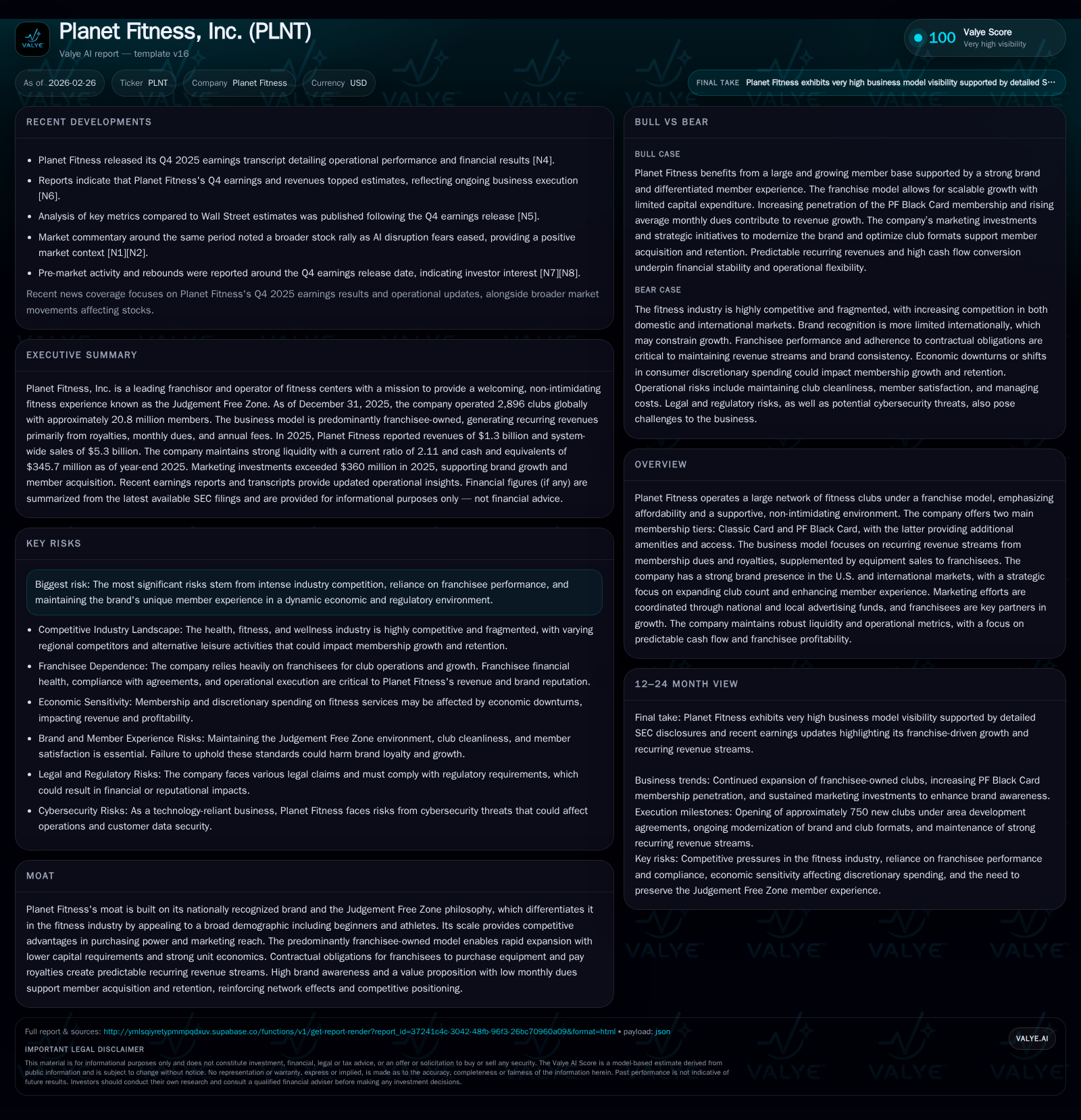
Planet Fitness has shown robust historical growth fueled by its highly scalable franchise system, which supports strong unit economics and recurring revenue streams. The company’s strategic focus on membership expansion, particularly the premium PF Black Card tier, drives revenue growth alongside systematic club openings. While competition intensifies globally with limited international brand recognition, Planet Fitness offsets these risks through its distinct value proposition and operational discipline. Its capital allocation balances aggressive share repurchases with reinvestment in growth initiatives and franchise partner development. Key forthcoming milestones include monitoring membership retention, new club pace, and evolving marketing strategies.
Transformation through Scale: Planet Fitness’ Historical Growth Journey
Since 2017, Planet Fitness has demonstrated compelling growth supported by a scalable franchising framework. Revenues surged from $134 million in FY2017 to approximately $1.3 billion by FY2025, representing an explosive compound growth trajectory tied directly to expanding membership volumes and club footprint [F1]. This progression is mirrored in operating income which rose from nearly $230 million in 2022 to about $395 million in 2025 — a 21.7% increase year-over-year that outpaces top-line gains and signals expanding operational leverage.
Net income similarly posted robust progression, growing by over 27% annually most recently to reach $219 million in FY2025 [F1]. Operating cash flow also kept pace with income advances, topping $418 million in the same year—a 21.7% year-over-year uptick—fueling free cash flow cushions well above capex needs [F1]. Capital expenditures have risen moderately but steadily (5.6% YoY growth), reflective of ongoing club additions and refurbishments necessary to maintain competitive positioning without excessive capital strain.
Historical performance (annual)
| FY | Net ($mm) | CFO ($mm) | OpInc ($mm) | Capex ($mm) | Net YoY |
|---|---|---|---|---|---|
| 2025 | 219 | 418 | 395 | 164 | +27.4% |
| 2024 | 172 | 344 | 324 | 155 | +24.4% |
| 2023 | 138 | 330 | 273 | 136 | +39.1% |
| 2022 | 99 | 240 | 230 | 100 |
Source: SEC companyfacts cache [F1].
Capital returns and efficiency (annual)
| FY | Buybacks ($mm) | FCF ($mm) | ROE% |
|---|---|---|---|
| 2025 | 500 | 255 | -45.4 |
| 2024 | 300 | 189 | -79.9 |
| 2023 | 125 | 194 | -119.6 |
| 2022 | 140 | -49.9 |
Source: SEC companyfacts cache [F1].
Figures sourced from latest fiscal year-end data show sustained momentum across key financial metrics.
Franchise Model Strengths Driving Unit Economics and Network Expansion
Planet Fitness operates a predominantly franchise-owned model comprising over 90% of its nearly 2,900 clubs spread across North America and select international markets including Panama, Mexico, Australia, Spain and Canada [S4][S5]. This structure empowers rapid scaling with substantially lower capital investment requirements compared to wholly company-operated chains.
Average unit volumes (AUVs) at mature corporate clubs exceed $2 million annually, generating four-wall Adjusted EBITDA margins around 42.7%, which adjust down to about 35.3% after factoring franchise royalties at the current rate of approximately 7% [S16]. Franchisee economics align closely per management estimates derived from business reviews [S16], validating the robustness of unit-level profitability.
Franchisees operate under Area Development Agreements ensuring disciplined geographic expansion commitments and high franchisee reinvestment rates into new clubs each year — all new locations in fiscal year ending December 2025 stemmed from incumbent multi-unit operators [S19][S27]. Contracts compel purchase of fitness equipment exclusively from Planet Fitness or approved vendors; leveraging the company's scale enables highly competitive pricing negotiation power for equipment supply chains [S4][S28]. This not only preserves brand consistency across clubs but also underpins a recurring backend revenue stream beyond royalties through 'equip' and 're-equip' cycles occurring every five to nine years.
Advertising is coordinated via National Advertising Funds (NAFs) complemented by compulsory local marketing spend equating to roughly a combined $360 million annually funded by both corporate-owned clubs and franchisees [S22]. Planet Fitness employs multiple agencies managing creative assets for campaigns emphasizing its Judgement Free Zone—a non-intimidating environment fostering inclusivity across diverse member profiles ranging from gym novices to athletes [S6][S24].
Keys to sustainability within this model include continuous club layout optimization and amenity upgrades such as massage chairs and tanning equipment accessible primarily via the premium PF Black Card membership tier now constituting two-thirds of total subscribing members—a figure rising steadily since inception of this product line [S17].
Emerging Challenges: Competition and Member Experience Sustainability
While Planet Fitness enjoys elevated brand awareness domestically—among the highest in U.S. fitness according to periodic third-party brand health research—it confronts stiff competition internationally due to relative market immaturity outside North America [S6][S14]. Competitors range broadly across traditional gyms, boutique studios, wellness centers, online fitness platforms, recreational athletic clubs, home fitness equipment providers as well as diversified leisure activities vying for consumer discretionary spend [S14].
Maintaining the unique Judgement Free Zone member experience as expansion introduces heterogeneity across geographies presents operational risk compounded by reliance on multi-unit franchisee performance quality control [S11][S25][S27]. The company mitigates these factors through rigorous compliance inspections involving mystery shopping assessments and regular formal review visits supplemented by digital survey systems measuring club-level net promoter scores introduced in the latest fiscal year [S27]. Moreover, adherence to brand standards is enforced contractually with consistent training through Planet Fitness University designed both for English- and Spanish-speaking personnel [S26][S28].
Regulatory frameworks applicable across diverse jurisdictions impose additional layers of complexity especially concerning labor laws and franchising statutes requiring ongoing management attention [S11][S25]. Cybersecurity oversight is similarly intensive — led by seasoned IT-security executives who advise board committees regularly given the increasing importance of digital channels supporting billing memberships largely via Automated Clearing House transactions [S1][S26].
Growth Prospects in Domestic and International Markets
Looking ahead, Planet Fitness identifies promising avenues for accelerating organic growth via incremental club openings primarily funded by existing seasoned franchisee partners who adeptly meet Area Development Agreement targets [N1][N3][S19][S27]. Geographic diversification benefits from platform presence across multiple countries where wellness spending continues upward trend though penetration remains modest compared to the U.S., offering room to grow brand equity.
The company pursues an upgrade strategy focused on converting Classic Card members toward higher-margin PF Black Card memberships that currently represent approximately two-thirds (66.5%) of members with average dues increasing commensurately from around $17.63 to $19.51 monthly between FY2021–FY2025 [S17]. This upselling drives average revenue per member enhancements alongside new member acquisitions backed by targeted marketing spends shifting toward increased national advertising versus local efforts set for calendar year 2026 [S22]. Generation Z constitutes one of the fastest-growing demographics within the member base indicating successful penetration into younger cohorts susceptible to long-term retention gains absent a competitor disruptor [S6].[N2]
Operating Metrics Insights: Capital Structure, Cash Flow, and Returns
Planet Fitness maintains a solid liquidity profile exemplified by a current ratio approximating 2.11 at fiscal year-end December 2025—reflecting strong working capital balances of approximately $658 million against liabilities near $312 million—with cash & equivalents alone nearing $346 million providing ample runway for operational resilience [F1][S19][S23].
Free cash flow generation remains robust at about $255 million calculated as operating cash flow less capital expenditures ($418M - $164M), underscoring efficient conversion from earnings into fungible funds available for various uses including reinvestment or shareholder returns [F1]. The company’s equity position is negative at roughly -$483 million principally stemming from accumulated repurchase activity reducing book equity despite profitability—rendering traditional return on equity metrics misleading as reflected by an approximate ROE of -45.4% when naively calculated using net income over negative stockholders’ equity levels [F1].[N1]
Debt-related covenants embedded within securitized notes transactions that cover substantial revenue-generating assets enforce leverage ceilings while allowing flexibility for balance sheet management highlighted through recent refinancings finalized late CY2025 securing fixed-rate senior secured notes intended partially for earlier series repayment plus general corporate purposes including share buybacks [F1][S12][S13][S18][S20][S21]. Lease obligations pertain mostly to corporate-owned facilities that represent a minority share counted among all locations [S23].
Strategic Capital Deployment: Balancing Share Repurchases and Reinvestment
The capital allocation approach favors aggressive share repurchases as a principal vehicle for returning value evidenced by sizeable authorization utilization totaling approximately $500 million in buybacks during FY2025 alone—well up from prior years—and complemented by negligible dividend distributions post-FY2017 consistent with prioritizing growth-oriented reinvestment opportunities through franchise development support programs [F1][S7].[N3]
The refinancing initiatives executed recently provided liquidity buffers facilitating this shareholder return strategy without compromising operational funding or franchise assistance programs critical given the reliance on multi-unit owners executing expansion plans [S12][S15][S18].[N4]
Key Milestones to Monitor in the Near Term
Investors should closely watch Q1/2026 operating metrics releases following robust full-year results reported February 24, including updates on system-wide sales trajectory, PF Black Card membership penetration rates rising or stabilizing above two-thirds threshold, same-store sales trends reflecting retention strength amidst competitive pressure plus detailed commentary around funnel expansion efforts targeting both domestic saturation mitigation and international foothold amplification .[N6][N7]
Additional signposts include:
- Progress against scheduled grand openings driven mainly by incumbent multi-club owners,
- Effectiveness of recent marketing fund reallocation increasing national advertising while reducing local spend slightly,
- Any shifts in capex cadence related to remodel programs or equipment upgrade frequency,
- Updates on regulatory developments potentially affecting franchise contractual terms or member interaction protocols,
- Refinements or expansions in technology infrastructure ensuring cybersecurity robustness amid escalating digital threats.
Overall Planet Fitness appears well-positioned but vigilance will be required given sector fragmentation profiles internationally along with sustained execution demands necessary for preserving its hallmark non-intimidating Judgement Free environment that anchors member loyalty.
Disclaimer: This analysis is provided solely for informational purposes based on disclosed company filings and recent news; it does not constitute investment advice or recommendations.
Disclaimer: This is research-only, informational analysis and not investment advice. It may include AI-generated interpretation and general industry context. Always verify important details using primary sources.

Comments