
Polaryx Advances PLX-200 Basket Trial to Address Rare Pediatric Lysosomal Storage Disorders
Recent FDA clearance sets stage for pivotal Phase 2 trial of Polaryx’s oral small molecule targeting multiple lysosomal diseases.
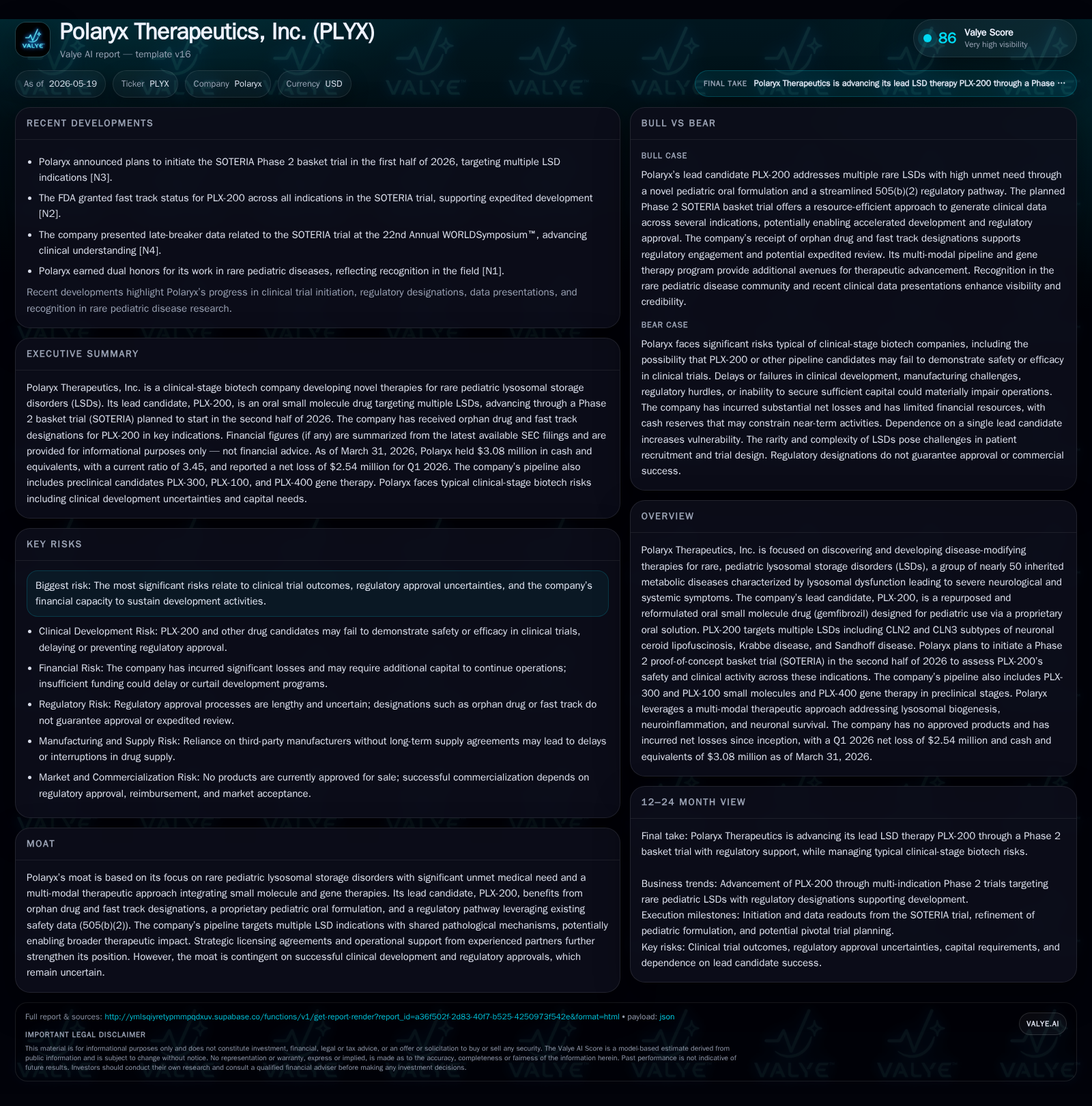
Polaryx Therapeutics is progressing its lead candidate, PLX-200, through regulatory milestones with plans to initiate a pivotal Phase 2 proof-of-concept basket trial in H2 2026 for multiple rare pediatric lysosomal storage disorders (LSDs). The latest quarterly filing confirms ongoing operational and financial status, highlighting the company’s reliance on PLX-200’s success. Polaryx’s strategy leverages a repurposed drug via the 505(b)(2) pathway combined with a proprietary pediatric oral formulation. While the clinical and regulatory paths have encouraging designations, execution risks remain significant, as does the need for capital to sustain development.
Recent Operating Update
Polaryx Therapeutics’ most recent quarterly filing dated May 15, 2026 [S2] provides an operational snapshot that solidifies the company’s ongoing focus: advancing PLX-200 into clinical development. The filing affirms no material changes in risk factors but reiterates capital constraints and dependency on PLX-200’s clinical success. In parallel news releases [N2], FDA granted Fast Track designation for PLX-200 across all major indications included in the planned SOTERIA Phase 2 basket trial—this endorses Polaryx’s accelerated pathway for rare pediatric lysosomal storage disorders (LSDs).
In essence, Polaryx has cleared key preparatory hurdles: they submitted the IND in August 2025 and secured SAFE to Proceed letters later that year. The FDA Fast Track marking intensifies regulatory engagement facilitating potential expedited review. As such, initiating their phase 2 basket trial – designed as an open-label protocol testing efficacy and safety simultaneously across multiple LSD cohorts – scheduled for the second half of 2026 becomes the company’s foremost near-term catalyst.
Business Model
Polaryx operates as a clinical-stage biopharmaceutical entity focused squarely on rare pediatric LSDs—diseases marked by enzyme deficiencies leading to toxic metabolite accumulation causing neurodegeneration and systemic damage. The company hopes to generate revenue eventually via commercializing PLX-200 and later assets.
Revenue mechanics hinge entirely on successful regulatory approval and subsequent market penetration of PLX-200 as a disease-modifying therapy administered orally—a feature designed specifically for pediatric patients who face swallowing difficulties often associated with their conditions [S1]. Their primary product candidate is not a novel molecule but a reformulation of gemfibrozil —a fibrate originally approved for lipid disorders—with demonstrated safety data allowing Polaryx to pursue a 505(b)(2) NDA regulatory path. This reduces early-stage clinical risk by leveraging prior established pharmacology while optimizing administration (oral solution rather than tablets) suitable for children.
Polaryx charges institutional payors including government health agencies and private insurers upon commercialization. Pricing power could be influenced by orphan drug exclusivities granted under U.S. laws and EU analogues plus accelerated approval pathways contingent on surrogate endpoints from early phase trials.
The company outsources significant operational functions through Mstone Partners Healthcare Limited consultancy services [S24], keeping internal headcount lean (11 employees; few full-time), minimizing fixed overhead costs but potentially requiring scaling upon commercial launch.
Industry Structure and Competitive Position
Rare pediatric LSDs constitute a specialized segment within orphan drug markets characterized by high unmet medical need but inherently limited patient populations. Enzyme replacement therapies dominate some LSD subtypes; however, these therapies are generally specialized for single disorders and require invasive administration routes like intravenous infusion.
Polaryx differentiates via its small molecule approach addressing multiple shared pathological features such as lysosomal dysfunction, neuroinflammation reduction through PPARα activation, and neuronal survival signaling [S18]. This broad mechanistic profile positions PLX-200 to potentially serve various LSDs beyond just one subtype. Current competitors include companies developing gene therapies or enzyme replacements but may lack equally broad indication applicability or non-invasive dosing methods convenient for pediatric care.
Further competitive advantage derives from regulatory designations: orphan drug status grants market exclusivity periods enhancing pricing leverage; PRIME designation from EMA (noted in annual filing [S1]) provides procedural benefits in Europe; fast track FDA designation accelerates U.S. interactions; patent portfolio around novel formulation caters to intellectual property protection layers enhancing barriers to entry.
Growth Drivers
Multi-Indication Basket Trial Strategy
The upcoming SOTERIA Phase 2 proof-of-concept basket trial is central to growth potential. Testing four distinct LSD subtypes under one master protocol enables efficiency while broadening potential registration pathways should efficacy signals emerge in any indication cohort.
Demonstrating consistent clinical activity may allow Polaryx to seek accelerated approval in priority cohorts such as CLN2 and CLN3 where certain precedent exists [S1]. This strategic approach maximizes resource utilization amid typical rare disease enrollment challenges.
Regulatory Incentives and Pathways
Fast track status coupled with orphan drug exclusivity accelerates potential time-to-market while providing competitive commercial protection post-launch [S23]. The utilization of the FDA’s streamlined 505(b)(2) route reduces the burden of extensive new chemical entity trials thanks to established safety data of gemfibrozil
Patient-Centric Formulation Development
Oral solution format addresses important therapeutic usability issues in young patients who suffer from dysphagia common across many LSD phenotypes [S23]. Ease of administration supports higher adherence rates which correlates positively with long-term treatment outcomes.
Expanded Pipeline Opportunities
While PLX-200 leads clinical development, Polaryx’s preclinical assets—PLX-100 and PLX-300 small molecules plus gene therapy candidate PLX-400—could extend therapeutic reach either as mono or combination therapies addressing upstream genetic causes or downstream pathological cascades [S1]. Success here would diversify future revenue streams.
Risks / Watchpoints / Growth Constraints
Clinical Development Risk
Primary dependency exists on demonstrating meaningful safety and efficacy outcomes in SOTERIA trial cohorts. Failure or delay can materially impair valuation or even viability given no approved products exist presently [S6]. Overlapping mechanisms among pipeline candidates mean negative results for PLX-200 increase developmental risk across smaller programs.
Funding Constraints
Reported cash & equivalents stood at $3.08 million as of end-March 2026 [F1]. This level supports operational liquidity but indicates limited runway relative to typical biopharma R&D burn rates, suggesting the company will likely require near-term capital raises or partnerships to sustain development activities [S2].
Manufacturing Scale-Up Challenges
Developing compliant GMP manufacturing scaled for commercial supply of novel oral formulations presents technical hurdles impacting timelines unless mitigated early [S6]. Regulatory inspections add operational risk.
Regulatory Uncertainties Across Jurisdictions
Although FDA Fast Track facilitates expedited engagement, final approval remains contingent on robust data submissions meeting defined surrogate or clinical endpoints simultaneously satisfying EMA or other foreign agency requirements which are subject to variability resulting from evolving global regulatory landscapes [S9]
Market Access Limitations
Pricing pressures exacerbated by government cost containment initiatives especially outside the U.S., reimbursement uncertainties for orphan drugs, off-label competition or generic erosion post exclusivity period pose commercialization risks [S7],[S16].
What to Watch Next
- Execution timeline: SOTERIA trial initiation expected H2 2026 establishing baseline recruitment pace and interim monitoring data points.
- Initial data releases anticipated within ~12 months post-enrollment that will indicate safety signals and early efficacy trends guiding registrational considerations per individual indication cohort.
- Regulatory feedback loops especially from FDA/EMA about endpoint acceptance influencing design of potential pivotal trials following phase 2 readouts.
- Financing activities critical given existing cash levels suggesting need for equity raises or partnerships to sustain multi-cohort trial operations.
- Progress updates on preclinical assets may provide incremental value injection depending on translational readiness parallels with PLX-200.
- Changes in regulatory policies governing orphan drugs or fast track provisions internationally could alter development economics thus requiring close monitoring.
Financial Profile Contextualized Briefly
At quarter-end March 31, 2026, Polaryx held $3.08 million in cash and equivalents supporting operational liquidity [F1]. Current assets totaled $3.50 million against current liabilities of $1.01 million, yielding a current ratio of approximately 3.45, which indicates a solid short-term liquidity position [F1].
Operating losses remain substantial reflecting clinical-stage spend without commercial revenues (-$7.8 million operating income loss recorded as of December 31, 2025) underscoring funding-driven development risk still prevalent as the company advances its pipeline [F1]
This analysis is intended solely for informational purposes reflecting publicly available filings and news up to May 2026 without investment research views or price forecasts. Readers should consider professional advice before making any financial decisions involving this or related securities.
Disclaimer: This is research-only, informational analysis and not investment advice. It may include AI-generated interpretation and general industry context. Always verify important details using primary sources.

Comments