
Philip Morris International: Navigating the Transition to a Smoke-Free Future Amidst Regulatory and Market Challenges
An in-depth analysis of Philip Morris International’s strategic transformation, financial resilience, and competitive standing within the evolving tobacco and nicotine industry.
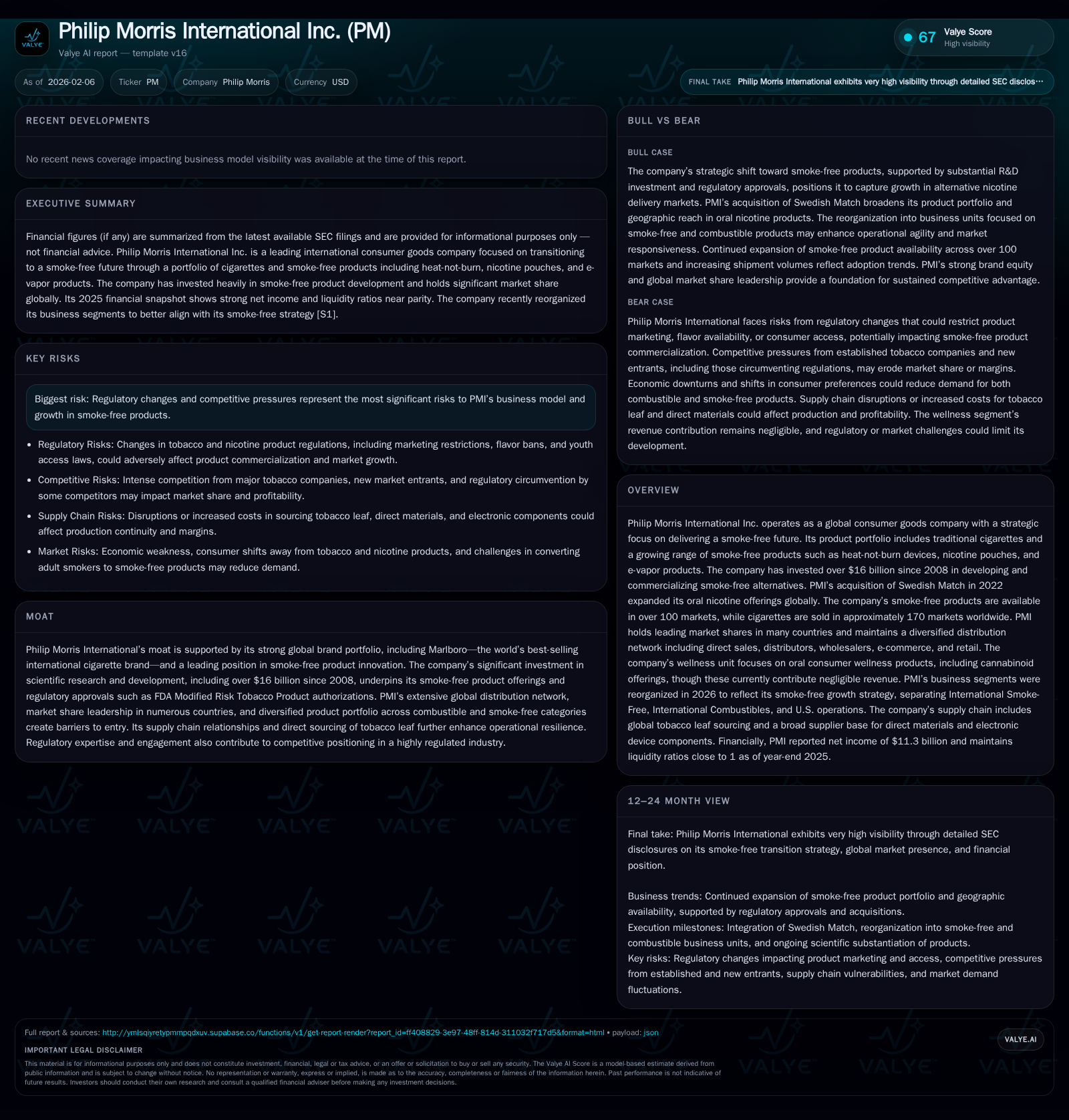
Philip Morris International Inc. (PM) remains a dominant player in the global tobacco market while aggressively pivoting towards smoke-free products, backed by over $16 billion invested since 2008. The acquisition of Swedish Match in 2022 enhanced its portfolio with oral nicotine products, complementing its flagship IQOS heat-not-burn device. Despite rising revenues and strong earnings growth through 2025, PMI faces headwinds from regulatory scrutiny and currency risks, especially in constrained markets like Russia and Argentina. Its extensive global footprint, diversified product suite, and leadership in smoke-free innovation underpin its moat, yet evolving regulations and competition remain significant risks.
Company Overview
Philip Morris International Inc. (PM) stands as one of the preeminent multinational consumer goods companies focusing on tobacco products but increasingly driving a transformative agenda toward a smoke-free future. Established as a Virginia holding company in 1987 and publicly listed since 2008 [S1], PMI has evolved its product portfolio beyond traditional combustible cigarettes to include heat-not-burn devices (such as IQOS), nicotine pouches (like ZYN), e-vapor technologies, and oral consumer wellness offerings.
Since 2008, PMI has invested over $16 billion into research, development, scientific substantiation, and commercialization efforts aimed at reducing smoking-related harm through alternatives that eliminate combustion—a principal source of tobacco-related health risks [Valye excerpt]. This strategic focus aligns with growing regulatory pressures globally to reduce cigarette consumption coupled with shifting consumer preferences toward less harmful delivery systems.
Strategic Shift and Product Portfolio
The core of PMI’s growth strategy is the advancement of Smoke-Free Business (SFB) encompassing all non-combustible products including:
- Heat-not-burn devices (IQOS)
- Nicotine pouches (ZYN)
- E-vapor products
- Oral consumables such as snus
- Consumer wellness items developed by its wellness subsidiary Aspeya
In November 2022, PMI consummated its acquisition of Swedish Match AB — significantly enhancing its oral nicotine product capabilities by integrating global brands like General snus and ZYN pouches [Valye excerpt]. This acquisition complemented PMI’s existing footprint by providing scale in non-combustible nicotine delivery outside traditional cigarettes.
IQOS has become PMI's flagship smoke-free offering with widespread availability now extending into more than 100 markets worldwide where these alternatives have been approved for sale. Notably, PMI secured FDA marketing authorizations and Modified Risk Tobacco Product (MRTP) orders for versions of IQOS devices and consumables as well as Swedish Match's General snus and ZYN brands — first-of-their-kind regulatory achievements opening doors for broader U.S. commercialization [S1]. These authorizations not only validate the scientific rigor behind these products but also create high barriers for competitors lacking similar endorsements.
Furthermore, PMI’s wellness unit Aspeya is targeting longer-term growth opportunities distinct from traditional nicotine products via oral consumer wellness offerings that include medical-grade cannabinoids. Although near-term revenue impact is anticipated to be negligible due to regulatory complexities around CBD and related formulations, this diversification fits within PMI's broader goal to evolve beyond tobacco dependence [Valye excerpt].
Financial Performance Highlights
For fiscal year ended December 31, 2025, PMI reported:
- Net revenues of $40.6 billion — a steady increase from $37.9 billion in 2024
- Cost of sales increased marginally to $13.4 billion
- Resulting gross profit margin improved reflecting efficient scale
- Operating income grew to $14.9 billion up from $13.4 billion
- Net earnings attributable to PMI surged to approximately $11.3 billion from $7.1 billion in 2024
- Basic diluted EPS rose markedly to $7.26 versus $4.52 prior year [F1][S1]
These gains underscore effective capitalizing on higher-margin smoke-free products along with maintaining significant volumes in combustible segments where market conditions permit.
Operating expenses encompassing marketing, administration, research & development climbed concurrently reflecting ongoing investments into innovation pipelines alongside customer acquisition efforts essential to sustaining category leadership.
Balance sheet strength remains solid albeit heavily leveraged:
- Total debt stood at $48.8 billion at year-end 2025 compared to $45.7 billion previous year
- Weighted average maturity of long-term debt approximately seven years allowing manageable refinancing timelines
- Cash & cash equivalents totaled $4.9 billion with substantial amounts held overseas including $2.3 billion specifically reported in Russia where foreign exchange controls impose repatriation challenges [S1][F1].
Liquidity management benefits from multiple avenues including access to an $8 billion aggregate commercial paper program (unused at year end), committed revolving credit lines totaling $6.3 billion fully untapped then, plus ongoing operating cash flows [S1].
Competitive Positioning & Moat Analysis
Philip Morris International enjoys a robust competitive moat sustained by several interlocking factors:
Brand Equity & Market Share Leadership
Marlboro remains the world’s leading international cigarette brand under PMI’s stewardship fostering enduring customer loyalty across key markets.
Innovation Investment & Science-Based Evidence
The firm’s extensive investment exceeding $16 billion since 2008 underpins proprietary technology platforms behind IQOS and other smoke-free offerings enabling pre-clinical toxicology assessments that drive regulatory approvals such as FDA MRTPs—exclusive credentials difficult for rivals to replicate quickly.
Distribution Network & Global Reach
Selling cigarettes in roughly 170 countries and smoke-free products in over 100 territories provides scale advantages uncommon among competitors primarily regional or focused on limited product lines [Valye excerpt]. Diverse sales channels encompassing direct operations alongside distributors, wholesalers, e-commerce platforms strengthen placement reliability especially amid shifting restrictions.
Vertical Integration & Supply Chain Relationship Strengths
Direct sourcing agreements for leaf tobacco coupled with long-term supplier partnerships secure consistent raw material quality accommodating rapid innovation cycles while mitigating input cost volatility.
Regulatory Engagement Expertise
Navigating a heavily regulated environment globally demands dedicated internal expertise which PMI has cultivated enabling proactive compliance measures plus constructive dialogue shaping policy frameworks beneficial to business sustainability.
Collectively these pillars create formidable entry barriers limiting newcomers’ ability to displace established positions rapidly or at scale.
Industry Dynamics & Regulatory Environment Consideration (Analysis)
The global tobacco sector remains uniquely challenged amid accelerating health-conscious trends balanced against entrenched demand for nicotine delivery:
- Increasing tax burdens inflate excise-related costs affecting pricing strategies globally.[S1]
- Evolving regulations impose stringent advertising constraints potentially curbing new consumer recruitment while necessitating enhanced transparency in harm reduction claims.
- Cross-border capital controls—as illustrated notably by Russia’s foreign currency restrictions—introduce operational complexities impacting liquidity deployment efficiency.
- Competitive pressures are intensifying not only from traditional cigarette manufacturers expanding smoke-free alternatives but also from insurgent players focusing exclusively on next-generation nicotine modalities including vaping startups or synthetic nicotine innovators.
- The sustainability imperative alongside social responsibility expectations encourages companies like PMI toward non-cigarette portfolios though success depends on consumer adoption rates outside the conventional smoker base.
Risks & Challenges Highlighted by Management [S1]
While financially robust today, PMI faces significant uncertainties:
- Regulatory changes could limit marketing freedoms or delay rollouts impairing revenue growth prospects especially amid divergent geographic policies.
- Competitive forces might erode margins if smokeless product penetration accelerates faster among lower-cost rivals lacking legacy cigarette obligations.
- Currency exposure combined with foreign exchange limitations introduces profitability unpredictability particularly where local economies face volatility or sanctions.
- Execution risks exist related to integration of acquisitions like Swedish Match along with scaling new product innovations without cannibalizing combustible revenue prematurely.
- Market acceptance remains critical—while early indicators support IQOS adoption rates there remains variability across demographics influenced by cultural norms or generational shifts.
Conclusion
Philip Morris International commands an enviable position within the tobacco landscape anchored by powerful brands, scientific innovation leadership in smoke-free technologies, expansive reach, and disciplined financial management. The combined strengths confer a meaningful moat even as the company recommits itself toward reshaping industry paradigms away from cigarettes towards reduced-risk alternatives bolstered by FDA endorsements—a rare competitive advantage facilitating deeper U.S. market penetration post terminating previous arrangements with Altria Group.
Nonetheless, navigating relentlessly evolving regulatory frameworks remains the foremost challenge alongside macroeconomic uncertainties impacting global operations notably in constrained jurisdictions such as Russia or Argentina with stringent capital controls partially restricting liquidity flows.
Overall PMI illustrates how legacy industry incumbents can strategically reinvent themselves amid prohibitive external pressures by investing heavily into product innovation validated through rigorous science thus positioning for medium-to-long term relevance amidst shifting consumer preferences away from combustible tobacco consumption.
This analysis does not constitute investment advice but provides an informed perspective grounded in available financial statements filed through February 6th, 2026 (Form 10-K) along with company disclosures.
Disclaimer: This is research-only, informational analysis and not investment advice. It may include AI-generated interpretation and general industry context. Always verify important details using primary sources.

Comments