
Polar Power Tackles Facility Eviction and Liquidity Constraints Amid Business Diversification
Recent Q1 2026 filings reveal major operational disruptions due to facility eviction and a new credit facility, underscoring risks as Polar Power pursues product diversification.
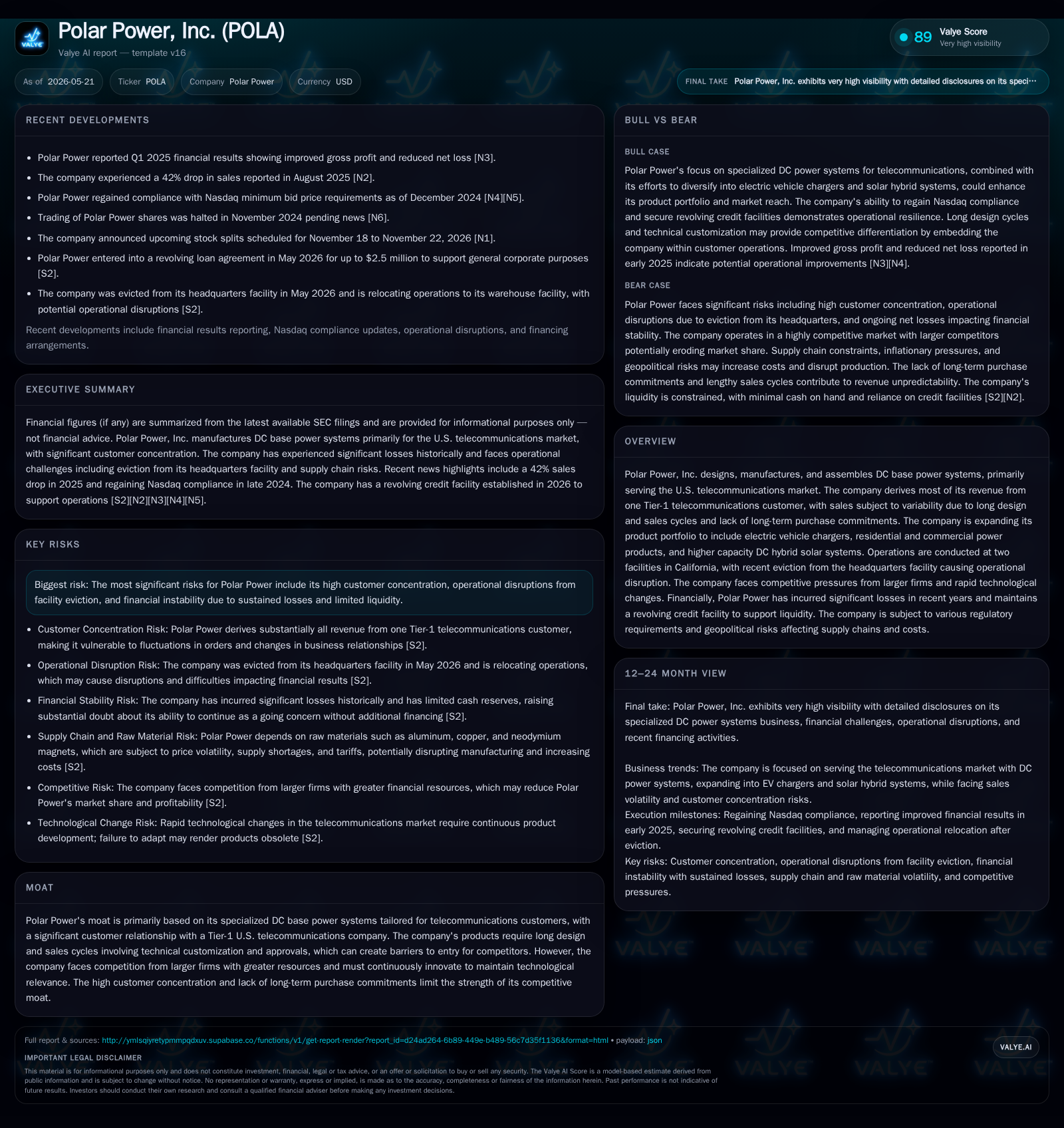
Polar Power's latest 10-Q details eviction from its primary headquarters, forcing an urgent relocation that is disrupting production and design operations. Concurrently, the company secured a $2.5 million revolving credit facility at high interest, reflecting liquidity pressures amid continued losses. Polar Power’s business hinges on custom DC base power systems mainly for a concentrated Tier-1 telecom customer, while it seeks growth through electric vehicle charging and hybrid solar systems. The operational upheaval compounded by tight cash flow and customer concentration presents significant execution risk, though the company aims to capitalize on evolving telecom infrastructure and clean energy trends.
Q1 2026 Operating Update Highlights: Eviction Impact and New Financing Initiatives
Polar Power’s latest 10-Q report filed May 20, 2026, foregrounds a critical near-term disruption with the eviction from its primary headquarters facility occurring May 19, 2026 [S2]. This headquarters location housed essential functions including product design, assembly, and testing. The company is relocating these operations into its warehouse facility while facing an August 31 deadline to vacate that space as well under leasing agreements that are in flux. Although a settlement agreement reached May 7 extends the headquarters lease term through April 2027 at reduced rent, the looming requirement to exit the warehouse creates a precarious operational timeline that threatens production continuity [S2].
In parallel with physical disruption risks, Polar Power entered into a revolving credit agreement on May 13 with Stone Brothers Capital allowing up to $2.5 million in loans bearing 12% interest annually—a relatively high cost reflecting elevated credit risk [S3]. This agreement also includes governance concessions: two existing directors resigned and three individuals designated by the lender now join the board. This shift signals lender influence over strategic decisions during ongoing liquidity constraints and operational challenges.
The combined impact of eviction-driven relocation headaches plus conditional lender support frame the current short-term challenge for execution of business strategies.
Business Model Overview: DC Base Power Systems for Telecom and Emerging Markets
Polar Power operates predominantly as a designer and manufacturer of specialized DC base power systems targeting telecommunications infrastructure that requires reliable off-grid or backup electrical power solutions [S1]. Its core offering integrates diesel, natural gas, or LPG fueled DC generators with automated controls packaged in environmentally controlled enclosures typically deployed at remote telecom sites lacking adequate utility grid access.
Distinctively, these systems prioritize integration efficiency with battery storage and solar photovoltaics by operating natively on DC power—aligning with telecom equipment's electrical requirements as well as emerging renewable microgrid standards [S1]. Output capacities range from low single digits up to roughly 50 kW.
The company further supplements its base systems with hybrid variants incorporating lithium-ion or alternative advanced batteries managed by proprietary systems plus solar hybrid configurations combining photovoltaic arrays into overall DC hybrid power plants suitable for telecom prime or backup applications. Mobile power products expanding into electric vehicle charging represent nascent product extensions intended to leverage this platform technology beyond classical telecom uses.
However, revenue remains heavily dependent on one Tier-1 telecommunications customer responsible for about 65% of total sales in 2025 with no long-term purchase commitments ensuring order variability due to protracted sales cycles involving complex design validation [S1], [S23]. This concentration poses strategic risk despite ambitions for greater market breadth through diversified applications including military, marine, industrial sectors.
Competitive Context: Customer Concentration, Pricing Dynamics, and Industry Structure
Polar Power’s competitive landscape is characterized by large-scale industry players able to offer broader product lines and deeper capital resources versus Polar’s niche specialization on customized DC base power solutions targeted primarily at telecom clients [S1]. Although customization and technical complexity create switching costs—for example requiring engineering design approvals—the lack of binding volume commitments exposes Polar's revenue streams to significant volatility tied to individual projects.
Pricing flexibility is constrained by dominant customer bargaining power especially given alternative provider availability in diesel generator and hybrid renewables markets [S1]. Nevertheless, regulatory trends present potential tailwinds for LPG and natural gas-fueled products as EPA restrictions tighten on traditional diesel generators ensuring market opportunity shifts favoring cleaner fuels where Polar has strategically invested in optimized propane/natural gas engines adapted from Toyota motors
Internationally, Polar services smaller-scale rural infrastructure projects such as those in South Pacific regions aiming to expand telecom networks where grid utility penetration remains minimal—though international revenues represented only about 7% of total sales in 2025 showing limited current scale relative to U.S. core market exposure [S1]
Growth Drivers: Product Diversification into EV Charging, Hybrid Solar, and International Expansion
Growth initiatives center on expanding product offerings beyond traditional telecom DC base systems toward mobile electric vehicle chargers updated to universal combined charging system standards superior to initial CHAdeMO versions tested since late 2024 [S1]. These mobile chargings solutions address emergent roadside emergency fast-charging requirements critical for growing EV fleets.
Simultaneously, tropicalizing their hybrid product lineup—including advanced battery chemistries paired with solar photovoltaics—aims to capture emergent distributed renewable generation demand within telecom microgrid frameworks plus related industrial or municipal usage cases.
Military applications leveraging Polar’s proven integrations hold incremental potential amid digitization trends increasing portable power needs for drones, robotics platforms requiring robust off-grid energy sources [S1].
International expansion ambitions remain modest but focused on developing underserved rural communications infrastructure aligned with global digital rollout programs projected over five-to-ten-year horizons.
Collectively these diversification vectors aim at building longer-term revenue streams although polarized by technically lengthy sales engineering lead times intrinsic to such custom capital equipment deployments.
Risks and Growth Constraints: Facilities Disruption, Customer Dependence, and Financial Viability
The eviction induced operational disruption constitutes a material execution risk threatening production throughput during transitional relocation phases [S2]. The mandate to vacate the warehouse facility by end-August compounds urgency in securing alternate premises capable of supporting manufacturing/testing workflows without extended downtime—failure would severely impair order fulfillment capacity potentially exacerbating customer attrition risks
Customer concentration remains critically high; dependency on one large Tier-1 entity representing nearly two-thirds of revenues introduces revenue volatility given absence of long-term contracts rendering demand structurally unpredictable notwithstanding multi-year product development cycles complicating forecasting reliability [S23]
Financially, Polar Power faces heightened pressure evidenced by scarce cash reserves ($27k as at March-end Q1) set against current liabilities exceeding $9 million offset by current assets around $11 million yielding modest current ratio near 1.23—their net working capital position offers limited buffer against unforeseen expenses or delayed receivables payment cycles putting strain on operational liquidity management [F1]
New credit arrangements impose expensive debt costs (12% interest rate) alongside governance concessions indicating weakened negotiating leverage amongst creditors while pressing capital raise success remains uncertain—heightening going concern probabilities flagged in recent filings due to persistent net operating losses exceeding $9 million last fiscal year showing ongoing cash burn challenges impeding sustained investment without external funding infusion [S3], [S1].
Collectively these issues create a precarious operational footing until resolution of landlord negotiations alongside realizable financing plans materialize within coming quarters.
What Investors Should Monitor Next: Lease Negotiations, Financing Progress, Order Book Signals
Key near-term milestones include confirmation of new facility lease agreements post-August deadline for warehouse vacatur alongside any landlord concessions or disputes that might mitigate forced shutdown risks.
Tracking drawdowns under the newly established revolving credit facility will provide insight into liquidity utilization trends while announcements regarding additional capital raises could illuminate management’s success in navigating financial constraints.
Order intake levels especially from the dominant Tier-1 customer or emerging segments like EV charging will serve as bellwethers for demand recovery or solidification amid diversification efforts.
Successful deployment milestones of new product configurations (hybrid solar systems or mobile EV chargers) could signal tangible progress toward addressing portfolio growth objectives beyond legacy telecom dependence.
Altogether these operational and financial indicators will crystallize management’s ability to stabilize core business while advancing strategic expansion ambitions amidst challenging conditions.
Financial Profile Summary: Liquidity Status and Loss Trends
As of March 31, 2026, Polar Power reported cash reserves totaling approximately $27,000 against current assets near $11.16 million balanced against current liabilities around $9.06 million resulting in a current ratio of roughly 1.23—a somewhat marginal liquidity cushion susceptible to tightening under sustained operating stress or delayed payments [F1]
The recently initiated revolving credit facility caps borrowings at $2.5 million carrying a steep annualized interest rate of 12%, reflective of elevated credit risk assessments by lenders who simultaneously obtained directorial representation rights implying corrective control capacity over corporate governance topics amidst financial fragility [S3]
Compounding this scenario is a track record of significant net losses amounting to over $9 million last fiscal year substantiating ongoing negative earnings momentum necessitating continual external capital injections to sustain operations absent positive earnings inflections or structural margin improvements [S1]
This fiscal profile underscores Polar Power's acute need for effective working capital management coupled with successful revenue diversification execution within compressed financial resilience parameters.
This analysis synthesizes recent SEC filing disclosures without making investment research views. It aims solely to provide an informed overview grounded strictly on available evidence respecting all specified content policies.
Disclaimer: This is research-only, informational analysis and not investment advice. It may include AI-generated interpretation and general industry context. Always verify important details using primary sources.

Comments