
Propanc Biopharma Advances Proenzyme Therapy Amid Nasdaq Listing Actions
The latest quarterly filing illuminates Propanc’s progress toward clinical trials for its novel PRP therapy along with strategic moves to sustain Nasdaq compliance.
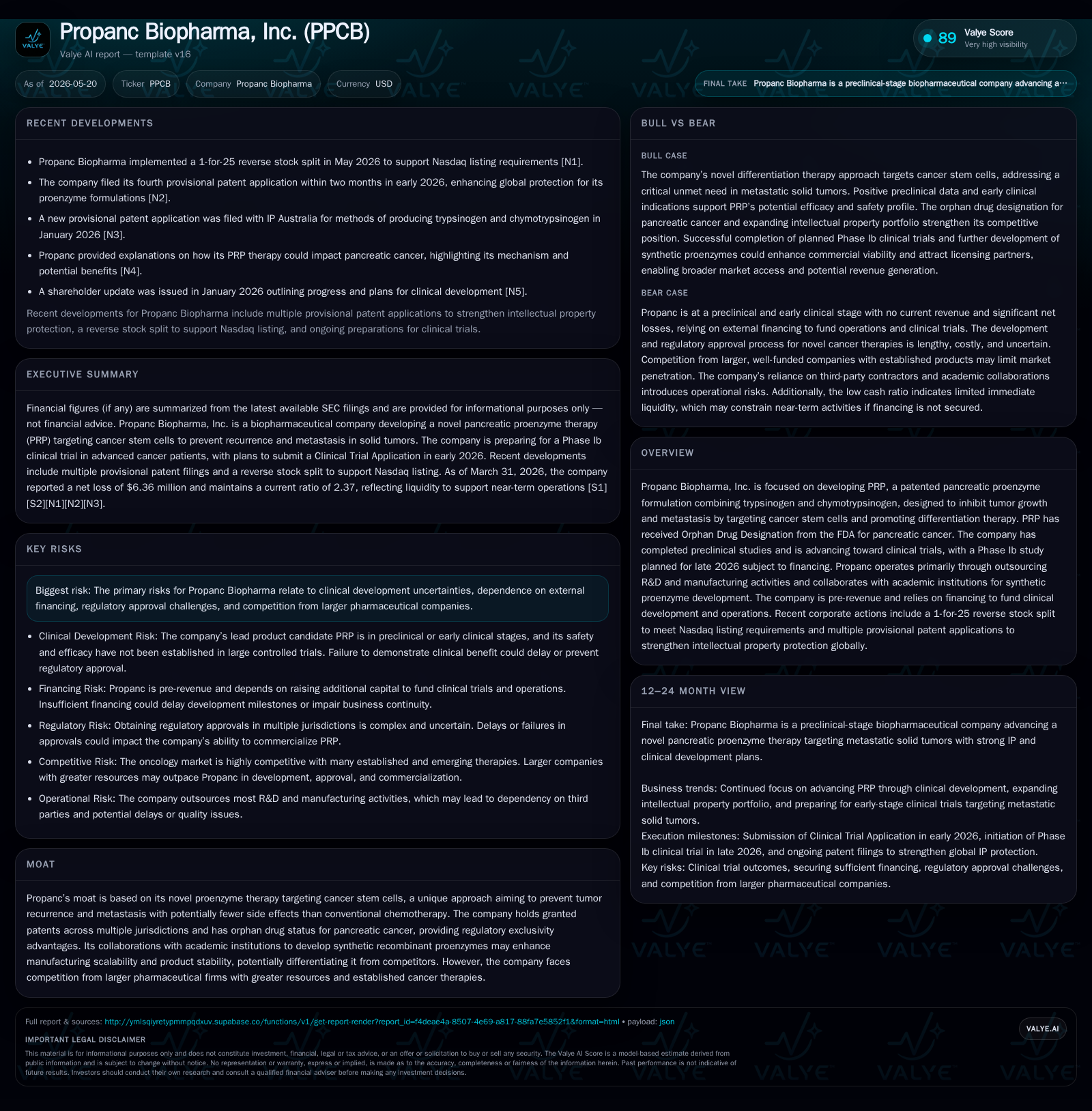
Propanc Biopharma, Inc. is preparing to initiate a Phase Ib clinical trial for its pancreatic proenzyme formulation, PRP, targeting cancer stem cells in advanced solid tumors contingent on securing additional financing. The company recently executed a 1-for-25 reverse stock split to maintain Nasdaq listing standards, underscoring liquidity challenges typical of early-stage biotechs. Operating predominantly through outsourced R&D and manufacturing, Propanc focuses on licensing opportunities post-Phase II milestones while benefiting from orphan drug designation in pancreatic cancer that may afford regulatory exclusivity and competitive differentiation. Key growth drivers center on advancing clinical milestones and potential synthetic recombinant manufacturing innovations, while risks revolve around capital dependency, clinical development uncertainty, and competition from larger pharmaceutical companies.
Recent Quarterly Update and Market Listing Developments
In the company’s most recent SEC filing dated May 14, 2026 (10-Q), Propanc disclosed that it plans to initiate a First-In-Human (FIH) Phase Ib study evaluating its PRP proenzyme therapy in patients with advanced solid tumors during the second half of calendar year 2026. This plan is expressly contingent on securing additional financing necessary to fund the study's anticipated operational costs [S2]. Alongside this development timeline, the company has completed preliminary regulatory dossier preparations including Investigational Medicinal Product Dossier compilation and Clinical Trial Application (CTA) preparation targeted for submission by mid-2026. Following submission, the regimen includes procuring ethical approvals, selecting contract research organizations (CROs), analytical labs, and trial sites, with patient enrollment expected by October 2026 if milestones hold [S1].
Concurrently, Propanc implemented a 1-for-25 reverse stock split as reported on the same day via Nasdaq news sources. This corporate action aims at restoring compliance with Nasdaq's minimum bid price listing requirements after persistent pricing pressure on the common stock [N1]. The reverse split underscores typical liquidity challenges faced by early developmental biotech firms operating without commercial revenues. Maintaining Nasdaq listing preserves vital access to public capital markets essential for funding upcoming trial expenditures.
These developments collectively frame Propanc's current operational inflection point: progressing from preclinical status toward pivotal clinical evaluation while managing capitalization limitations inherent for an emerging biotech.
The PRP Proenzyme Therapy: Business Model and Scientific Proposition
Propanc’s core asset is PRP—a proprietary pancreatic proenzyme formulation combining two inactive enzyme precursors, trypsinogen and chymotrypsinogen. Scientifically grounded in modulation of biological pathways mediated by pancreatic enzymes, PRP targets cancer stem cells implicated in tumor growth, metastasis, and recurrence across pancreatic, ovarian, and colorectal cancers. This novel therapeutic mechanism proposes differentiation therapy as opposed to cytotoxic chemotherapy, aiming for reduced systemic toxicity and improved patient quality of life [S1].
PRP currently resides in preclinical development phases with successful animal or in vitro proof-of-concept studies completed. The business model hinges on reaching value inflection points through measurable clinical efficacy milestones—principally after Phase II proof-of-concept data—thereby catalyzing licensing discussions with large pharmaceutical entities or strategic partners who would assume late-stage development and commercialization responsibilities [S8][S1]. Licensing deals would entail milestone payments supplemented by royalties governed by regional sales post-approval.
Key differentiators include granted patents protecting PRP's unique composition across major global jurisdictions alongside orphan drug designation for pancreatic cancer granted by the FDA—the latter providing protocol assistance incentives, fee waivers, tax credits on US-based trials, plus seven years of market exclusivity post-approval under the Orphan Drug Act [S1][S23]. These elements collectively strengthen entry barriers against generic competitors and extend time-value capture opportunity
Operationally, Propanc employs an outsourcing-centric R&D strategy engaging specialized external providers for compound synthesis (including synthetic recombinant forms under academic collaboration), preclinical activities, manufacturing processes, regulatory tasks, and planned clinical execution. This approach minimizes fixed overhead costs while allowing flexible scaling aligned with milestone progression but limits internal control over critical path activities [S8][S24].
Industry and Competitive Setting: Oncology Therapeutics Targeting Cancer Stem Cells
The oncology therapeutics landscape is intensely competitive with significant R&D investments by well-capitalized pharmaceutical companies seeking innovative drugs targeting tumor biology mechanisms such as immune modulation or targeted apoptosis pathways. Propanc’s focus on cancer stem cells represents a relatively less crowded niche emphasizing differentiation rather than direct cytotoxicity.
While first-in-class innovation offers potential first-mover advantages including premium pricing prospects contingent on superior safety/efficacy profiles, such pioneering products face stiff regulatory scrutiny evidencing safety over standard regimens as well as clinician adoption hurdles rooted in entrenched prescribing behaviors and reimbursement climates [S9][S10]
Regulatory considerations amplify complexity: multiple approvals across divergent geographies including FDA (US), EMA (EU), TGA (Australia), among others are required with CTA authorization preceding marketing applications. Pricing power will be tempered by government payor controls especially outside the US where cost containment policies dominate pharmaceutical reimbursement strategies—factors necessitating robust health economics data supporting overall value propositions beyond pure efficacy endpoints [S10][S12]
Within this context, Propanc remains focused on leveraging its orphan drug status as a means not only of regulatory expedience but also as a partial competitive moat given the lower prevalence but high unmet need environment characterizing pancreatic cancer treatment markets.
Growth Catalysts: Clinical Milestones, Licensing Potential, and Market Entry
The pipeline advancement through discrete clinical milestones constitutes primary growth drivers for Propanc. Immediate emphasis lies on completing CTA compilation soon followed by ethical approvals and logistical trial readiness activities slated throughout H1-H2 2026 leading up to Phase Ib initiation targeting advanced solid tumor cohorts with comprehensive endpoints encompassing safety profiles, pharmacokinetics variability assessments, and preliminary signals of anti-tumor efficacy [S1][S20]
Successful demonstration of safety combined with early efficacy signals during Phase Ib will underpin further progression into Phase IIa proof-of-concept trials anticipated within three to four years horizon per company disclosures—a timeline informing secondary valuation inflections linked to licensing negotiations. The company explicitly targets partnerships triggered by data supportive of compelling efficacy profiles suitable for accelerated regulatory pathways or conditional marketing authorizations especially given orphan indications [S24][S6].
Collaboration with academic institutions yielding synthetic recombinant production capabilities marks a promising avenue toward scalable manufacturing that could improve product consistency and margins relative to animal-derived formulations; this technical innovation may appeal to prospective licensors concerned about supply chain robustness critical for market penetration [S16][S21]
Moreover, Propanc indicates intentions to explore early-stage preventative indications based on genetic risk stratification—potentially expanding addressable populations beyond late-stage advanced disease thus enhancing commercial viability.
Risks and Constraints: Financing Dependency, Clinical Uncertainties, and Competitive Challenges
Propanc operates under classical biotech industry risk parameters prominently featuring dependence on external equity or debt financing events essential for funding expensive clinical trials commencing imminently per schedule [S2][F1]. Failure or delay in capital raising could significantly impair trial launch timing or continuation thereof given constrained cash reserves reported in recent financials.
Clinical development uncertainties persist given unproven human safety or efficacy profiles despite encouraging preclinical data; failure at any pivotal stage can diminish valuation markedly or extinguish program viability altogether. Regulatory approval timelines are additionally subject to variability tied to each jurisdiction’s review frameworks potentially impacted by evolving health authority guidelines especially amid geopolitical shifts like Brexit influencing EMA operations [S10][S28]
Competitive pressure from pharmaceutical incumbents possessing larger R&D budgets may accelerate competing product launches ahead of Propanc’s entrance thereby eroding first-mover advantages or narrowing market exclusivity windows; likewise patient recruitment competition can affect trial enrollment pacing constraining operational execution fluidity [S9][S14]
Lastly internal team size remains minimal—with only one full-time employee reported as of mid-2025—the company continues reliance on external consultants increasing coordination complexity risks alongside intellectual property enforcement challenges despite extensive patent filings protecting proenzyme compositions internationally [S9][S18]
What to Watch: Upcoming Regulatory Filings, Trial Initiations, and Capital Raises
Investors should track several key milestones indicative of program execution success:
- Completion of CTA submission targeted for June-July 2026 followed by regulatory approval anticipated shortly thereafter enabling trial commencement protocols [S20].
- Initiation of Phase Ib trial patient dosing expected starting October 2026 marks definitive transition from preparatory stages into active clinical development reporting timeline within next twelve months post-initiation.
- Ongoing licensing partner engagement updates reflecting interest generated from emerging clinical data set expansion beyond currently limited discussions primarily focused at preclinical phase level [S6].
- Capital market activities supporting liquidity replenishment particularly following reverse split action remain crucial; signs of successful funding rounds proximate to H2 2026 will be material enablers sustaining operational continuity through critical study phases [N1][S2].
Monitoring enrollment velocity once trials commence also offers early signals regarding investigator site effectiveness and patient acceptance which can presage feasibility for subsequent larger scale studies required for definitive approval pathways.
Brief Financial Overview: Current Liquidity and Funding Outlook
As per the latest financial snapshot ending March 31, 2026, Propanc holds approximately $93K in cash and equivalents as of March 31, 2023 per earlier fact files, with more recent interim figures reflecting current assets totaling roughly $8.22 million versus current liabilities near $3.48 million resulting in a current ratio around 2.37 suggesting short-term solvency capability [S2][F1]
Operating losses are substantive consistent with development-stage status — net income loss reported north of $58 million as recent annual results indicate no revenue generation at present phase emphasizing dependence entirely upon outside funding sources made increasingly difficult amid volatile small biotech equity volatility profile.
Financial stewardship intentions prioritize tightly managed fixed/variable cost structures supported through outsourcing arrangements consistent with sector practice aimed at minimizing burn rate extensions until milestoned value accrual events materialize.
This analysis is based solely on information contained within cited SEC filings and related disclosed news up to May 2026 without speculative assumptions beyond presented evidence. It does not constitute investment advice but aims at providing a comprehensive evaluation grounded strictly in sourced corporate disclosures.
Disclaimer: This is research-only, informational analysis and not investment advice. It may include AI-generated interpretation and general industry context. Always verify important details using primary sources.

Comments