
Perimeter Solutions’ Strategic Shift After Record Loss Spurs Reinvestment and Market Diversification
Analyzing how Perimeter’s substantial 2025 loss paired with robust cash flow drives a new focus on diversification and capital deployment.
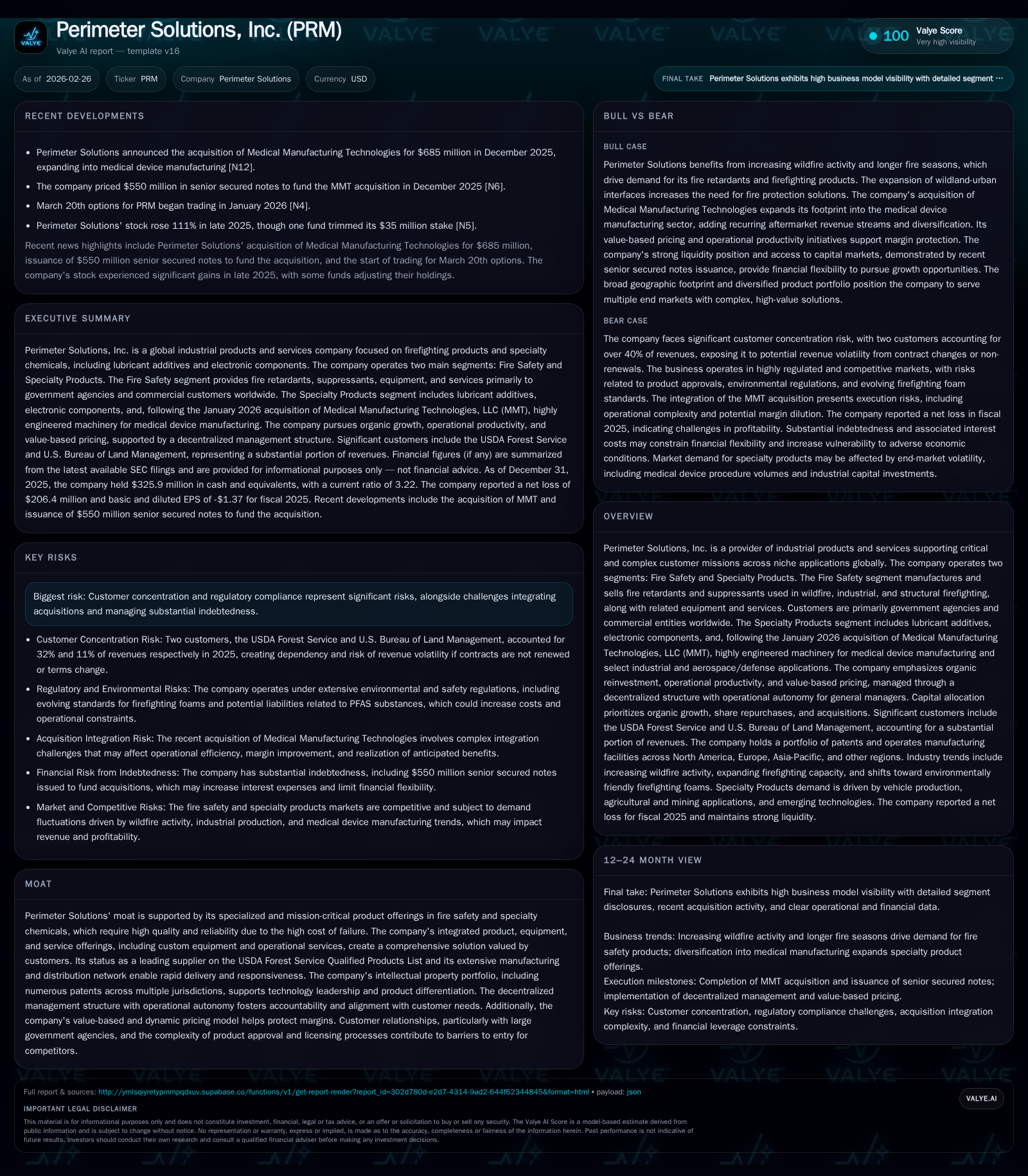
Perimeter Solutions, Inc. endured a sharp financial setback in fiscal 2025, marked by record operating and net losses surpassing $200 million, despite generating strong operating cash flow exceeding $238 million and free cash flow over $208 million. The company operates in two specialized segments: Fire Safety, supplying critical fire retardants mainly to government customers such as the USDA Forest Service and Bureau of Land Management; and Specialty Products, recently augmented by its acquisition of Medical Manufacturing Technologies (MMT), which broadens its exposure into medical device machinery. While customer concentration and complex regulatory compliance remain significant risks, Perimeter is actively reinvesting in organic growth, expanding markets via MMT integration, and maintaining disciplined capital allocation including buybacks amid financial pressure. Monitoring the impact of seasonal wildfire trends, government contract renewals, and regulatory developments will be key to assessing Perimeter's evolving trajectory.
Navigating a Pivotal Year: 2025 Financial Performance Review
Perimeter Solutions confronted a stark reversal in profitability in fiscal year 2025. Operating income plummeted from a positive $94.45 million in 2023 to a significant operating loss of approximately $201 million in 2025—a decline representing a staggering -5234% year-over-year change. Net income mirrored this downturn, tumbling from a $67.49 million profit in 2023 to a net loss exceeding $206 million in the same period (-3395% YoY). Notwithstanding these headline losses, the company generated strong operating cash flow totaling roughly $238 million for the year—a robust increase of 26.4% compared with 2024—and produced free cash flow near $209 million after capital expenditures rose sharply by over 90% to nearly $30 million [F1].
This acute decoupling between accounting earnings and cash generation reveals underlying operational resilience, particularly within cash cycles and working capital management. It also contextualizes management’s strategic decisions to maintain aggressive organic reinvestment alongside opportunistic share repurchases amounting to approximately $40 million in that challenging year—signaling confidence in long-term value creation despite near-term earnings pressures [F1]. The company also recorded an improved current ratio around 3.22 at year-end, pointing to strong short-term liquidity buffers even as net profitability suffered [F1].
Historical performance (annual)
| FY | Net ($mm) | CFO ($mm) | OpInc ($mm) | Capex ($mm) | Net YoY |
|---|---|---|---|---|---|
| 2025 | -206 | 238 | -201 | 30 | -3394.8% |
| 2024 | -6 | 188 | -4 | 16 | -108.7% |
| 2023 | 67 | 0 | 94 | 9 | -26.5% |
| 2022 | 92 | -40 | 130 | 9 |
Source: SEC companyfacts cache [F1].
Capital returns and efficiency (annual)
| FY | Buybacks ($mm) | FCF ($mm) | ROE% |
|---|---|---|---|
| 2025 | 40 | 209 | -18.2 |
| 2024 | 14 | 173 | -0.5 |
| 2023 | 64 | -9 | 5.9 |
| 2022 | 49 | -49 | 8.1 |
Source: SEC companyfacts cache [F1].
Table: Historical Financial Performance of Perimeter Solutions, Inc., highlighting extreme earnings volatility contrasting with solid operational cash flows.
Fire Safety Segment: Historical Drivers and Market Dynamics
The Fire Safety segment remains Perimeter’s primary commercial foundation, manufacturing fire retardants critical for wildfire suppression as well as industrial and structural firefighting purposes worldwide [S7]. Key customers are concentrated among government agencies tasked with land protection—most prominently the USDA Forest Service and the U.S. Bureau of Land Management—which collectively contributed about 43% of consolidated revenues in fiscal year 2025 [S4]. These sizable customers operate under highly specialized procurement frameworks that affect contract terms and revenue recognition.
Products range widely by form factor—liquid or powder concentrates—and are tailored by chemical properties such as visibility, viscosity, adherence to vegetative fuels, and weather persistence [S7]. This product differentiation supports customer-specific operational demands where failure risk is prohibitively high—the “cost-of-failure” concept underscores these products’ mission-critical stature affecting ecosystem safety and firefighter lives alike.
Demand patterns display marked seasonality tied closely to wildland fire seasons which typically span April through September across major U.S. markets; therefore, quarterly revenues fluctuate significantly with wildfire occurrence intensity, length, geography shifts, and air tanker availability [S17]. Demand uncertainty is compounded by regulatory approval processes requiring rigorous environmental toxicity testing, stability validation under USDA Forest Service standards, National Environmental Policy Act consultations, and coordination with agencies like the EPA [S7][S22]. These approvals erect high barriers against entrant competitors while ensuring product safety for ecosystems affected by aerial retardant applications.
Specialty Products Segment and Medical Manufacturing Acquisition Impact
The Specialty Products division provides diversification beyond fire safety into lubricant additives (notably phosphorus pentasulfide known as P2S5), electronic components through its Intelligent Manufacturing Solutions unit, and now medical device machinery following Perimeter’s January 2026 acquisition of Medical Manufacturing Technologies LLC (MMT) [S10][S11][S6].
P2S5 serves as a critical precursor in lubricating oils production; however, demand could face headwinds over time due to the gradual proliferation of electric vehicles reducing internal combustion engine usage globally—an emerging secular risk noted by management [S1]. Beyond motor oils, ancillary applications include pesticides intermediates in agriculture, flotation agents for mining operations, certain battery technologies development, as well as hydraulic fluids sustained demand [S17].
MMT expands Perimeter’s footprint into highly regulated FDA-oversight industries manufacturing advanced machinery for catheter and guidewire production among other medical devices—a field where customer demand correlates directly with procedural volumes and medical device launch cadences plus capital budgets within healthcare OEMs [S11][S25].
However, integration presents non-trivial challenges: MMT’s regulatory environment is distinct from Perimeter’s legacy operations requiring conformance with FDA quality systems regulations (QSR), ISO certifications, ongoing audits for compliance maintenance—and any lapses could jeopardize customer trust or contract continuity [S6][S25]. Additionally, MMT operates across roughly fourteen manufacturing sites serving over fifty countries which necessitates establishing new sales channels globally—a task requiring operational agility amidst ongoing macro uncertainties.
Customer Concentration Risks and Regulatory Landscape
Perimeter’s concentrated client base embodies both strength and significant risk exposure. In Fire Safety alone, contracts with the USDA Forest Service and Bureau of Land Management constitute approximately one-third and one-tenth of total revenue respectively; California state firefighting agencies also comprise material exposure resulting in geographic concentration focusing largely on North America [S4][S12].
These agencies commonly engage Perimeter on “as-needed” purchase orders lacking guaranteed minimum volume thresholds; thus any reduction or deferment—potentially triggered by favorable fire seasons or budgetary constraints—from these entities can cause volatile revenue swings quarter-to-quarter [S11][S12]. Moreover, disclosure highlights volume-based discounts granted upon renegotiations which compress gross margins further reflecting pricing power compromises under dominant customer bargaining positions [S1][S12].
As a government contractor segment supplier subject to heightened scrutiny risks including audits, investigations or contract terminations for convenience default rights—as underscored under U.S federal procurement regulations—any adverse findings could materially impact future business opportunities or financial obligations including penalty repayments or suspension/debarment from future contracting programs [S19].[N1]
Litigation represents another latent pressure point primarily centered on aqueous film forming foam (AFFF) legal proceedings consolidated within multi-district litigation addressing alleged contamination from fluorinated surfactants linked to multiple defendants including legacy assets connected via acquisitions like Solberg acquired in early 2019 by Perimeter from Amerex [S20]. While indemnity claims have largely been curtailed post-2021 contractual cutoffs providing some limitation exposure windows—the multidistrict proceedings continue presenting uncertainty both financially due to potential liabilities but also reputation-wise causing cautious buyer behavior until settled conclusively [S15][S20].[N1]
Future Prospects: Growth Catalysts and Emerging Challenges
Looking ahead, growth within Fire Safety aligns closely with increasing wildfire severity trends attributable to climate change alongside expanding Wildland-Urban Interface (WUI) areas that heighten firefighting demand potential—though subject always to seasonal variability nuance which requires careful earnings volatility monitoring each fiscal cycle [N1][S1][S4].[N6]
Innovation plans targeting foam market expansion—particularly fluorine-free foams anticipated to grow their market share substantially versus traditional fluorinated foams facing regulatory challenges—constitute targeted drivers intended to consolidate industry leadership domestically plus internationally where demand shifts are forecasted [S17].[N1]
In Specialty Products,the recent MMT acquisition offers diversification potential albeit intertwined with execution-dependent risks given unfamiliar regulatory regimes plus evolving medical device sector dynamics; product quality controls together with timely new product introductions remain critical success factors here.[N1]
Meanwhile operational value drivers emphasizing value-based dynamic pricing strive to preserve attractive margin profiles partially offsetting input cost inflation pressures transmitted through raw material supply chain disruptions noted in specialty chemicals manufacturing broadly.[S14] Macro uncertainties—including changing wildfire frequency predictions plus policy shifts regarding chemical usage approvals—represent ongoing headwinds requiring sustained adaptive management effort.
Capital Allocation in Action: Reinvestment, Buybacks, and Debt Management
Perimeter publicly delineates its disciplined capital deployment hierarchy favoring first organic investment into growth areas yielding attractive returns before pursuing opportunistic share repurchases—which reached $40 million in fiscal year 2025—and subsequently acquisitions targeting portfolio diversification consistent with broader corporate strategy themes focused on sustained per-share equity value creation akin to private equity investor models.[F1][S29]
Despite earnings irregularities resulting from extraordinary impairment or restructuring charges contributing heavily to reported losses,the company maintained substantial operating cash flows exceeding capex outlays allowing free cash flow generation supporting continued buyback activity demonstrating a focus on shareholder-aligned capital returns even amid turbulence.[F1] Equity base remained stable nearing $1.13 billion at year-end with manageable leverage metrics not detailed herein but supported by liquidity ratios exhibiting ample short-term solvency cushions underpinning financial flexibility standing at over three times current assets versus liabilities.[F1]
What to Watch: Key Upcoming Milestones and Industry Developments
Near-term investors should carefully observe integration progress following the January acquisition of Medical Manufacturing Technologies—monitoring whether expected synergy realization occurs seamlessly without undue operational disruption or compliance lapses given FDA-regulated environment complexities.[N1]
Renewal negotiations of sizable government contracts including long-term agreements covering USDA Forest Service and Bureau of Land Management provide crucial revenue cadence visibility—their outcome will shape sales trajectories significantly.[N1][N5]
Seasonal wildfire activity forecasts constitute important barometers for expected volume fluctuations driving fire retardant demand; unfavorable fire seasons could transiently depress sales while severe conditions would reinforce growth narratives.[N6]
Regulatory developments especially those impacting firefighting foam classifications around PFAS substances require close attention given potential product reformulation costs or market access restrictions that might impinge on competitive positioning.[N1]
Lastly,the emergence of options trading activities indicates evolving market sentiment capturing expectations on volatility scenarios applicable to PRM stock price performance warranting diligent scenario analyses.[N5]
Disclaimer: This report is prepared solely for informational purposes based on publicly available data from official filings ([F1]/[S#]) and recent news ([N#]). It does not constitute investment advice or recommendations nor imply assurance about future company performance. Readers should conduct independent analysis considering their own circumstances before making any investment decisions.
Disclaimer: This is research-only, informational analysis and not investment advice. It may include AI-generated interpretation and general industry context. Always verify important details using primary sources.

Comments