
Provident Financial Holdings: Regional Community Bank Navigating Concentrated Market Dynamics
Provident Financial Holdings leverages deep local market penetration in Southern California’s Inland Empire through community-focused banking and real estate lending, balancing interest rate sensitivity with geographic concentration risks amid competitive pressures.
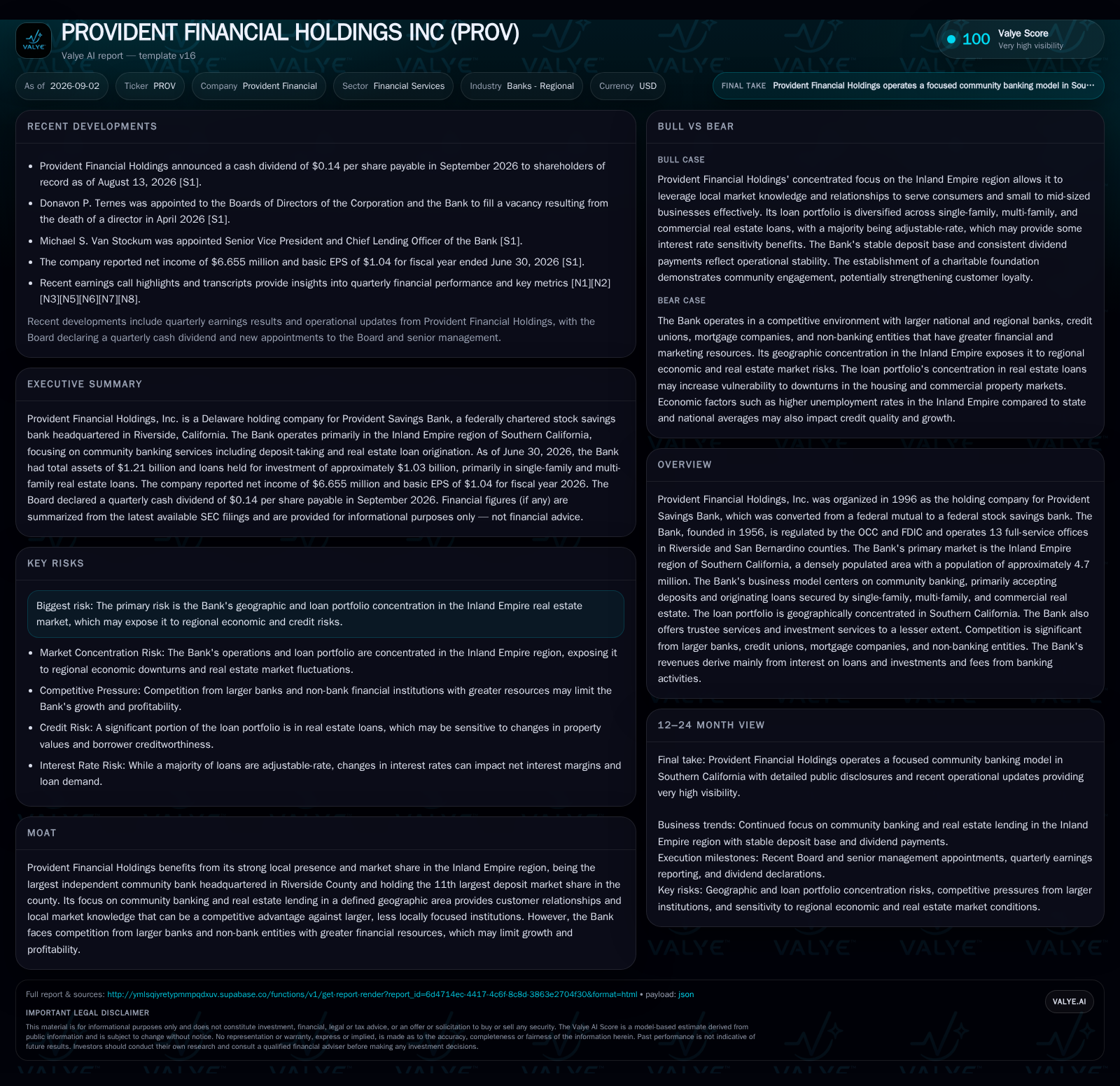
Provident Financial Holdings operates a $1.2 billion regional bank centered on the Inland Empire, emphasizing adjustable-rate residential and multi-family real estate loans. While its local market expertise supports stable deposit gathering and community ties, its concentrated loan portfolio and competition from larger institutions present key risks. Its earnings and dividend consistency reflect operational discipline, but future performance hinges on regional economic resilience, credit quality, and interest rate dynamics.
Provident Financial Holdings, a Delaware holding company for Provident Savings Bank, operates a focused community banking franchise in Southern California’s Inland Empire. With $1.21 billion in assets and a loan portfolio predominantly secured by single-family and multi-family real estate, the bank’s business model is deeply rooted in regional market dynamics. Approximately 90% of its loans are adjustable or floating rate, offering some insulation against rising interest rates but also exposing earnings to rate volatility. Provident’s competitive positioning relies on entrenched local relationships and market knowledge, yet the firm faces significant challenges from larger banks and alternative lenders. Its recent financial results, management changes, and dividend policies illustrate a measured approach amid an economic environment that tests the resilience of regional banks focused on real estate lending.
Latest Operating Snapshot
As of June 30, 2026, Provident Financial Holdings reported total assets of $1.21 billion and total deposits of $910.4 million, with stockholders’ equity at $126.2 million, reflecting a moderate capital base for a regional bank [S1]. The loan portfolio, which represents 85% of total assets, is primarily composed of single-family (55%), multi-family (38%), and commercial real estate loans (6.5%), concentrated geographically in the Inland Empire region [S1].
Earnings for the fiscal year ended June 30, 2026, showed net income of $6.655 million and basic earnings per share of $1.04, accompanied by a declared quarterly dividend of $0.14 per share payable in September 2026 [S1]. Approximately 90% of loans held for investment are floating or adjustable rate, positioning the bank to benefit from prevailing interest rate environments but also exposing it to funding and loan repricing risks [S1]. Recent board and senior management appointments indicate a focus on governance continuity amidst operational pressures [S1].
Business Model and Unit Economics
Provident Financial’s revenue generation centers on net interest income derived from lending activities, primarily secured real estate loans that constitute the majority of its $1.03 billion loan portfolio. Interest income variability is driven by the high proportion of adjustable-rate loans, which allows the bank to respond more quickly to changing interest rate environments compared to fixed-rate loan portfolios. Fee income from community banking activities supplements interest earnings but is a smaller contributor.
From an operating leverage perspective, Provident’s cost structure is influenced by its 13 full-service branches, personnel costs, and regulatory compliance expenses inherent in a federally chartered savings bank. Capital intensity is moderate; loan growth requires incremental capital allocation and deposit funding, but the bank’s relatively small scale limits potential economies of scale. Operating leverage may emerge if loan volume expands in a stable credit environment, but regional economic sensitivity and competitive pressures could constrain margin expansion.
Moat, Competition and Counterforces
Provident’s moat is primarily geographic and relational, anchored by its status as the largest independent community bank headquartered in Riverside County and holding the 11th largest deposit market share there. Its community banking model fosters localized customer relationships and regional market expertise, which can create switching frictions for retail and small business customers seeking personalized service and local decision-making.
However, this localized moat is challenged by competition from larger national and regional banks with greater capital, technology platforms, and marketing budgets, as well as credit unions and non-bank lenders offering mortgage and consumer finance products. The Inland Empire’s economic cycles and real estate market volatility exert countervailing pressures on asset quality and loan demand, limiting the bank’s growth runway and pricing flexibility.
Bull Case
In an optimistic scenario, Provident leverages its deep local knowledge and community trust to expand market share in the Inland Empire, especially among small to mid-sized businesses and owner-occupied real estate borrowers underserved by larger institutions. The adjustable-rate loan portfolio enables the bank to maintain net interest margins as rates rise, while stable deposit inflows reinforce funding resilience. Growing fee income from ancillary services and modest branch network efficiency improvements contribute to operating leverage.
Supporting evidence would include sustained loan growth exceeding regional GDP, stable or improving credit quality metrics despite economic variability, and consistent dividend payments signaling confidence. Falsification would occur if loan delinquencies rise materially, deposit attrition accelerates, or competitive pressure forces margin compression, undermining earnings stability.
Base Case
Under the base case, Provident maintains its current operational footprint with modest loan growth aligned with regional economic trends and real estate market conditions. The adjustable-rate exposure cushions net interest income against moderate interest rate fluctuations, but competitive intensity limits substantial margin expansion. Credit quality remains stable, supported by the bank’s underwriting discipline and geographic familiarity, while dividend continuity reflects prudent capital management.
This scenario assumes that regional employment and housing markets remain steady without significant downturns, allowing the bank to sustain earnings around current levels. Confirmation comes from consistent quarterly earnings, stable deposit bases, and manageable non-performing assets. Conversely, deterioration in any of these metrics or an unexpected regional economic contraction would challenge this outlook.
Bear Case
The downside scenario envisions a pronounced regional economic downturn in the Inland Empire, with rising unemployment and declining real estate values leading to increased loan defaults and impaired collateral values. Provident’s geographic and loan portfolio concentration amplifies its exposure, resulting in elevated credit losses and pressure on net interest margins as loan demand softens and deposit cost increases due to competitive funding pressures.
Additionally, intensified competition from larger banks and non-bank lenders erodes market share and compresses pricing power, while fixed operating costs limit cost flexibility. Dividend cuts or capital raises may follow if earnings deteriorate. Falsification of this scenario would require signs of credit stabilization, improving local economic indicators, or successful strategic initiatives countering competitive threats.
What Matters Next
Key performance indicators to monitor include quarterly loan growth rates and composition by loan type, which reveal demand trends and portfolio diversification dynamics. Credit quality metrics such as non-performing loan ratios, loan loss provisions, and charge-offs will indicate risk management effectiveness amid regional economic conditions.
Net interest margin trends, reflecting the interplay of loan repricing and funding costs, are critical to profitability given the loan portfolio’s adjustable-rate profile. Deposit growth and cost of funds are important to assess funding stability and competitive positioning. Finally, dividend declarations and capital ratios provide insight into management’s confidence in earnings sustainability and regulatory capital adequacy.
Disclaimer: This is research-only, informational analysis and not investment advice. It may include AI-generated interpretation and general industry context. Always verify important details using primary sources.

Comments