
Postal Realty Trust's Growth Driven by USPS Leasing Amid Concentration and Market Risks
Postal Realty Trust commands a unique niche in postal property leasing with steady growth but faces risks tied to USPS financial health and operational reforms.
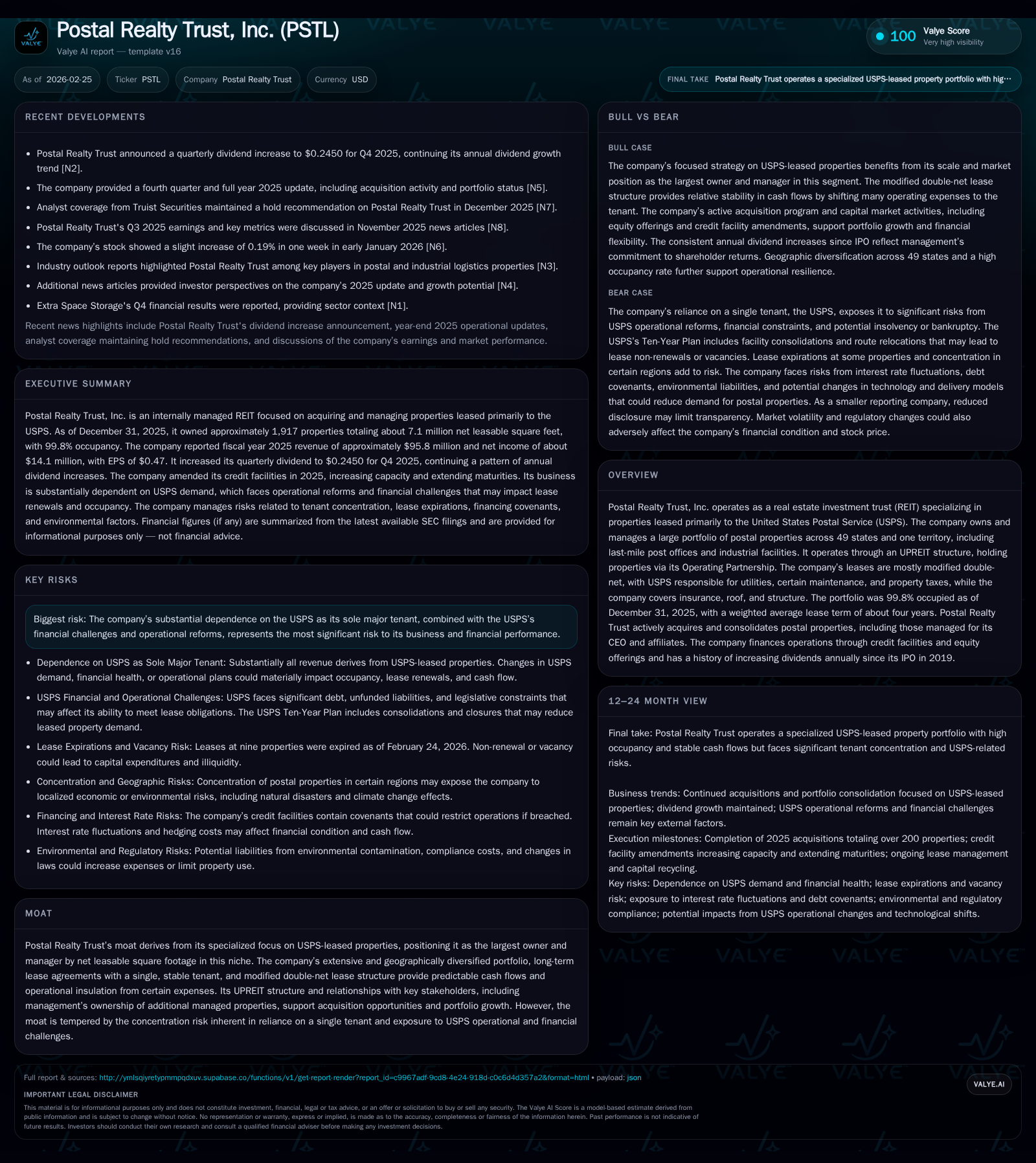
Postal Realty Trust, Inc. (PSTL) operates as the largest owner and manager of properties leased primarily to the U.S. Postal Service, leveraging a specialized portfolio that supports steady revenue growth and high occupancy rates. Its modified double-net lease structure provides predictable cash flows, while acquisitions from related parties enhance consolidation strategies. However, concentration risk due to sole dependence on USPS and ongoing USPS operational changes and financial pressures could materially impact future performance. The company’s capital allocation prioritizes dividends with incremental growth supported by equity raises and amended credit facilities. Key milestones include continued portfolio expansion, lease renewals, and maintaining leverage covenants amid rising interest rates.
Company Overview and Business Model
Postal Realty Trust, Inc. (NYSE: PSTL) is an internally managed real estate investment trust dedicated exclusively to owning and managing properties leased primarily to the United States Postal Service (USPS). Founded in Maryland in 2018 with operations commencing post-IPO in May 2019, PSTL has positioned itself as the largest owner by net leasable square footage in this highly specialized niche [S1],[S16]. The company holds a diversified national footprint encompassing approximately 1,917 properties spread across 49 states plus one U.S. territory totaling roughly 7.1 million net leasable interior square feet [S1],[F1].
Operating through an UPREIT structure via its Operating Partnership—where it holds about 79% ownership—PSTL benefits from acquisition flexibility including OP unit consideration [S1],[S8]. Lease arrangements with USPS are predominantly modified double-net: the tenant handles utilities, certain maintenance obligations, and reimburses property taxes; whereas PSTL retains responsibility for insurance, roofing, and structural upkeep [S1],[S8]. This segregation helps mitigate volatility associated with operating expenses while maintaining lease predictability.
Importantly, Postal Realty Trust manages an additional managed portfolio of over 300 postal properties owned by its CEO Andrew Spodek and affiliates. This affiliation enhances sourcing pipelines: PSTL completed an acquisition of 25 such properties for $13.9 million during fiscal year 2025 and retains rights of first offer on many others [S1],[S8].
Historical Performance and Growth Drivers
Over the last four years up to fiscal year-end (FYE) December 31, 2025, PSTL has demonstrated strong top-line growth fueled largely by sustained acquisitions and high occupancy:
Historical performance (annual)
| FY | Rev ($mm) | Net ($mm) | CFO ($mm) | OpInc ($mm) | Rev YoY | Net YoY |
|---|---|---|---|---|---|---|
| 2025 | 96 | 14 | 45 | 34 | +25.5% | +114.5% |
| 2024 | 76 | 7 | 34 | 21 | +19.9% | +77.8% |
| 2023 | 64 | 4 | 28 | 14 | +19.5% | -3.8% |
| 2022 | 53 | 4 | 25 | 10 |
Note: Omitted columns lack sufficient annual XBRL coverage in the provided tags (need ≥2 annual points): Capex, FCF. Source: SEC companyfacts cache [F1].
Capital returns and efficiency (annual)
| FY | Div ($mm) | Buybacks ($) | ROE% |
|---|---|---|---|
| 2025 | 31 | 5.0 | |
| 2024 | 28 | 0 | 2.6 |
| 2023 | 24 | 558000 | 1.5 |
| 2022 | 22 | 1.7 |
Source: SEC companyfacts cache [F1].
Note: Buybacks modest at $0-$0.56M range except zero in latest years [F1]
This acceleration reflects high-value acquisitions—totaling roughly $123 million in postal properties during calendar year 2025—and efficient portfolio management maintaining near-full occupancy at a strikingly steady rate of ~99.8% [S1],[S8],[F1]. Operating margins improved notably as economies of scale and operating efficiencies increased.
Net income outpaced all prior years substantially in FY2025 due to these factors plus rental escalations embedded within lease agreements and favorable cost structures aligned with modified double-net approach reducing variable costs borne by PSTL.
Operating cash flow increased robustly by nearly one-third year-over-year aided by collection stability due to its single creditworthy tenant model though accompanied by higher capital expenditures principally related to property acquisitions [F1].
Portfolio Composition & Lease Dynamics
PSTL's portfolios cover a spectrum from last-mile retail post offices—critical for customer-facing USPS operations—to larger industrial-style processing facilities integral to parcel handling logistics [S1]. The business is highly concentrated both geographically across most US states but distinctly tenant-wise relying almost exclusively on the USPS (overwhelming majority revenue source) which places a profound emphasis on their operational stability [S16],[S26].
The weighted average lease term stands at approximately four years indicating medium-term contractual visibility though lease expirations pose fallback renewal or re-leasing risks—nine properties’ leases were expired as of Dec '25 [S1],[S12]. This tenant concentration risk is pivotal since any financial distress or strategic consolidation moves by USPS directly impact PSTL’s revenues.
USPS's ongoing Ten-Year Plan involves network optimization efforts including consolidations potentially affecting underutilized facilities that could lead to vacancies or less favorable lease renewals over time [S18],[S24],[S26]. However, expanding parcel volume driven partly by e-commerce had fueled recent growth offsetting traditional mail volume declines [S9].
Importantly industry context notes that the largest USPS customers (Amazon/UPS/FedEx) increasingly internalize logistics capabilities potentially diverting volume away from USPS – triggering long-term demand uncertainty for leased postal properties but increments remain possible where last-mile coverage is necessary.
Capital Structure & Liquidity Management
In September 2025 amendments strengthened PSTL’s debt capacity increasing combined credit facilities to $440 million while extending maturities into late decade (Revolver facility maturity Nov ‘29; Term Loan Jan ‘30) [S4],[S6],[S20],[F1]. Such financing flexibility aids acquisition capitalization alongside equity capital raises.
Interest expense management includes swapping variable-rate exposure into fixed rates via derivatives mitigating rising rate challenges prevalent in commercial real estate markets lately [S19],[S27]. Covenants enforce leverage constraints including fixed charge coverage ratio minimums and total leverage maximums ensuring prudent financial policy compliance amid potential credit market tightening.
Cash balances remain modest relative to total debt but are supplemented strongly by stable operating cash flows ($44M+ annually post-capex), supporting dividend distributions consistently increased annually since IPO inception [S8],[F1]. Buyback activity has been minimal recently signaling capital allocation preference toward growth investments and dividends.
Dividend Policy & Returns Metrics
Postal Realty Trust’s dividend policy focuses on regular quarterly payments supported by REIT distributable earnings requirements mandating at least a ~90% payout of taxable income annually to retain tax status [S8].[F1]
Dividends per share rose modestly by roughly a cent during the last year (from $0.2425 to $0.2450 quarterly) continuing positive momentum reflected also in January '26 dividend announcement [N2]. Total dividend outlays rose commensurately amounting to ~$30.8 million in FY2025 versus $27.9 million the prior year evidencing incremental payout capacity aligned with earnings growth trends.
Approximate return metrics based on latest financial data yield around a low single-digit ROE of ~5%, which may seem conservative compared to more aggressive sectors but is typical within specialized REITs emphasizing stable cash flow yields rather than rapid earnings volatility [F1].
Free Cash Flow calculated as operating cash flow minus capex stands at about $32 million for FY2025 providing cushion for distributions and capital investments.
Future Growth Opportunities & Catalysts
Growth prospects center on further acquisition opportunities leveraging PSTL's market leadership as largest consolidated owner in the sector—and ability to access off-market deals including via relationships tied to CEO-managed portfolios—with an estimated substantial number of smaller owners fragmented within this market segment [S1],[S8],[S16].
Consolidating postal properties can capture scale benefits while filling gaps created by retirements or consolidations of USPS-owned assets nationwide.
Additionally, evolving USPS service dynamics driven by package delivery expansion offer structural revenue upside if growing parcel volumes translate into increased demand or higher rental escalations embedded contractually, although this remains contingent on customer retention trends amid logistic competition noted above [S9].
Monitoring lease renewals will be critical given a modest pipeline of expiring leases that could cap revenue growth if not renewed favorably or replaced promptly.
Legislative or regulatory shifts impacting USPS funding or facility strategies represent major catalysts influencing portfolio utilization rates.
Risk Factors & Challenges
Central risk remains PSTL’s singular reliance on USPS tenancy representing nearly entire revenue base creating concentration vulnerability unlike diversified multi-tenant REITs [S7],[S12],[S13]. Financial distress or insolvency risk inherent at USPS—a government agency facing structural funding deficits despite recent reform legislation—could significantly disrupt rental income streams or trigger lease terminations under federal law frameworks potentially resulting in reduced collections or asset impairments [S7],[S24],[S29].
Operational changes via USPS’s Ten-Year Plan including consolidations could lead to closures or relocations reducing occupied footprint lowering rent rolls unless offset through backfilling leases.[S18],[S26]
Natural disasters or geopolitical disruptions disproportionately expose postal facilities given government attachment posing heightened terrorism or catastrophic event risk beyond typical CRE profiles.[S10]
Environmental compliance costs or latent land liabilities form additional cost uncertainties especially given older building stock being acquired.[S14]
Dependence upon key management personnel particularly those controlling sourcing pipelines including associated party transactions introduces execution risk should leadership change or conflicts emerge limiting deal flow or strategic consistency.[S25],[S27]
Capital markets disruptions impacting refinancing availability amid covenants impose liquidity pressures critical for sustaining distribution policies.[S20],[S22]
What To Watch Next - Upcoming Milestones & Indicators
- Acquisition pace for new postal properties within CEO-affiliated managed portfolios exercising rights-of-first-offer; monitoring pricing trends relative to book valuations.
- Renewal status updates on expiring leases (notably nine expired end-2025); assessing terms impact on rent escalations or vacancies.
- Progress against debt covenant thresholds amidst interest rate shifts; adjustments in hedging positions.
- Quarterly dividend announcements confirming payout policy consistency or adjustments amidst earnings fluctuations.
- Any regulatory developments impacting USPS funding or facility networks affecting occupancy assumptions.
- Changes in USPS parcel volume trajectory from e-commerce competition dynamics influencing long-term rent roll stability.
- Potential entry into joint ventures or diversification moves towards other governmental tenants if pursued.
Summary Implications for Operational Strategy & Capital Allocation
Postal Realty Trust’s stable yet specialized platform anchored by long-term leasing relationships secures recurring cash flows suitable for yielding regular dividends amid measured growth fueled primarily through accretive acquisitions concentrated within manageable geographic dispersion. However market fundamentals tether strongly to U.S Postal Service performance exposing PSTL inherently high single-tenant concentration risk uncommon among most REIT peers necessitating vigilant monitoring of USPS operational reforms and financial conditions alongside conservative balance sheet management including proactive liability hedging strategies. Capital allocation exhibits disciplined commitment towards dividend increases supported by growing funds from operations complemented with selective equity issuance preventing excessive leverage accumulation within covenant limits maintaining investor confidence. While tenants gradually modify mail usage behaviors influenced by technological advances and private courier competition may modulate long-term demand elasticity challenging forecasting precision there remains clear runway converging operational scale advantages through continued consolidation within this niche asset class unique among real estate investment trusts today.
Disclaimer: This analysis is provided solely for informational purposes based on publicly available data as of February 25, 2026, without any investment recommendation or opinion regarding buying or selling securities related to Postal Realty Trust, Inc.. It incorporates disclosures from SEC filings and news reports without speculation beyond stated facts.
Disclaimer: This is research-only, informational analysis and not investment advice. It may include AI-generated interpretation and general industry context. Always verify important details using primary sources.

Comments