
Q/C Technologies Pursues Laser Computing Breakthrough with qc-LPU100 Amid Early Validation Stage
The latest quarter highlights progress on Q/C Technologies’ photonic hardware prototype as it navigates critical development and regulatory challenges.
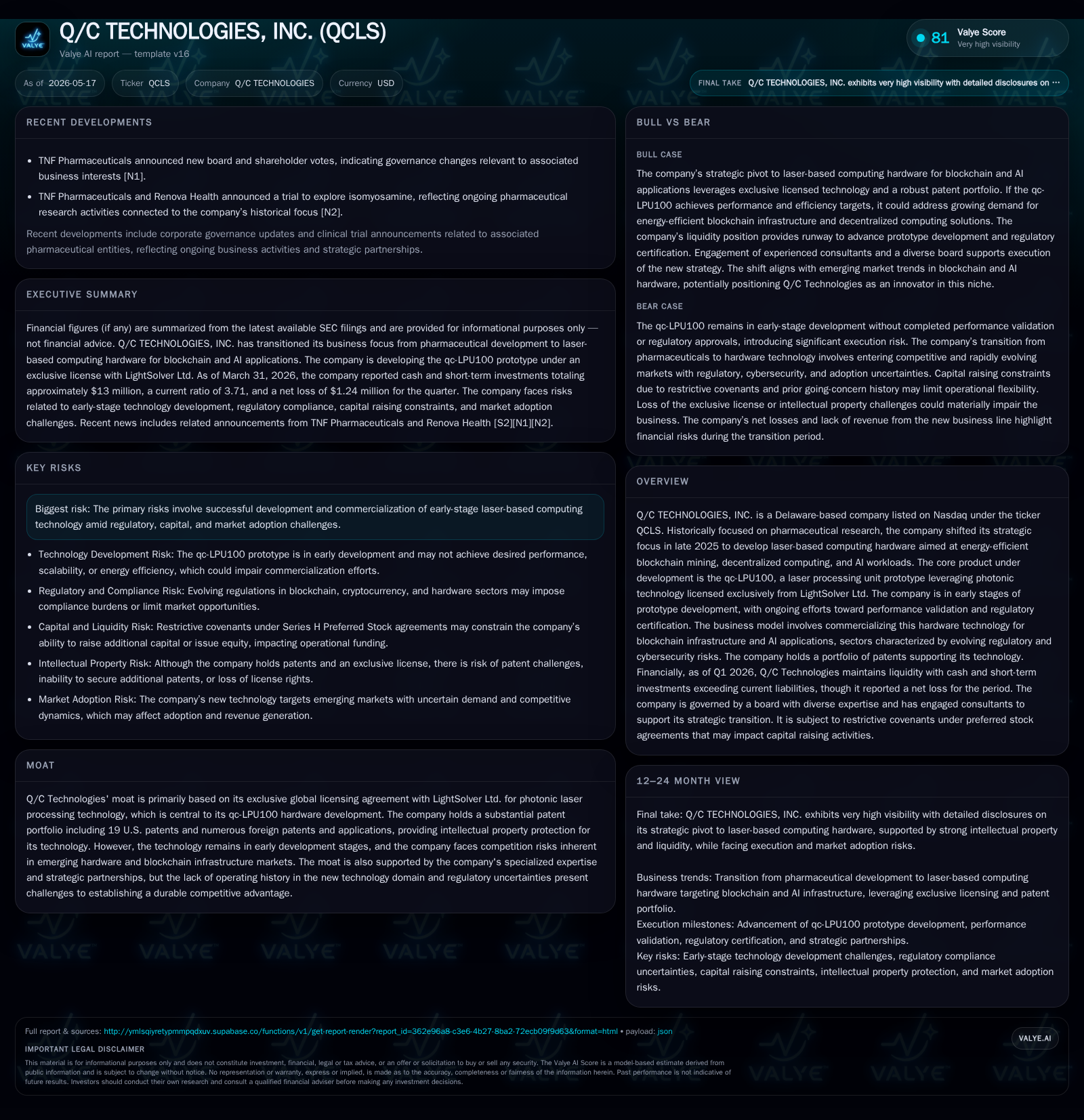
Q/C Technologies, having shifted from pharmaceuticals to laser-based computing hardware in late 2025, is actively advancing its qc-LPU100 prototype aimed at energy-efficient blockchain mining and AI workloads. The company’s exclusive licensing of LightSolver’s photonic technology underpins its IP moat but commercialization remains contingent on successful prototype validation and regulatory approvals. Industry adoption is uncertain given nascent technology risks and evolving regulatory frameworks. Q/C Technologies’ near-term outlook hinges on execution milestones that will demonstrate product viability and unlock growth potential.
Latest Quarterly Operating Update: Prototype Progress and Regulatory Trajectory
In its Q1 2026 10-Q filed May 15, 2026 [S2], Q/C Technologies reports focused advancement on the qc-LPU100 laser processing unit (LPU) prototype. This phase is pivotal as the company works toward validating performance metrics essential for commercial applications in blockchain mining and AI workloads. The filing notes ongoing testing but emphasizes that key milestones like regulatory certifications have not yet been achieved. These regulatory hurdles are critical given the novel photonic computing technology’s application in highly regulated decentralized finance and AI infrastructure markets.
This quarter reflects Q/C’s early-stage status—balancing prototype iterations with strategic partnerships under its exclusive license arrangement. The company has transitioned away from pharmaceutical R&D to complete the technological shift, placing operational emphasis firmly on engineering execution and certification processes.[S2]
Business Model and Technology Offering: The Role of qc-LPU100 and Photonic Innovation
Q/C Technologies generates future revenue primarily through commercialization of its patented laser-based computing hardware targeting energy-efficient blockchain infrastructure and AI computing tasks [S1]. The cornerstone product, the qc-LPU100, leverages photonic technologies licensed exclusively from LightSolver Ltd., which employs light-based processing methods potentially offering substantial speed and energy consumption advantages over traditional semiconductor architectures.
This exclusive global licensing agreement anchors the company's intellectual property moat alongside a portfolio comprising 19 U.S. patents with extensive foreign patents pending or granted across key jurisdictions such as Canada, China, Israel, and Japan [S1][F1]. The company intends to monetize this technology by producing hardware platforms specifically tailored for high-demand blockchain mining nodes and distributed AI computation networks where energy efficiency translates directly into operational cost savings.
However, these revenue mechanics hinge on successfully progressing beyond prototype validation – demonstrating scalability, manufacturability, and compliance with industry regulation—none of which are assured at this nascent stage. Pricing power is expected to derive from differentiated hardware capabilities if performance claims are met but remains unproven [S1].
Market Structure and Competitive Dynamics: Emerging Blockchain and AI Hardware Landscape
The competitive landscape situates Q/C within the frontier segment of laser/photonic computing targeting blockchain validators and AI infrastructure providers [S2][S1]. Traditional semiconductors dominate general-purpose computing; however, their incremental efficiency gains face physical scaling limits. This gap has spurred interest in alternative architectures such as photonics for specific high-throughput workloads.
Nonetheless, switching costs remain high for infrastructure operators due to integration complexity and risk aversion toward unproven platforms. Additionally, supply chain constraints typical in specialized hardware production pose capacity challenges for startups like QCLS. Cybersecurity concerns inherent to decentralized token networks further elevate operational risk profiles [S2]. Regulatory frameworks affecting energy consumption within blockchain ecosystems add compliance complexity that can limit addressable market size or impose costly modifications.
Emerging competitors include established semiconductor firms exploring photonics adjuncts as well as startup ventures developing alternative energy-efficient compute units. QCLS's challenge lies in establishing clear value differentiation supported by patent exclusivity while navigating uncertain adoption timelines amidst this evolving ecosystem.
Key Growth Drivers: Licensing Exclusivity, Patent Portfolio, and Performance Validation Milestones
Growth hinges substantially on Q/C’s exclusive rights to LightSolver’s LPU technology which precludes direct replication by competitors lacking similar access [S1]. Its patent estate adds defensive barriers protecting these innovations through at least 2040 across multiple jurisdictions [F1], enhancing strategic leverage.
Performance validation of the qc-LPU100 represents a critical inflection point—the successful demonstration of speed enhancements coupled with lower power draw would directly correlate with commercial scalability potential and customer acquisition in blockchain validators seeking operational efficiency. These technical milestones are monitored closely as concrete KPIs signaling transition readiness from R&D to revenue-generating production.
Further growth enablers include securing regulatory certifications essential for deployment within regulated decentralized finance settings or AI compute clusters requiring strict compliance documentation [S2]. Additionally, strategic partnerships or early adopter engagements may amplify market penetration once validated design benchmarks are met.
Risks and Constraints: Technology Development, Regulatory Approval, Capital Intensity, and Adoption Challenges
Q/C operates amid substantial technical execution risk inherent to pioneering laser-based computing platforms—prototype delays or failure to meet targeted performance specifications could derail commercialization plans [S2]. Moreover, the dependency on the exclusive licensing relationship with LightSolver introduces counterparty risk should collaboration falter or licensing terms alter unfavorably [S1].
Regulatory approval pathways remain opaque given the innovation’s convergence across emerging blockchain regulations concerning energy use alongside cybersecurity mandates for decentralized networks [S2]. Any setbacks here could postpone product launches or shrink total addressable markets.
Capital constraints represent a persistent challenge given ongoing negative operating income alongside funding demands required to advance prototypes through validation cycles—and potentially scale manufacturing capability later [F1][S2]. Adoption uncertainty also looms; customers may delay investments until product viability is unequivocally demonstrated or alternative technologies gain traction.
Next Steps and Performance Indicators: Monitoring Engineering Progress, Certification Timelines, and Capital Deployment
Stakeholders should closely monitor forthcoming quarterly updates detailing engineering progress milestones including beta prototype performance metrics & endurance testing results reported post-May 2026 filings [S2][S3]. Tracking progress on regulatory submissions or certifications will provide visibility into compliance advances essential for market entry.
Additionally, announcements relating to partnerships or pilot deployments within decentralized computing ecosystems will indicate traction levels. Financial disclosures reflecting continued R&D investment pace or capital raises will reveal runway adequacy amid extended development timelines.
Collectively these metrics offer measurable indicators for gauging shifts from an experimental hardware entity toward a commercially viable infrastructure supplier.
Financial Snapshot: Liquidity Profile and Investment Priorities in Early Commercialization Phase
Latest financial snapshot
| Metric | Value | Period |
|---|---|---|
| Cash & equivalents | $1127619 | |
| 2026-03-31 | ||
| Current assets | $14mm | |
| 2026-03-31 | ||
| Current liabilities | $4mm | |
| 2026-03-31 | ||
| Current ratio | 3.71x | |
| 2026-03-31 |
Source: SEC companyfacts cache [F1].
As of March 31, 2026 ([F1]), Q/C Technologies held cash & equivalents totaling approximately $1.13 million complemented by current assets of $13.7 million against current liabilities around $3.69 million—yielding a healthy current ratio of approximately 3.71 supporting near-term liquidity requirements.
Total debt stands nominal at around $307 thousand (historical residuals), resulting in a net cash position that modestly buffers financial flexibility though does not eliminate funding risks associated with ongoing R&D burn leading to cumulative operating losses exceeding $9.8 million as of end-2025.[F1]
This liquidity profile underpins continued focus on prototype development while highlighting sensitivity to capital market access going forward given intrinsic early-stage business risk parameters. It affirms management’s prioritization of controlled cash deployment towards achieving technical benchmarks requisite for scaling operations.
Disclaimer: This analysis summarizes public SEC filings and related disclosures without providing investment advice or recommendations.
Disclaimer: This is research-only, informational analysis and not investment advice. It may include AI-generated interpretation and general industry context. Always verify important details using primary sources.

Comments