
Quetta Acquisition Corp Pursues Smart Kreate Merger After KM QUAD Deal Falls Through
Quetta Acquisition pivots to a $200 million merger with Smart Kreate following the termination of the KM QUAD deal and recent Nasdaq compliance reinstatement.
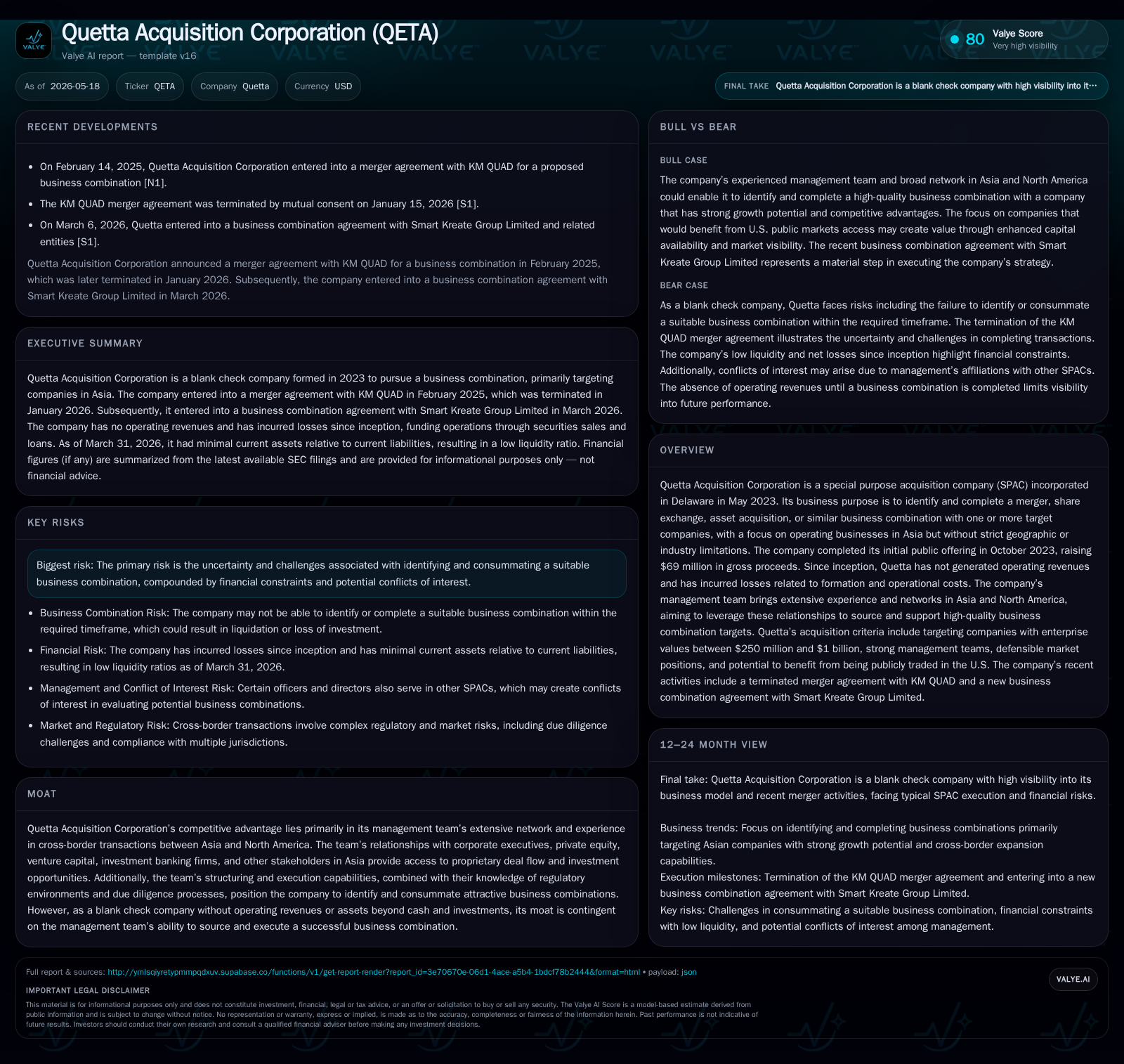
In its latest 10-Q filing dated May 15, 2026, Quetta Acquisition Corp disclosed termination of the prior KM QUAD business combination and announced a new agreement to merge with Smart Kreate Group Limited. Concurrently, an 8-K filing shows the company regained Nasdaq listing compliance after transferring to the Nasdaq Capital Market, removing immediate delisting threats. As a blank check company focused on Asian targets, Quetta’s ability to leverage its management’s cross-border network remains critical to sourcing deals. The upcoming Smart Kreate transaction, valued at $200 million enterprise value, is the centerpiece growth catalyst. However, execution risks remain elevated given prior deal failure and a thin liquidity profile with a current ratio near 0.01.
Latest Operating Developments: Business Combination Pivot and Nasdaq Compliance
Quetta Acquisition Corporation’s latest quarterly report filed on May 15, 2026 ([S2]) marks a pivotal strategic turning point after the failure to consummate its previously announced $300 million KM QUAD merger. The parties mutually terminated that merger agreement effective January 15, 2026 ([S1], [S24]). Shortly thereafter, on March 6, 2026, Quetta entered into a new Business Combination Agreement with Smart Kreate Group Limited ("Smart Kreate"), a Cayman Islands-incorporated company valued at an enterprise level of $200 million ([S1], [S12], [S18]). This two-step transaction involves Quetta merging into a wholly owned Merger Sub under Smart Kreate's parent company structure.
Alongside this deal pivot, Quetta also navigated critical listing challenges. The May 12, 2026 Form 8-K disclosed that following transfer to the Nasdaq Capital Market, Quetta regained compliance with the Minimum Market Value of Listed Securities (MVLS) rule and other applicable listing requirements ([S3]). This regulatory development cancelled a previously scheduled Nasdaq hearings panel which was set to review potential delisting. Regaining compliance removes immediate delisting pressures and provides an operational runway critical for closing the Smart Kreate combination.
This sequence of events underscores Quetta’s strategic agility in rapidly refocusing on new deal opportunities while addressing regulatory risks. The transition away from the KM QUAD deal reflects typical SPAC market dynamics where negotiated transactions can be volatile and contingent on multiple approval hurdles. Nonetheless, regaining listing compliance provides temporary stability that is essential as the company advances toward executing its business combination roadmap.
SPAC Business Model: Deal Sourcing and Execution Focused on Asia
Quetta Acquisition operates purely as a special purpose acquisition company formed in May 2023 under Delaware law with no commercial operations or revenues ([S1], [S13]). Its business model centers exclusively on identifying and consummating an initial business combination – typically via merger or asset acquisition – ideally targeting operating companies in Asia but without restrictive geographic limitations. Since going public in October 2023 by raising approximately $69 million gross proceeds ([N1] inferred from IPO date), Quetta’s financial results simply reflect formation costs, operating expenses related to diligence processes, and professional fees.
Revenue generation is contingent upon successfully completing a business combination whereby post-transaction operating entities contribute earnings streams. Prior to such completion, all costs weigh on net losses. This revenue dependency creates a fundamental binary growth outlook: either Quetta closes a value-accretive merger or remains an empty shell facing capital exhaustion. Therefore, the selection process for high-quality targets encompasses intense due diligence including management interviews, supplier/customer reviews, facility inspections, and regulatory analyses ([S1]).
Pricing power lies predominantly in negotiating equity terms favorable enough to provide prospective upside to combined shareholders while balancing dilution considerations for existing SPAC investors. Volume drivers relate directly to securing one or more suitable counterparties willing to transact within Quetta’s remaining time horizon for completion – presently extended through October 10, 2026 subject to monthly extensions ([S1], [S26]).
Management’s Cross-Border Network as a Competitive Advantage
Quetta’s stated moat principally derives from its management team’s extensive experience executing cross-border transactions between Asia and North America ([S1], [S13]). The leadership team has established long-standing relationships with corporate executives, private equity firms, venture capital funds, investment banks, consultants, family offices, and multinational corporations concentrated in Asian markets. These networks potentially unlock proprietary deal flow inaccessible to more generalized SPAC sponsors competing in commoditized pools.
Beyond sourcing advantages, the team emphasizes structuring expertise gained across various stages of corporate life cycles—enabling tailored transaction engineering encompassing capital allocation strategies and risk mitigation approaches. This expertise also encompasses adept navigation of multi-jurisdictional regulatory environments relevant to complex international mergers commonly observed in Asian deals.
However, such competitive strengths are inherently intangible and contingent upon continuing engagement with ecosystem participants as well as preserving credibility by successfully closing marquee transactions amidst challenging market conditions.
Industry Environment: SPAC Market Dynamics and Regulatory Considerations
The SPAC sector remains under heightened scrutiny post the recent boom years marked by rapid issuance volumes and aggressive deal timelines. Many SPACs encountered difficulties completing targeted acquisitions meeting both investor expectations and regulatory benchmarks related to disclosures and governance practices.
Competition for attractive mid-market private companies has intensified among specialty acquisition vehicles—including those focused on Asia—where valuation premiums can be stiff due to geopolitical uncertainties and currency volatility risks typical of cross-border transactions. Regulatory regimes spanning Delaware incorporation standards along with SEC mandates impose strict timelines (generally two years from IPO) compelling efficient yet thorough deal execution.
Quetta’s emphasis on Asian-focused businesses strategically positions it within an underserved niche benefitting from rising outbound investment flows from Asia-based growth companies seeking exposure to U.S./Western capital markets via de-SPAC pathways. Valued at $200 million enterprise value—down from the earlier $300 million KM QUAD proposal—the transaction affirms management's intent to activate shareholder value via operational scale-up rather than purely financial engineering.
Execution milestones critical for growth realization include securing shareholder approval votes for the merger relationship forthcoming during mid-2026 proxy solicitations; obtaining all requisite regulatory clearances; finalizing merger mechanics involving share cancellations and vehicle reorganizations; followed by systematic integration efforts post-close aimed at amplifying margins through operational synergies.
Beyond initial closure benefits such as liquidity infusions possibly supplemented by PIPE financing arrangements implicit in contemporaneous sponsor support agreements ([S14]), longer-term value depends heavily on leveraging management’s operating support capabilities with Smart Kreate’s existing businesses—thus expanding revenue channels and enhancing profitability profiles.
Risks and Constraints: Deal Execution Uncertainty and Capital Structure Challenges
Despite evident progress toward closing atop fresh opportunities exists considerable execution risk characteristic of blank check vehicles. Termination of the former KM QUAD agreement without consummation signals real transactional fragility impacting investor confidence ([S2], [S25]). Such setbacks also consume time resources crucial given capped organizational lifespans determined by SEC-imposed deadlines unless extensions are secured via costly monthly deposits drawn from trust funds.
Further compounding challenges is Quetta’s precarious liquidity position apparent from latest available balance sheet data showing effectively zero cash & equivalents as of September 30, 2024 and negligible current assets ($21,502) against substantially higher current liabilities approaching $3 million as reported for period ended March 31, 2026 ([F1]).
Moreover, although immediate delisting risk has been mitigated by Nasdaq compliance restoration ([S3]), ongoing valuation minimum maintenance remains a watchpoint owing to strong market sentiment volatility around SPAC shells transitioning post-merger thus sustaining reputational risk factors complementary to structural financial exposures.
Catalysts to Watch: Merger Close Milestones and Market Listing Status Update
Key forward-looking milestones revolve around:
- Shareholder vote schedule expected before October 2026 covering approval for Smart Kreate Business Combination.
- Completion of all customary conditions including regulatory approvals outlined in Business Combination Agreement documentation ([S18], [S20]).
- Final updates regarding ongoing Nasdaq listing status announcements confirming sustained MVLS adherence post-combination closure ([S3], [S5]).
- Proxy statement filings providing transparency into shareholder perspectives plus possible conference calls detailing integration plans following merger consummation. Collectively these events will chart Quetta’s progression from an inactive SPAC shell toward operationally relevant entity status capable of delivering sustainable shareholder returns.
Financial Overview: Current Liquidity and Operational Burn
From a financial perspective supported by [F1] metrics reported through Q1 calendar year-end Mar ‘26 ([F1]), Quetta maintains zero total debt but reports virtually no cash & equivalents last disclosed Sept ‘24—a severe limitation for ongoing operations requiring urgency around capital infusion linked directly to closing new business combinations ([F1]).
Current liabilities significantly overshadow minimal current assets driving working capital deficits exceeding $2.9 million indicative of stretched liquidity conditions reflecting accumulated payables primarily associated with organizational overheads attracted since inception without offsetting revenue inflows ([F1]). Historical net losses totaling approximately $780 thousand as most recently recorded year-end Dec ‘25 further illustrate pre-combination cost burdens without offsetting income streams ([F1]).
This financial snapshot corroborates thematic analysis emphasizing operational survival reliant on swift successful consummation of Smart Kreate transaction or alternative financing events designed explicitly for bridging until positive cash flow generation begins post-merger closure.
This analysis is prepared solely for informational purposes based on reviewed SEC filings; it does not constitute investment advice or research views regarding any securities discussed herein.
Disclaimer: This is research-only, informational analysis and not investment advice. It may include AI-generated interpretation and general industry context. Always verify important details using primary sources.

Comments