
Ethereum Price Swings and Regulatory Uncertainty Shape Galaxy Ethereum ETF’s 2025 Performance
The Galaxy Ethereum ETF reflects ether’s volatility, regulatory challenges, and strategic share repurchases amid widening losses in its first full year.
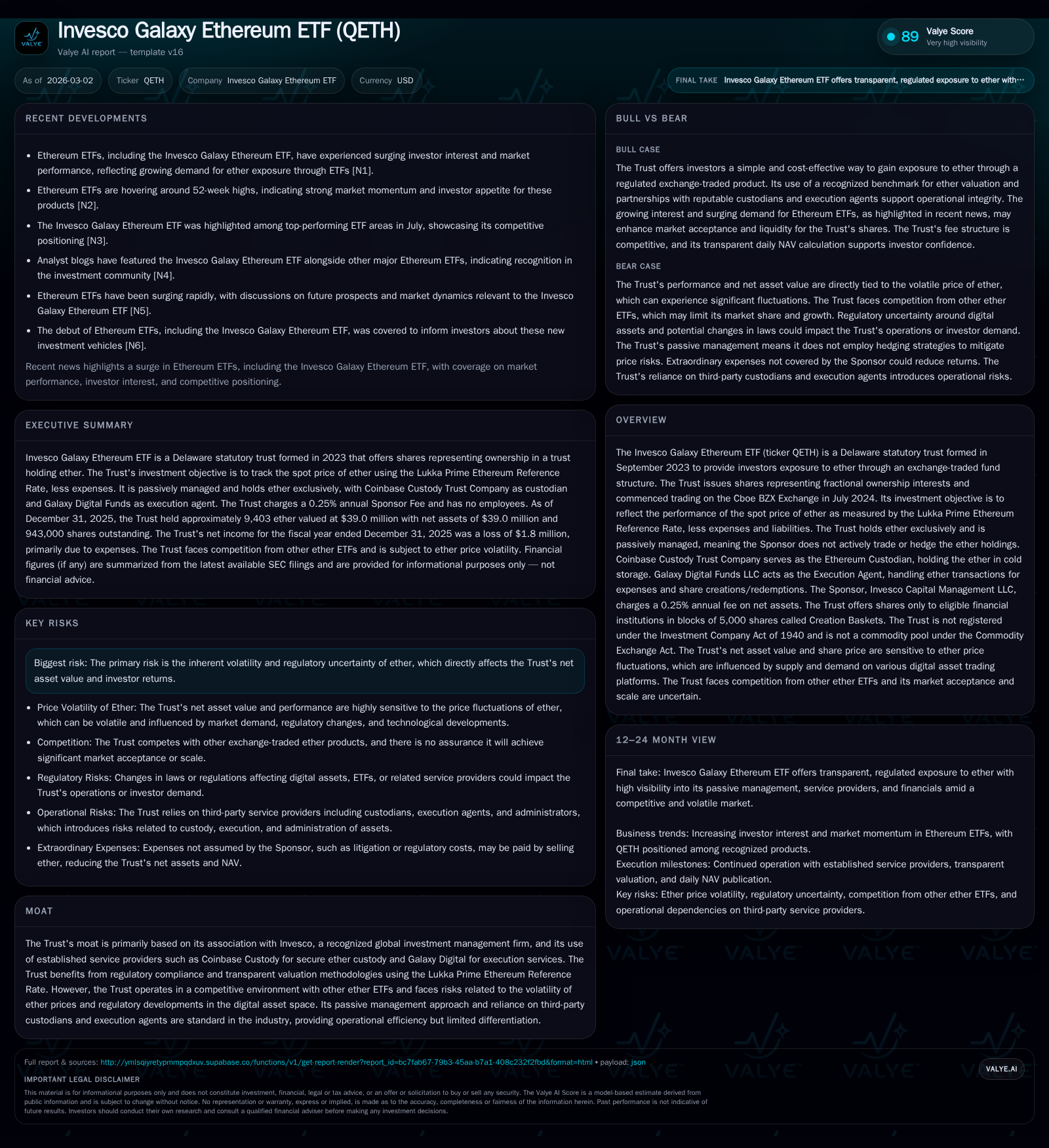
The Invesco Galaxy Ethereum ETF (QETH), launched in 2024 to track the spot price of ether, has encountered considerable volatility reflecting the underlying digital asset’s high risk profile. The Trust operates with a passive management strategy, relying on established custodians and benchmark providers, while facing regulatory uncertainties and market adoption challenges. Financial results show widening losses and negative cash flows in its first full year of operation, tempered by significant share buybacks indicating capital return efforts. Future growth is intrinsically linked to ether price dynamics, regulatory clarity, and competitive pressures within the crypto-backed ETF space.
Overview
Incorporated as a Delaware statutory trust in September 2023, the Invesco Galaxy Ethereum ETF (ticker QETH) began trading publicly on the Cboe BZX Exchange in July 2024 with the explicit aim of providing investors with a cost-efficient means of gaining exposure to the spot price performance of ether (ETH). The Trust is passively managed and exclusively holds ether tokens stored securely via Coinbase Custody Trust Company's cold storage solution, mitigating direct operational risks associated with active digital asset trading.
Managed by Invesco Capital Management LLC as Sponsor, with Galaxy Digital Funds LLC acting as Execution Agent, QETH leverages the Lukka Prime Ethereum Reference Rate as its benchmark for daily net asset value (NAV) computation. The structure eschews active trading or hedging strategies on ether holdings; thus, performance closely tracks the underlying asset but is net of fees and expenses.
Historical Performance and Growth Drivers
Because QETH commenced trading only mid-2024, its financial history is brief but provides insight into challenges faced by digital asset ETPs navigating volatile markets. The initial seed investment comprised approximately $100,000 for 4,000 shares purchased by Invesco Ltd., establishing foundational capital.
Financial metrics from the full year ending December 31, 2025 reveal operating income of -$64,961 USD compared to -$22,459 USD for the prior partial fiscal period in 2024 — translating into an approximately 189% deterioration [F1]. Net income deteriorated sharply from a positive $4.1 million to a loss of nearly $1.8 million over this timeframe [-144% YoY], symptomatic of adverse market conditions for ether during this nascent phase combined with operational costs [F1]. Operating cash flows remain negative at roughly -$4.1 million USD but reflect notable improvement versus -$19.5 million in prior periods [F1].
QETH’s equity base expanded moderately from approximately $23.6 million USD at end-2024 to $25.8 million USD by close of 2025 reflecting both retained earnings impact and new share issuances or repurchases [F1]. Notably, buybacks surged more than threefold year-over-year to $34.8 million USD in 2025 versus $10.8 million USD previously signaling proactive capital allocation adjustments potentially seeking to support share price levels amid volatility [F1].
Historical performance (annual)
| FY | Net ($mm) | CFO ($mm) | OpInc ($) | Net YoY |
|---|---|---|---|---|
| 2025 | -2 | -4 | -64961 | -144.2% |
| 2024 | 4 | -19 | -22459 |
Source: SEC companyfacts cache [F1].
Capital returns and efficiency (annual)
| FY | Buybacks ($mm) | ROE% |
|---|---|---|
| 2025 | 35 | -7.0 |
| 2024 | 11 | 17.4 |
Source: SEC companyfacts cache [F1].
The table highlights limited financial data available given QETH's short operational history.
Future Growth Prospects
QETH's growth prospects are tightly intertwined with several factors:
- Ether Price Dynamics: As a pure play on ETH spot prices without leverage or derivative overlays, appreciation in ether directly benefits NAV growth and investor returns; conversely sharp declines depress value.
- Ethereum Network Adoption: Broader adoption or stagnation of Ethereum technology impacts investor confidence and demand for related products like QETH [S15].
- Regulatory Environment: Pending U.S. regulatory framework refinement—including possible SEC determinations regarding ether as a security—could materially impact product availability or operational requirements [S14][S18][S23].
- Competitive ETF Landscape: Entry of additional ETH-focused ETFs could constrain market share gains for QETH.
- Fee Structure Stability: The Trust levies an annualized Sponsor Fee around 0.25%, which remains competitive but could be pressured downward with growing competition [S13][S16].
- Operational Enhancements: No current participation in Ether staking restricts yield accumulation potential relative to other vehicles that integrate such protocols [S24].
Forecasts and Milestones
Explicit forward guidance is absent from filings; however notable milestones include:
- Maintenance of liquidity through controlled issuance/redemption activity involving Authorized Participants.
- Continued reliance on Lukka Prime Ethereum Reference Rate methodology for transparent NAV calculations.
- Vigilant monitoring by Sponsor concerning regulatory developments that may necessitate structural adjustments.
- No announced plans for transitioning into actively managed or hedged strategies.
Industry analysis suggests sustained regulatory scrutiny throughout 2026 will be pivotal for market confidence across crypto ETFs broadly.
Capital Allocation and Returns
QETH exhibits limited traditional return metrics given its structure as an open-ended trust holding volatile digital assets:
- The approximate Return on Equity based on latest net loss relative to equity stands near -7% showing losses outweighed equity gains during inaugural full fiscal periods [F1].
- Negative operating cash flows reflect expenses exceeding cash generated despite active capital inflows; amelioration compared to earlier periods suggests improving operational efficiency or diminished collections costs [F1].
- Dividend distributions have not been indicated; instead returns are capital appreciation dependent.
- Share repurchase activity is material; however these may serve more as structural liquidity management tools than classical capital return mechanisms given absence of earnings stability [F1].
Risk Considerations
Key risks identified with QETH revolve primarily around:
- Market Volatility: Ether prices have historically experienced wild swings attributable to speculation and momentum investing which inflict valuation unpredictability on QETH shares [S15][S20].
- Adoption Uncertainty: Slowdown or obsolescence risks related to Ethereum network development could erode underlying asset value [S15][S21].
- Regulation Ambiguity: Ongoing U.S. federal investigations and potential reclassification threaten operational continuity; changes might impose compliance costs or force product liquidation [S14][S18][S23].
- Cybersecurity Threats: Vulnerabilities both within Ethereum codebase and custodial infrastructure pose potential for theft or loss impacting asset security [S15][S21][S27].
- Benchmark Integrity Risk: Reliance on third-party pricing inputs subject to manipulation risks could distort NAV valuations [S17].
- Limited Liability Protections: Custodian indemnifications are capped absent gross negligence while bankruptcy risks exist for custodians/prime brokers handling assets degenerating recovery prospects [S9][S11].
- Liquidity Risks: Differences between trade hours for ETF Shares and underlying ether markets can cause discounts/premiums introducing arbitrage challenges affecting Share prices relative to NAV [S15].
Operational Structure Insights
QETH is distinctive through several sector-native operational design choices:
- Leveraging cold storage custody reduces hot wallet security exposures common among crypto funds.
- Use of cash creations/redemptions facilitated by Execution Agent aligns with industry norms but can induce NAV-market price discrepancies briefly.
- Deployment of Lukka Prime Ethereum Reference Rate underlines importance placed on auditability and transparency amid diverse spot venues lacking uniform regulation.
- Governance under Delaware statutory law affords legal predictability familiar within ETF contexts though novel issues may arise uniquely due to crypto assets’ nature.
Conclusion
The Invesco Galaxy Ethereum ETF provides a streamlined vehicle for gaining exposure to ether without direct ownership complexities but wrestles with headwinds common across emerging crypto financial products: nascent regulatory certainty coupled with inherent asset volatility weighs heavily on near-term profitability metrics. Shareholders must balance innovative access against fundamental risks including market swings and potential policy changes that remain fluid through early-to-mid decade regulatory landscapes.
Investors considering QETH should watch closely developments regarding U.S. crypto regulation evolution especially SEC interpretations impacting token classifications and product eligibility. Equally important will be monitoring ether price trajectories aligned to Ethereum platform adoption success as well as operational performance indicators such as NAV premiums/discounts relative to spot prices driven by creation/redemption efficacy.
Disclaimer: This report is intended solely for informational purposes based on publicly available SEC filings and company disclosures without providing investment advice or recommendations.
Disclaimer: This is research-only, informational analysis and not investment advice. It may include AI-generated interpretation and general industry context. Always verify important details using primary sources.

Comments