
Quartzsea Acquisition Faces Regulatory and Liquidity Challenges After Merger Termination
Termination of Broadway Technology merger underscores regulatory hurdles and liquidity pressures for Quartzsea's SPAC model.
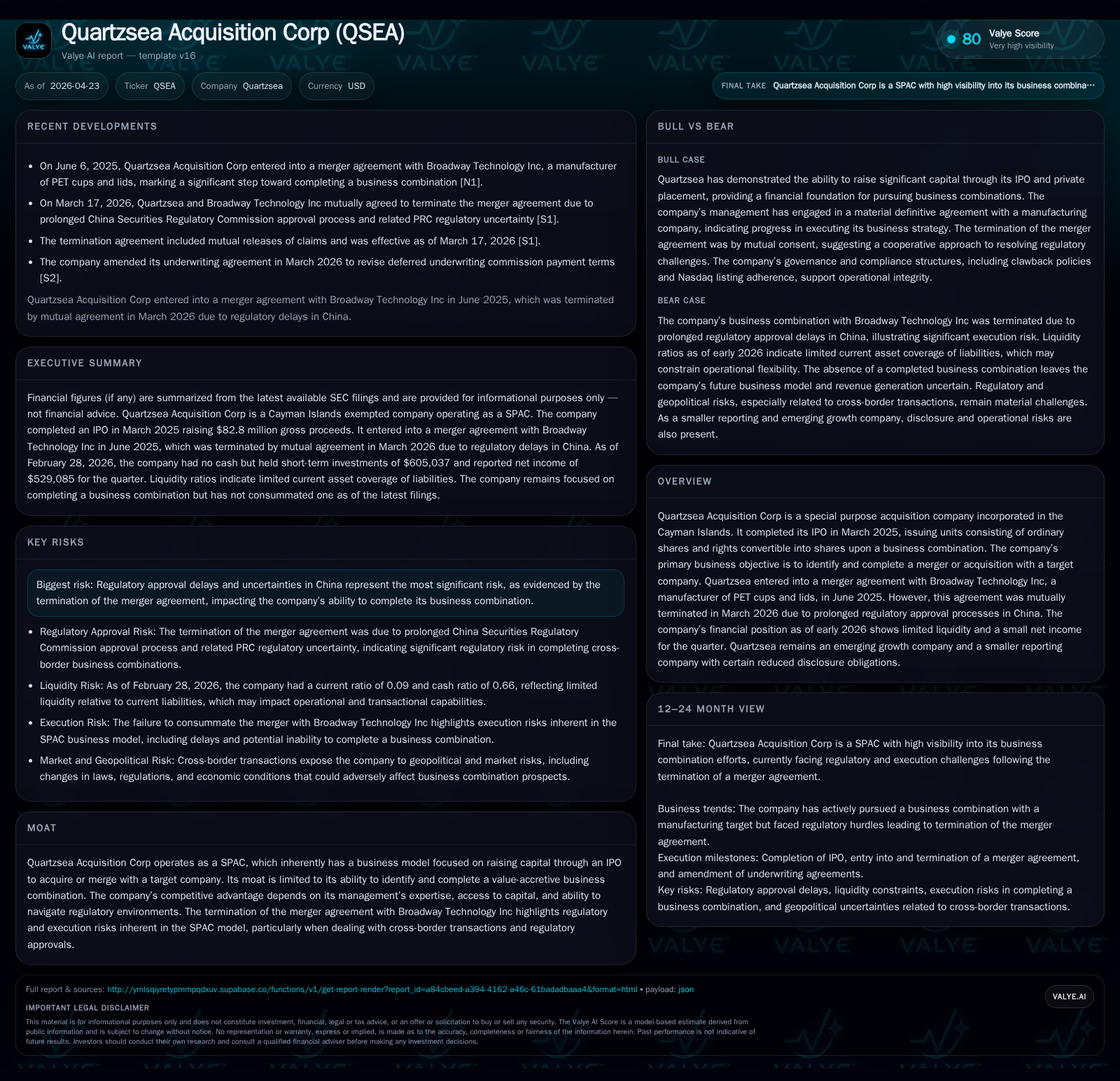
Quartzsea Acquisition Corp’s latest quarterly filing confirms the termination of its planned merger with Broadway Technology due to prolonged Chinese regulatory approval delays, dealing a significant setback to its primary business objective. The company now faces acute liquidity constraints with zero reported cash at quarter-end and a severely imbalanced current ratio, raising execution risks in completing any new business combination. As a Cayman Islands-based SPAC, Quartzsea’s value proposition hinges on closing a strategic merger or acquisition, but increasing regulatory scrutiny, especially with cross-border targets involving China, complicates this task. Monitoring for new merger announcements or capital raises will be critical to gauge the company’s ability to regain growth momentum.
Recent Quarterly Update: Merger Termination and Its Implications
Quartzsea Acquisition Corp’s (QSEA) most recent 10-Q filing dated April 23, 2026 [S2] explicitly reports the termination of its previously announced merger agreement with Broadway Technology Inc., which had been signed in June 2025. As disclosed in an 8-K filing on March 18, 2026 [S3], the parties mutually agreed to terminate this transaction effective March 17, 2026. The primary cause cited was the prolonged and uncertain regulatory approval process by China’s securities regulators—a common bottleneck for cross-border mergers involving Chinese entities. This termination abruptly halts the company’s path toward completing its first business combination.
The Broadway transaction had represented Quartzsea's main opportunity to transition from a blank-check shell into an operating entity through integration with a manufacturer specializing in PET cups and lids. The failure to conclude this deal sharply disrupts the company's growth trajectory and enforces an immediate need to reassess strategic alternatives.
Quartzsea’s SPAC Business Model and Value Proposition
Quartzsea Acquisition Corp is structured as a special purpose acquisition company incorporated in the Cayman Islands [S1]. Its founding premise rests on raising capital via an IPO—completed in March 2025—with proceeds held in trust pending identification and consummation of a merger or acquisition. Unlike traditional operating companies, Quartzsea itself currently does not generate revenues or operate business lines; value creation pivots entirely on successful deal-making.
The company issued units consisting of ordinary shares paired with rights convertible into fractional shares upon closing their initial business combination. This structure aims to balance investor protection (through redemption rights) with upside potential if a strategic acquisition delivers operational growth. Notably, Quartzsea qualifies as an emerging growth company and smaller reporting company reflecting reduced disclosure requirements [S1], streamlining compliance but also signaling relatively early development stage.
Strategically, the company relies heavily on management expertise to source attractive private targets that can unlock shareholder value through scale or market entry expansions post-merger. However, Quartzsea's position remains vulnerable due to dependencies on external factors like regulatory approvals and market receptiveness.
Industry Structure: Competition Among SPACs and Regulatory Challenges
Quartzsea operates within an increasingly crowded SPAC ecosystem where numerous sponsors compete aggressively to identify acquisition candidates within tight time frames—typically two years post-IPO—to avoid liquidation [S1]. Competition drives rapid deployment pressure but also intensifies deal quality scrutiny.
Cross-border deals involving Chinese companies face escalated scrutiny following heightened regulatory activity both domestically in China and internationally. As evidenced by Quartzsea’s own aborted merger due to China Securities Regulatory Commission delays [S3], these administrative hurdles can severely impede transaction timing or termination risk.
This structural tension—a proliferation of SPAC entrants versus stringent regulatory environments—creates significant execution uncertainty for those targeting Chinese or Asia-Pacific-based assets. Investors must consider whether any prospective target can clear regulatory gates expeditiously without incurring excessive delay costs or reputational stress.
Growth Prospects: Potential Paths Amid Regulatory Headwinds
With the Broadway deal terminated, Quartzsea must pivot swiftly toward securing alternative transactions that align better with shareholder expectations yet avoid prior regulatory pitfalls [S2]. Successful announcement and closure of a new business combination remain the core drivers for share price appreciation and long-term viability.
Managerial capabilities now face high scrutiny over ability to identify targets either outside problematic jurisdictions or within sectors subject to less onerous review. Growth might also stem from repositioning toward domestic or other international markets where approvals are less fraught.
Shareholder confidence depends critically on transparency about pipeline opportunities and any adaptations in underwriting agreements that might provide additional sponsor support under current strained liquidity conditions [S3]. The window for these strategic moves narrows substantially given resource constraints.
Key Risks: Liquidity Constraints and Market Execution Challenges
Financially, the situation is precarious. Companyfacts data dated February 28, 2026 reveals zero cash & equivalents held by Quartzsea at quarter-end alongside current assets totaling approximately $82,104 versus current liabilities nearing $920,617—resulting in a current ratio of just 0.09 [F1]. Such imbalance highlights acute liquidity stress potentially impeding operational activities including negotiation expenses or pursuing alternative acquisitions.
Furthermore, operating income recently reported negative (approximately -$1.9 million as of November 30, 2025), whereas net income was modestly positive but small ($510k) [F1], indicating minimal ongoing profitability buffer. No explicit plans for capital raises or refinancing emerged from recent filings [S2],[S3], leaving questions on how immediate funding needs will be met beyond existing trust accounts.
This fiscal rigidity accentuates risks around delayed deal closures translating into share redemptions or contract terminations triggered by inability to uphold financial commitments amidst competitive pressures.
Monitoring Milestones: What Investors Should Watch Next
Looking forward, critical milestones include any formal announcement of new merger targets followed by registration statements filed with the SEC disclosing detailed transaction terms [S3]. Amendments to underwriting agreements signaling revised commission structures or expanded sponsor participation would also be material indicators of management's strategic repositioning under constrained liquidity.
Other markers include shareholder meeting notices related to vote scheduling on proposed transactions, proxy statements illuminating governance changes post-business combination attempts, or communications about potential extensions on SPAC life limits as managers seek breathing room during negotiations.
Periodic updates about engagement with regulators or evolving stance in key target jurisdictions will further shape feasibility outlooks amidst continuing global geopolitical uncertainties affecting cross-border capital flows.
Financial Snapshot: Balance Sheet Health and Earnings Context
Summarizing available financial evidence underscores why liquidity remains Quartzsea’s foremost operational concern entering mid-2026:
- Cash & equivalents: $0 as of February 28, 2026 [F1]
- Current assets: $82,104; Current liabilities: $920,617 producing a critical current ratio of only 0.09 [F1]
- Operating loss approximated $1.9 million as of November 2025 end-of-year reporting [F1]
- Net income modestly positive at approximately $511k for same period consistent with limited administrative expenses controlling burn rates [F1]
This profile reflects typical SPAC startup cost burdens absent revenue streams combined with technical accounting impacts related to trust account management post-IPO proceeds deployment strategies. However, zero cash signals minimal operational flexibility moving ahead, mandating either swift deal closure triggering release of trust funds or external funding interventions.
Quartzsea Acquisition Corp exemplifies the acute vulnerability encountered by SPAC vehicles reliant on cross-border mergers subject to unpredictable foreign regulatory landscapes—in this case underscored by the China approval delays leading to abandonment of its marquee Broadway Technology deal. Compounding this challenge are severe liquidity shortages limiting the firm’s capacity to sustain ongoing pursuit efforts without prompt resolution either from capital raises or successful business combinations. The next several quarters will be decisive as management endeavors to reset strategy amid competitive pressures while navigating complex geopolitical controls that shape transnational capital formation today.
This analysis is based solely on publicly available SEC filings as of April 23, 2026 and does not constitute investment advice.
Disclaimer: This is research-only, informational analysis and not investment advice. It may include AI-generated interpretation and general industry context. Always verify important details using primary sources.

Comments