
Tancheng Group's Strategic Pivot in Cultural Tourism and Ornament Product Innovation
Latest quarterly results reveal operational challenges amid ambitious cultural tourism and product initiatives centered on 'Jue Cheng' heritage.
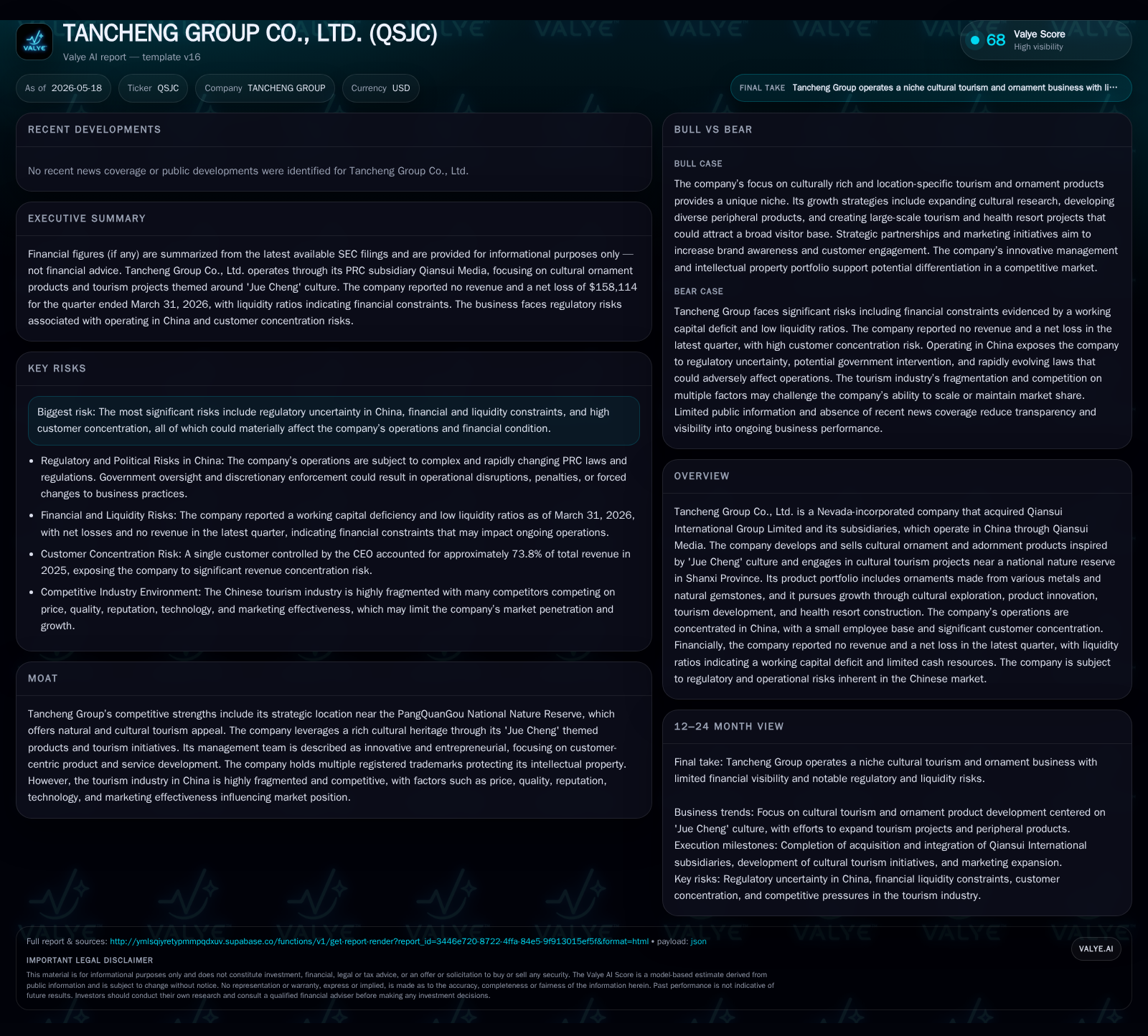
Tancheng Group reported zero revenue and sustained net losses in its latest quarter, highlighting pressing liquidity concerns such as a working capital deficit with a current ratio of 0.42. The company integrates cultural ornaments inspired by 'Jue Cheng' culture with tourism development near Shanxi’s PangQuanGou National Nature Reserve, leveraging intellectual property protections through registered trademarks. While the fragmented Chinese cultural tourism industry creates opportunities for growth via multi-channel marketing and health resort projects, regulatory uncertainties in China combined with financial constraints and customer concentration represent material risks. Key milestones to monitor include marketing execution at transportation hubs, partnerships with provincial tourism authorities, and enhancements to online presence.
Latest Quarterly Operating Update and Implications
Tancheng Group’s May 2026 quarterly filing reveals an operational landscape marked by zero reported revenue and ongoing net losses, underscoring pronounced financial strain just as the company attempts to scale cultural tourism ventures and ornament product lines [S2],[F1]. The absence of sales during this quarter contrasts prior years' modest receipts but signals challenges in converting strategic initiatives into immediate top-line growth. These metrics are critical for stakeholders in assessing the sustainability of Tancheng’s current growth path amidst evolving market conditions.
Business Model: Cultural Ornaments and Tourism Integration
Tancheng Group operates through its wholly owned PRC subsidiary which develops and sells products anchored in the "Jue Cheng" cultural heritage while concurrently orchestrating large-scale tourism projects adjacent to the PangQuanGou National Nature Reserve in Shanxi Province [S1],. Monetization occurs primarily through sales of ornamental products crafted from diverse metals and natural gemstones that embody this unique cultural motif. The company targets tourists visiting the region alongside collectors interested in culturally authentic adornments. Complementing physical products is the development of cultural tourism offerings designed to leverage the region's natural beauty combined with immersive historic narratives—an integrated approach aimed at creating synergistic value from both tangible goods and experiential services.
This dual revenue stream strategy positions Tancheng at the confluence of product innovation and place-based tourism development. The geographically concentrated operations in China emphasize localized market insights while relying on intellectual property protections via multiple trademarks to guard against indiscriminate replication of their cultural motifs [S1],.
Product Portfolio Quality and Intellectual Property Protection
Central to Tancheng’s offering is an emphasis on high-quality ornamental craftsmanship involving metals such as copper or bronze alongside natural gemstones associated with traditional symbolism within "Jue Cheng" culture. These attributes contribute not only to distinct product differentiation but also support potential pricing premiums within niche markets sensitive to authenticity and artisanal value.
The company's registered trademarks form an essential moat by safeguarding the proprietary design elements tied to its cultural theme. Given the competitive environment where low-cost replicas could easily erode value, these IP protections mitigate dilution risks and help maintain consumer trust. Production standards linked to these offerings likely influence demand elasticity positively; customers inclined toward genuine artifacts are less price-sensitive but expect consistent quality.
Competitive Landscape and Industry Dynamics in Chinese Cultural Tourism
The cultural tourism sector within China is markedly fragmented with numerous small-scale operators vying for visibility against a backdrop of rapid regulatory changes and evolving consumer expectations [S1],. Competition extends beyond traditional price dynamics; reputation management, effective online platform integration, and innovative marketing significantly shape market positioning.
Tancheng’s strategies include cooperative engagements with provincial governments such as the Shanxi Provincial Tourism Bureau alongside partnerships with influential online travel aggregators including Ctrip.com—aimed at expanding distribution breadth. The company also implements multi-channel marketing encompassing digital advertising in dense tourist locales plus telemarketing campaigns—all intended to enhance brand recall amidst heightened market noise.
Nonetheless, scale limitations relative to larger players imply cost structure challenges and necessitate tactical agility. Customer switching costs appear moderate given many substitution options for cultural products or alternative tourist destinations. Success hinges on blending authentic experience delivery with seamless booking and purchase processes enabled through regional transport hub reception points (airports, railway stations) acting as direct customer contact interfaces.
Growth Drivers: Marketing Initiatives, Tourism Development, and Product Innovation
Executional momentum derives primarily from an escalating suite of marketing initiatives anchored by hiring a dedicated team tasked with expanding reach via print/digital media campaigns across key tourist centers [S1]. This includes strategic setup of sales points offering ticket purchases at travel nodes such as Taiyuan Wusu International Airport—bridging awareness directly into transactional channels.
Parallel growth levers involve collaborative programs co-designed with regional tourism bureaus aimed at positioning Tancheng product experiences within popular traveler itineraries. Such institutional partnerships are vital due to government influence over permitted tour operations and access rights within protected nature reserves.
On the product front, ongoing innovation centered on expanding the "Jue Cheng" ornament line addresses broadening consumer preferences while simultaneously bolstering cross-selling opportunities tied to newly constructed health resort facilities planned as complex attractions contributing longer visitation cycles.
These synergistic developments could drive KPIs like visitor footfall increases at partner venues or uplift sales conversion ratios at physical reception points—metrics critical for monitoring near-term traction.
Risks and Constraints: Regulatory Environment, Liquidity Issues, and Customer Concentration
Navigating the tightening regulatory landscape in China remains a paramount risk factor due to evolving oversight policies impacting overseas-listed China-based companies like Tancheng Group [S1],[S3]. Recent cybersecurity laws necessitate compliance reviews that may delay or complicate foreign financial activities. Furthermore, inconsistent application of emerging legislation could result in unexpected restrictions or penalties that materially disrupt business operations.
Liquidity constraints loom large given the company's working capital deficit coupled with modest cash reserves reported earlier this year (~$274K) insufficiently buffered against liabilities totaling more than double that amount; these financial headwinds heighten vulnerability to adverse operational shocks or delays in expected revenue streams [F1],[S2].
Additionally, concentrated customer bases expose Tancheng to revenue volatility risks if key buyers reduce orders or shift allegiance amid competitive pressures or macroeconomic shifts. Given limited disclosure stemming from smaller reporting company status under SEC rules for risk factors post-latest quarterly report [S3], stakeholders face opacity regarding mitigating steps employed.
Key Upcoming Milestones and Indicators to Monitor
Critical upcoming checkpoints include full deployment of dedicated personnel managing digital content updates designed to strengthen web-based engagement aligned with broader marketing objectives [S1]. Progress reports emanating from collaborative alliances with Shanxi provincial entities will also serve as barometers for institutional support translating into tangible tourist inflows.
Monitoring new "Jue Cheng" product launches will offer insight into innovation cadence influencing repeat purchase behavior. Observing operational metrics from ticket sale outlets at transportation hubs will provide real-time signals regarding demand uptake among transitory travelers.
Finally, updates pertaining to capital management—whether through asset monetization or potential financing rounds—are crucial given current liquidity pressures impacting overall viability judgment.
Financial Snapshot and Liquidity Analysis
As of March 31, 2026, Tancheng Group held approximately $274,000 in cash with current assets near $1.5 million and current liabilities exceeding $3.6 million, resulting in a current ratio of approximately 0.42, highlighting a fragile liquidity position susceptible to short-term solvency concerns [F1]. Continuing net losses reinforce pressure on operational cash flows, emphasizing that absent revenue generation there is incremental reliance on external funding sources or asset monetization strategies moving forward. Although explicit recent debt levels are not granularly disclosed beyond balance sheet snapshots, these conditions collectively frame finance as an ancillary yet critical element complementing primarily strategic operating considerations discussed above.
This analysis synthesizes Tancheng Group Co., Ltd.'s intrinsic position navigating business model challenges amid pursuit of growth harnessing culturally rooted products integrated with regional tourism development efforts under complex regulatory environments typical for China-focused enterprises listed overseas. The highlighted operational stance draws heavily from the latest quarterly disclosures framed against previously articulated annual strategic context while faithfully adhering to documented quantitative evidence without conjecture beyond cited sources.
Financial position in context
Current assets of $1,515,092 and current liabilities of $3,634,272 imply a current ratio near 0.42x for 2026-03-31 [F1]
Disclaimer: This is research-only, informational analysis and not investment advice. It may include AI-generated interpretation and general industry context. Always verify important details using primary sources.

Comments