
How RBC Bearings Leverages Precision Manufacturing to Drive Aerospace and Industrial Growth
RBC Bearings strengthens its leadership through advanced engineering, broadening global presence, and navigating market cyclicality and debt obligations.
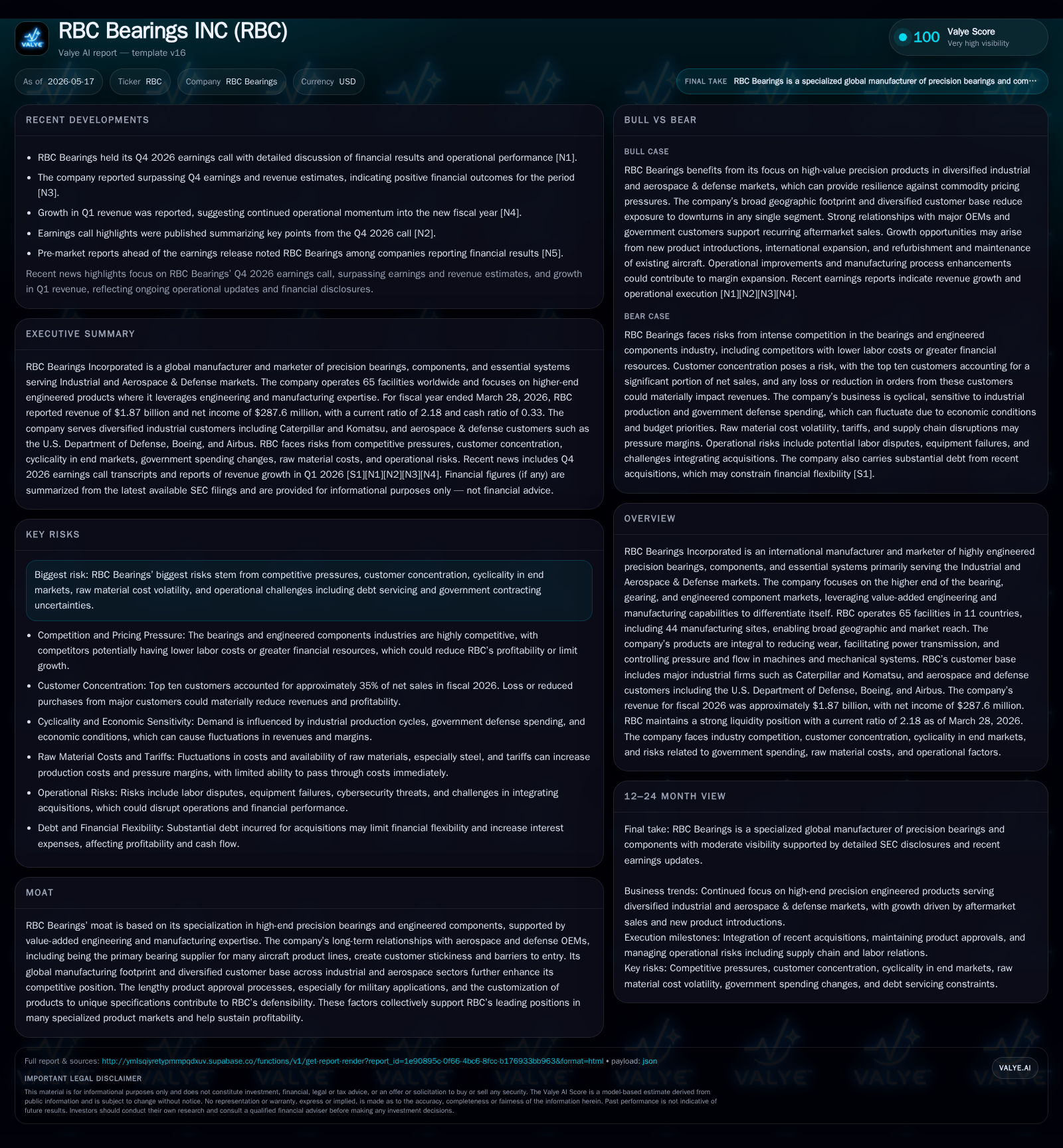
In its latest quarterly 10-Q filing for Q4 2025 and subsequent Q1 2026 earnings announcement, RBC Bearings demonstrated resilient operational performance underpinned by strong aerospace and industrial demand. The company’s focused strategy on high-end precision bearings and engineered components supports durable customer relationships, particularly in aerospace and defense, while its expanding aftermarket presence bolsters revenue streams. However, elevated debt levels from recent acquisitions and raw material price volatility present ongoing challenges. Near-term growth hinges on new program wins, execution of manufacturing efficiencies, and broader international market penetration.
Recent Operating Update: Quarterly Highlights That Shift the Near-Term Narrative
RBC Bearings Incorporated's latest quarterly filing dated February 5, 2026 (Form 10-Q) provides the earliest anchor for recent operating developments. The quarter ended December 27, 2025, reflected steady operational momentum despite ongoing raw material cost inflation challenges common across the bearings industry [S2]. Shortly thereafter, on May 15, 2026, an event filing (8-K) furnished an earnings press release for Q1 ending March 28, 2026 [S3]. This update conveyed revenue strength continuing into the new fiscal year with management highlighting growth in both Aerospace & Defense and Industrial segments amid supply chain stabilization [N1][N2][N3].
Notably, RBC emphasized passing through elevated steel costs via surcharges where contracts permitted but acknowledged a lag effect on margins due to fixed-price agreements in backlog [S28]. The company also noted healthy capacity utilization across its manufacturing footprint along with incremental wins from new defense contracts that should support backlog conversion in near term [N4]. While these factors confirm resilience in demand fundamentals, raw material headwinds remain an important margin pressure point.
Business Model and Product Quality: Deep Expertise in High-End Precision Solutions
RBC operates as a specialty manufacturer of highly engineered precision bearings, gearing components, and essential systems primarily catering to Aerospace & Defense plus diversified Industrial sectors worldwide [S1]. The company’s value proposition rests significantly on its technical differentiation—serving niche specialized bearing and component markets that require extensive OEM certification cycles ranging from six months to multiple years [S21]. This OEM certification process effectively raises switching costs for customers once RBC products become embedded at design stage.
With an extensive global manufacturing network spanning 65 facilities across 11 countries—including 44 manufacturing sites—RBC supports broad geographic reach allowing supply chain diversification alongside local proximity to key customers [S1]. Customized engineering capabilities enable tailored solutions addressing complex application needs such as military ground vehicles or commercial aircraft engines. This strategic focus on high-end precision reduces competitive commoditization risk common in lower-tier bearing products.
Industry Structure and Competitive Position: Global Reach Amid Fragmented Markets
The bearings and engineered components sector remains fragmented with numerous players varying widely by scale and specialization. RBC occupies a leadership position within its chosen high-precision segment by maintaining strong OEM relationships with major aerospace names like Boeing, Airbus, U.S. Department of Defense, Lockheed Martin among others—many of which designate RBC as primary supplier across life cycles of critical platforms [S1][S21]. This enduring partnership model aids stability through cyclical fluctuations intrinsic to aerospace procurement timelines.
On the Industrial side accounting for about 58% of fiscal 2026 net sales, RBC’s diversification spans construction machinery (with customers such as Caterpillar and Komatsu), mining equipment, oilfield services (Halliburton), warehousing systems and beyond—buffering exposure through distribution channels including Motion Industries and Baldwin Supply [S8][S9]. Despite industry cyclicality driven by capital spending deferrals during economic downturns typical for mining or energy sectors, RBC’s aftermarket focus ingrains recurring revenue streams supporting operating leverage.
Growth Drivers: Expanding Aftermarket Penetration and Aerospace Innovation
Measured expansion in aftermarket sales constitutes a significant growth driver for RBC owing to enduring OEM relationships where proprietary products require replacement parts over extended platform lifespans [S9][S21]. The company benefits from tailwinds tied to new commercial aircraft programs with anticipated rising production rates worldwide coupled with military platform refurbishment budgets driving recurring service component demand.
International market penetration is also a focal area; approximately 11% of net sales originate from foreign operations situated in strategically important regions such as Australia, Europe (England, France, Germany), India, China and Mexico—with local manufacturing enabling responsiveness to regional demand shifts while mitigating tariff impacts [S25][N4]. Product mix improvements influenced by rollout of innovative bearing designs optimized for next-generation aerospace engines potentially contribute margin enhancement opportunities. The cumulative effect is a balanced dual-market approach positioning RBC for sustainable growth despite macroeconomic uncertainties.
Risks and Constraints: Debt Burden, Customer Concentration, Raw Material Sensitivities
A principal risk factor is the sizable debt assumed to finance acquisitions—most notably $1.8 billion incurred in fiscal 2022 for Dodge Industrial followed by $200 million for VACCO Industries in mid-2025—resulting in total debt nearing $875.5 million as of March 28, 2026 [S4][F1]. This level constrains free cash flow availability given required interest/principal servicing obligations which may limit investment agility or necessitate prioritizing deleveraging efforts.
Customer concentration represents another watchpoint; the top ten customers contributed about one-third to nearly half of net sales during fiscal years recently reported—a concentration that amplifies revenue volatility if any major customer curtails purchases due to their own business cycles or consolidation trends within industrial OEMs or defense primes [S8][S12]. Additionally raw material cost exposure—primarily steel which features prominently in proprietary bearing alloys—poses margin compression risk compounded by potential tariff policy changes or supply disruptions; while RBC seeks contractual pass-through mechanisms these are neither universal nor instantaneous thereby pressuring reported results periodically [S28].
Regulatory compliance also demands vigilance given classification as U.S. government contractor subjected to requirements including FAR and DFARS clauses; ongoing DOJ investigation related to False Claims Act allegations adds legal uncertainty though current disclosures indicate no anticipated material adverse effect at this juncture [S5][S27].
What to Watch Next: Guidance, Execution on New Contracts, and Innovation Milestones
Key forward-looking milestones focus on management’s forthcoming updates regarding quarterly guidance especially around revenue trajectories influenced by raw material cost pass-through success and potential backlog adjustments documented at $2.3 billion as of late fiscal-year end with cancellation risks factored in [S16][N4]. Monitoring new contract awards within defense segments remains crucial given the lengthened approval cycles affecting shipment timing.
Equally important is progress integrating recent acquisitions toward achieving synergies alongside continuous innovation investments enhancing manufacturing efficiency notably via explorations into AI-enabled tools aimed at process improvement albeit currently confined largely to administrative use due to associated compliance risks discussed publicly [S6]. Tracking aftermarket sales growth metrics linked directly to strategic partnerships with PMAs (Production Modification Approvals) will provide insights into effectiveness of expanded service penetration internationally as well.
Financial Snapshot: Leveraging Balance Sheet to Support Strategic Initiatives
At the close of fiscal Q1 ending March 28, 2026, RBC Bearings reported revenues approximating $1.87 billion with operating income near $421 million supported by gross margin management despite commodity price pressures; net income stood around $288 million reflecting operational profitability resilience against cyclicality forces [F1]. The balance sheet exhibits approximately $49.6 billion total debt offset partially by $57.3 million cash equivalents yielding net debt close to $438.8 million alongside a current ratio of roughly 2.18 indicating adequate short-term liquidity coverage relative to liabilities though leverage levels remain elevated following acquisition-financed expansions [F1][S4]. Balancing capital deployment between debt servicing demands and growth investments will be pivotal moving forward.
This analysis synthesizes filings through May 15, 2026 without projection or research view implications. It aims to clarify how RBC Bearings’ precision engineering expertise combined with its strategic global footprint underpins competitive advantages while identifying structural risks arising from financial leverage and sector dynamics common within aerospace/industrial manufacturing niches.
Disclaimer: This is research-only, informational analysis and not investment advice. It may include AI-generated interpretation and general industry context. Always verify important details using primary sources.

Comments