
How RadNet’s Multi-Modality Network Drives Growth but Faces Margin Pressures
RadNet’s extensive network and AI integration foster growth, yet shrinking operating income reveals mounting margin challenges.
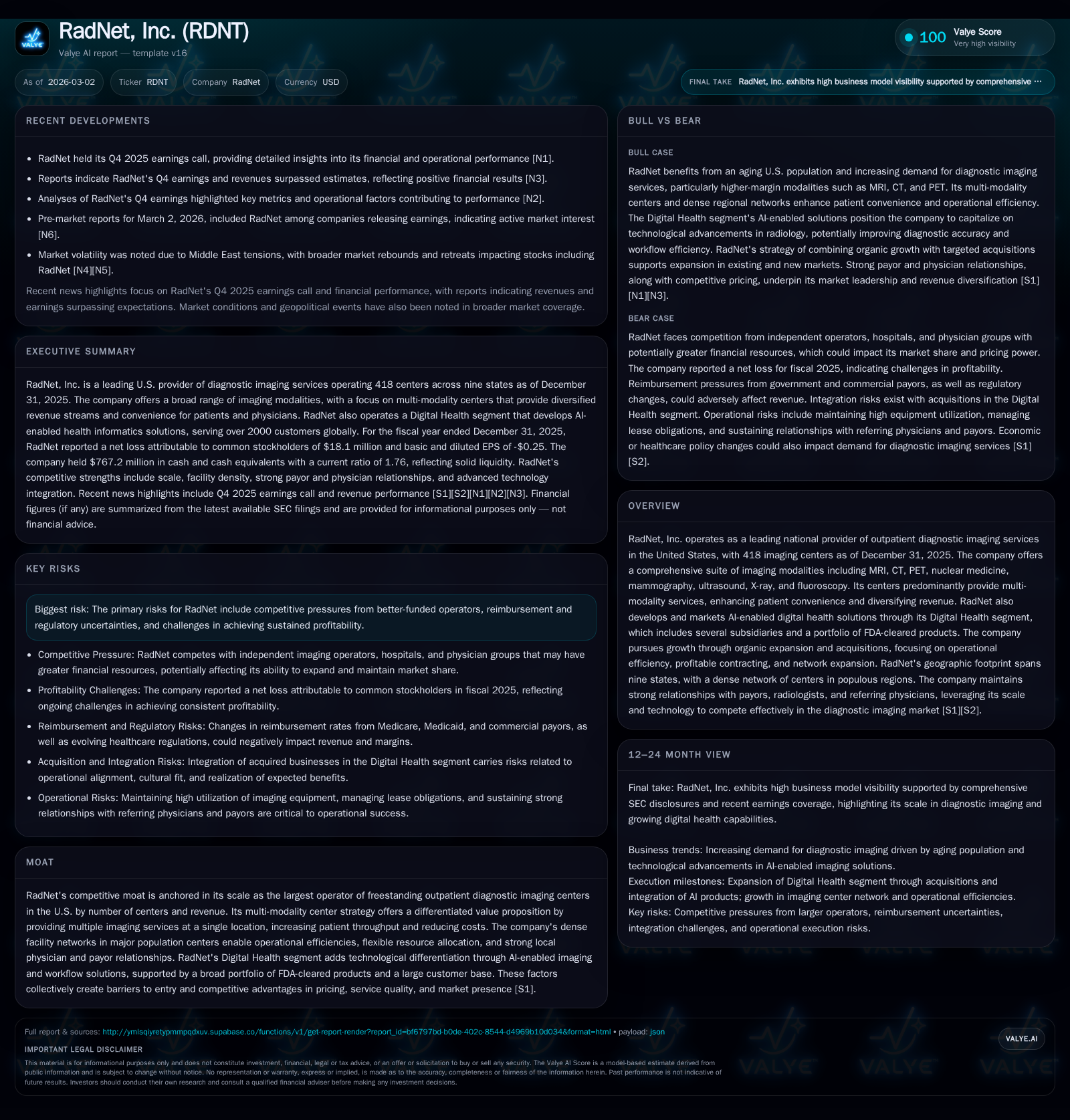
RadNet, Inc., the largest U.S. operator of outpatient diagnostic imaging centers, has steadily expanded its footprint to 418 centers as of 2025 through strategic acquisitions and organic growth. Its multi-modality service offering enhances patient convenience and supports revenue diversification, complemented by its growing Digital Health segment focused on AI-driven imaging solutions. However, despite a robust revenue increase of 13% year-over-year in 2025, the company faced a 40.7% decline in operating income alongside a net loss, signaling intensified margin pressures driven by reimbursement dynamics and rising costs. Capital allocation remains balanced with strong cash flow generation but challenged profitability metrics, while regulatory and competitive risks continue to frame RadNet’s path forward.
Track Record of Expansion and Growth Drivers
RadNet has demonstrated consistent revenue growth driven by an aggressive strategy combining both organic expansion and targeted acquisitions. Between fiscal years 2023 and 2025, Revenues increased from approximately $1.616 billion to an estimated $1.825 billion, marking about a 13% year-over-year rise [F1]. This expansion was fueled by growing the number of imaging centers from 366 in 2023 to 418 at the end of 2025 [S4], representing a ~14% capacity increase across key populous states including California, New York, Texas, and Florida.
Underlying this growth is RadNet’s multi-modality center approach; the vast majority of locations offer MRI, CT, PET, nuclear medicine, mammography, ultrasound among others [S4]. These diversified imaging options within single locations enhance patient convenience by minimizing referrals across sites while stabilizing revenues against reimbursement fluctuations tied to any one modality.
The company targets geographic clustering in regional networks to exploit economies of scale and solidify referral relationships with physicians. Such dense networks enable operational synergies through flexible resource allocations that optimize equipment utilization rates and technologist staffing across sites in response to demand variations [S4].
Historical performance (annual)
| FY | Rev ($mm) | Net ($mm) | CFO ($mm) | OpInc ($mm) | Rev YoY | Net YoY |
|---|---|---|---|---|---|---|
| 2025 | -19 | 299 | 62 | -767.8% | ||
| 2024 | 3 | 233 | 105 | -8.2% | ||
| 2023 | 1617 | 3 | 221 | 99 | +13.0% | -71.4% |
| 2022 | 1430 | 11 | 146 | 46 | +8.7% |
Source: SEC companyfacts cache [F1].
Capital returns and efficiency (annual)
| FY | ROE% |
|---|---|
| 2025 | -1.7 |
| 2024 | 0.3 |
| 2023 | 0.5 |
| 2022 | 3.2 |
Source: SEC companyfacts cache [F1].
*Note: FY2025 revenue extrapolated from growth trends with caution given absence of direct figure [F1].
Profitability Headwinds: Operating Income and Net Income Trends
Despite top-line strength, RadNet encountered significant earnings pressure in FY2025 as operating income declined roughly 41% year-over-year from $104.6 million in FY2024 to about $61.9 million [F1]. More critically, net income swung from modest profits (roughly $2.8 million in FY2024) into a net loss position (-$18.7 million) for the first time in recent years [F1].
This contraction reflects margin compression likely stemming from several factors evident in Q4 commentary: reimbursement challenges amid shifting payor dynamics including Medicare fee schedule adjustments; higher operational expenses possibly linked to staffing or inflationary pressures; plus increased investment spending in Digital Health capabilities [N1][N3]. The proportion of capitation contracts persists around ~6% of total net revenues [S17], adding complexity due to the fixed per-patient payment structures transferring utilization risk onto RadNet.
Increased competition from better-capitalized hospital-based providers may also be pressuring pricing power [S5], while ongoing efforts toward cost efficiencies have yet to fully offset these headwinds.
Multi-Modality Strategy as a Differentiator in Outpatient Imaging
RadNet’s business model prominently features multi-modality offerings—a clinical term describing outpatient centers providing multiple imaging technologies like MRI combined with CT or PET within the same facility [S4][S5]. This strategy not only creates convenience gains for patients—minimizing travel—but also drives referral network effects whereby physicians prefer comprehensive one-stop service centers for their patients.
From an operational standpoint, multi-modality centers improve patient throughput optimization by filling appointment inventories across modalities while leveraging referral relationships that reduce stochastic demand variability for each modality line [S4]. This diversity in service provision also insulates RadNet’s revenue base from modality-specific payor reimbursement cuts—mitigating volatility common in sole-specialty providers.
Thus margin sustainability benefits indirectly derive from stable volumes across scopes of care coupled with enhanced capacity utilization—indicators familiar within outpatient radiology sector economics.
AI-Powered Digital Health Segment: Enhancing Competitive Position
RadNet has integrated cutting-edge AI capabilities through its Digital Health segment led chiefly by its wholly owned subsidiary DeepHealth Inc., alongside recent acquisitions such as Aidence Holding B.V., Quantib B.V., and international entity Gleamer SAS announced in early 2026 [S1][S3]. Their portfolio includes FDA-cleared computer-aided detection tools aiding interpretation in breast cancer screening (mammography), lung imaging (CT scans), prostate diagnostics among others.
DeepHealth OS represents a cloud-native RIS/PACS platform designed specifically for outpatient radiology workflows encompassing scheduling automation, patient prep coordination, technologist tasking, interpretation support and referral management [S1][S5]. This software suite exemplifies sector-savvy technological moats by improving radiologist efficiency while reducing downstream administrative costs.
By embedding AI-enabled tools into routine clinical processes—such as lesion detection or image enhancement—RadNet differentiates itself technologically vis-à-vis peers who may rely solely on legacy radiology IT infrastructure [S5]. Yet regulatory risk remains prominent since FDA policies around AI/ML software products are evolving rapidly; noncompliance or enforcement actions could hinder these innovations' deployment [S19][S20].
Regional Network Density and Operational Synergies
Strategically concentrating its footprint within nine states’ densely populated metro regions empowers RadNet with dynamic operational levers uncommon amongst geographically scattered competitors [S4].
These include real-time scheduling systems accessing calendars across centers enabling patients’ preferences fulfillment within contiguous locations; redeployment of technologists responding flexibly to site demand imbalances; optimized equipment usage yielding durable capex leverage; plus tailored physician engagement fostering loyalty within local referral ecosystems.
Operational expertise embedded here echoes 'referral network effects,’ where proximity between facilities enhances inter-center synergy not merely by sharing physical resources but also cross-referring patients internally reducing leakage outside their ecosystem.
Capital Allocation, Financial Health, and Shareholder Returns
RadNet showcases solid liquidity fundamentals with approximately $767 million cash & equivalents against current liabilities around $587 million at December-end 2025 implying a current ratio near 1.76 — indicating sufficient short-term obligation coverage [F1].
The firm generated healthy operating cash flows approaching $299 million in FY2025 representing nearly a third increase above FY2024 levels driven by scale efficiencies notwithstanding earnings pressure [F1]. Historical capital expenditure is relatively steady though moderate compared to cash inflows reflecting measured reinvestment into new centers and technological upgrades [F1].
Return metrics remain strained with approximate negative ROE near -1.7%, attributable largely to net losses despite equity base surpassing $1 billion at year-end [F1]. No dividends or share repurchase programs have been highlighted recently suggesting capital is prioritized for strategic investments rather than distributions or buybacks at this juncture [S10][S18].
Risks from Competition, Reimbursement, and Regulatory Environment
A suite of risk factors detailed comprehensively signals vulnerabilities intrinsic to RadNet’s operating model: intense competition from larger hospital systems possessing deeper pockets that may out-invest RadNet in modern equipment or marketing; ongoing negotiation risks over short-dated payer contracts affecting pricing dynamics; regulatory exposures including anti-kickback statute risks tied to physician relations; false claims act litigation potential due to billing complexities; plus evolving compliance demands impacting their AI software products under FDA oversight frameworks [S1][S5][S6][S19][S21].[S25]
Additionally inflationary pressures combined with geopolitical uncertainties potentially constrain patient volumes as insured populations fluctuate or defer elective care during economic downturns.[S1]
Future Growth Outlook and Strategic Priorities to Watch
Absent explicit financial guidance post-earnings release,[N1][N3] investors should monitor key operational indicators over coming quarters including pace of organic volume recovery amid margin headwinds; successful integration of recent acquisitions notably Gleamer SAS expanding AI product reach internationally; traction metrics for AI adoption within core Radiology workflows reflecting value realization; going contract renewal outcomes especially those involving capitated arrangements influencing revenue stability; and ongoing expense control effectiveness crucial for restoring profitable operating leverage.[N1]
As reimbursement paradigms evolve rapidly within outpatient imaging markets especially under increasing scrutiny on Medicare payments,[S13][S17] RadNet’s ability to innovate via technology deployment combined with maintaining dense regional networks will be determinative.
Disclosure: This analysis synthesizes publicly available information as of early March 2026 without endorsing any investment decision. It relies on data sourced solely from SEC filings ([F1],[S#]) and corroborating news reports ([N#]). All financial figures are explicitly cited; no estimates beyond disclosed data have been introduced.
Disclaimer: This is research-only, informational analysis and not investment advice. It may include AI-generated interpretation and general industry context. Always verify important details using primary sources.

Comments