
TheRealReal Inc: Navigating Luxury Resale Amidst Operational and Financial Headwinds
TheRealReal operates a leading authenticated luxury consignment platform combining technology and retail channels to serve a dynamic luxury resale market.
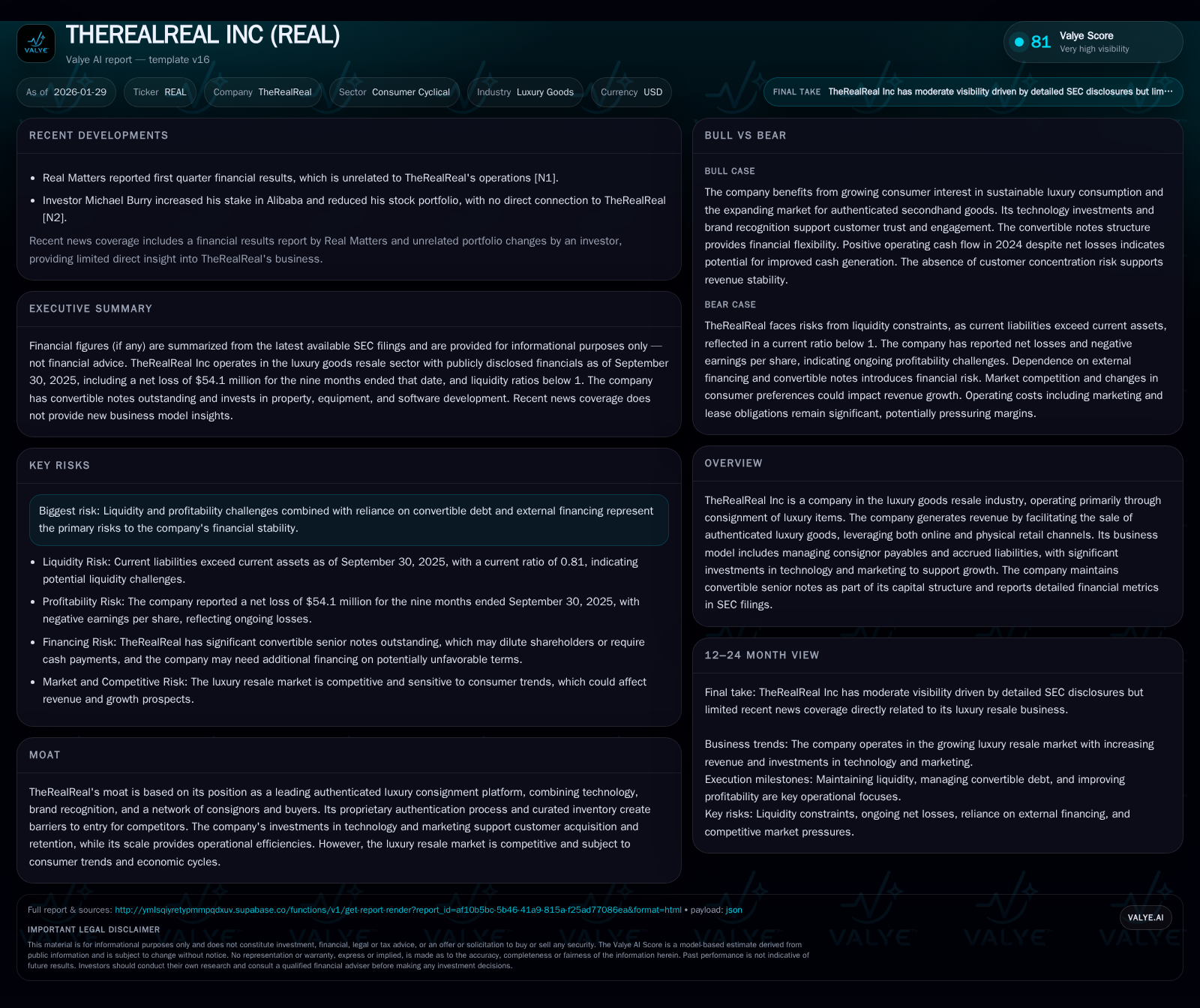
TheRealReal Inc remains a prominent player in the luxury goods resale industry, leveraging a proprietary authentication process and a hybrid online-retail presence. Recent quarterly results reflect ongoing challenges in profitability and unit economics, with a strategic focus on marketing efficiency and technology investments to enhance marketplace liquidity. The company operates in a competitive environment shaped by evolving consumer preferences and economic cycles, while managing liquidity constraints and convertible debt maturities. Key operational leverage points include take rates, consignor supply, and retail footprint optimization.
What Changed Recently
TheRealReal reported its first quarter financial results for fiscal 2026 with no specific detailed metrics disclosed in the provided data, but ongoing operational and financial dynamics suggest continued challenges in profitability and liquidity. The company remains focused on driving revenue growth through its authenticated luxury resale platform, balancing marketing spend efficiencies, and optimizing its retail footprint. There is no direct news on material strategic shifts or acquisitions within the last 45 days, and broader market movements such as Michael Burry's portfolio changes do not directly relate to TheRealReal [N1][N2].
Business Model as a System
TheRealReal operates primarily as a luxury consignment marketplace where it facilitates sales of authenticated pre-owned luxury goods on behalf of consignors. The substantial majority of its revenue derives from consignment sales, with the company retaining a variable take rate averaging approximately 38%, which depends on the item category, price point, and consignor sales volume [S1]. The take rate declined slightly from 38.6% to 37.9% year-over-year due to an increased mix of higher-value items in sales.
The company’s proprietary technology platform powers its online marketplace, supporting complex single-SKU inventory management, enabling rapid sell-through, and delivering data-driven pricing optimized by insights from over 40 million historical item sales [S1]. Authentication is a cornerstone, ensuring the authenticity and quality of luxury goods, which is vital to maintaining buyer trust and market differentiation.
Complementing the digital marketplace, TheRealReal operates a limited number of physical retail stores intended to raise brand awareness among consignors and buyers, generate new supply, and provide a consistent luxury buying experience [S6]. However, retail expansion involves risks such as long-term lease commitments, operational overhead, employee management, and potential theft or property damage.
Marketing investments are sizeable, aimed at customer acquisition and retention, with management expecting these costs to decrease as a percentage of revenue over time, reflecting anticipated operating leverage [S2]. The company manages consignor payables and accrued liabilities as part of its working capital operations, with an emphasis on optimizing inventory turnover.
Financially, TheRealReal carries convertible senior notes with maturities extending to 2031, with outstanding principal amounts around $48 million. The company repaid its 3.00% notes due in 2025 but continues to carry debt that adds to liquidity risk [S13]. As of September 30, 2025, the company held about $108 million in cash and equivalents but had current liabilities exceeding current assets, resulting in a current ratio of 0.81, indicating potential near-term liquidity pressures [Sec XBRL].
Industry Map & Competitive Battlefield
The luxury resale market is a niche but growing segment within consumer cyclical and luxury goods sectors, characterized by high customer expectations for authenticity, product quality, and experience. TheRealReal's competitive moat is rooted in its scale, brand recognition, proprietary authentication processes, and data assets accumulated over millions of transactions, which collectively create entry barriers.
The competitive landscape includes online pure-play platforms, traditional consignment boutiques, brand-direct resale initiatives by luxury houses, and broader e-commerce marketplaces. TheRealReal’s hybrid model—combining technology-enabled marketplace with physical retail—aims to differentiate by addressing both supply acquisition and customer experience.
Macro factors influencing the industry include consumer discretionary spending cycles, luxury brand pricing strategies, and economic uncertainty impacting secondhand purchasing behavior. The company also navigates regulatory risks related to data privacy and AI usage in marketing and merchandising, which could affect its operational capabilities [S20].
Talent competition is notable in technology, authentication expertise, and retail operations, with key personnel retention being a highlighted risk [S21]. Moreover, competitive pricing dynamics in both new and resale luxury goods affect gross merchandise value (GMV) and average order value (AOV), influencing TheRealReal’s take rates and inventory valuation [S12].
Where the Economics Become Real
Unit economics pivot on the take rate on consigned goods, which has remained near 38% but can fluctuate with sales mix. Higher-value items tend to lower the take rate percentage but increase absolute revenue and margins. The company’s ability to quickly sell through inventory at optimal prices is critical, leveraging its data-driven pricing and authentication to maintain buyer confidence and consignor supply.
Marketing spend directly drives supply and demand, but is a significant cost, with management targeting improved efficiency and scale economies over time [S2]. People costs are material, reflecting labor-intensive authentication, customer service, and retail operations, with labor-related expenses reported at roughly $79 million in recent quarters [S10].
Retail operations add complexity and cost, including rent obligations, theft risk, and staffing, with the company actively managing its footprint to balance brand presence and cost-effectiveness [S6]. The single-SKU nature of luxury items intensifies supply chain challenges, requiring bespoke pricing and merchandising strategies.
Capital expenditures focus on proprietary software development to enhance marketplace functionality and operational efficiency, with roughly $9 million spent recently on software investments [S16]. Interest income is modest relative to operating expenses, which run in the hundreds of millions, with the company operating at a loss from operations in recent periods [S10].
Liquidity is constrained as current liabilities exceed current assets, with a current ratio of 0.81. Convertible notes due in 2028 and beyond pose refinancing or repayment considerations, adding to financial risk [S13][Sec XBRL].
Diligence Questions / Disconfirming Signals
- How does TheRealReal expect to improve take rate stability amid shifting sales mix toward higher-value items that reduce percentage take rates?
- What are the company’s plans for managing or optimizing its retail footprint given the operational challenges and costs outlined?
- How resilient is the authentication process to emerging counterfeit sophistication and competitive replication?
- What contingencies exist around liquidity and convertible debt maturities, especially if market conditions tighten?
- How effective have marketing investments been in driving net new consignor supply and buyer engagement, and what are the trends in marketing efficiency?
- Are there signs of margin compression from increased competition or changes in consumer behavior impacting resale pricing?
- How is TheRealReal mitigating risks from potential regulatory changes affecting data usage and AI-driven merchandising?
- What is the attrition rate and succession planning status among key personnel critical to the company’s technology and authentication capabilities?
Conclusion
TheRealReal Inc operates at the intersection of luxury retail and digital marketplace innovation, with a business model reliant on authenticated consignment of high-value goods. While the company enjoys a defensible competitive position, it contends with operational complexity, significant marketing and people costs, and liquidity risks from current liabilities and convertible note obligations. Navigating these factors alongside a competitive and economically sensitive luxury resale market will be key to its evolving economic and operational profile.
This report synthesizes publicly available information and company disclosures as of January 29, 2026, and does not constitute investment advice or recommendations.
Disclaimer: This is research-only, informational analysis and not investment advice. It may include AI-generated interpretation and general industry context. Always verify important details using primary sources.

Comments