
Rekor Systems, Inc.: Navigating Liquidity and Compliance Challenges Amid Operational Realignment
Rekor Systems faces near-term financial and listing pressures while seeking to leverage contract wins and cost initiatives to stabilize and grow. The company’s outcome depends critically on refinancing success, Nasdaq compliance, and operational execution amid uncertain business model clarity.
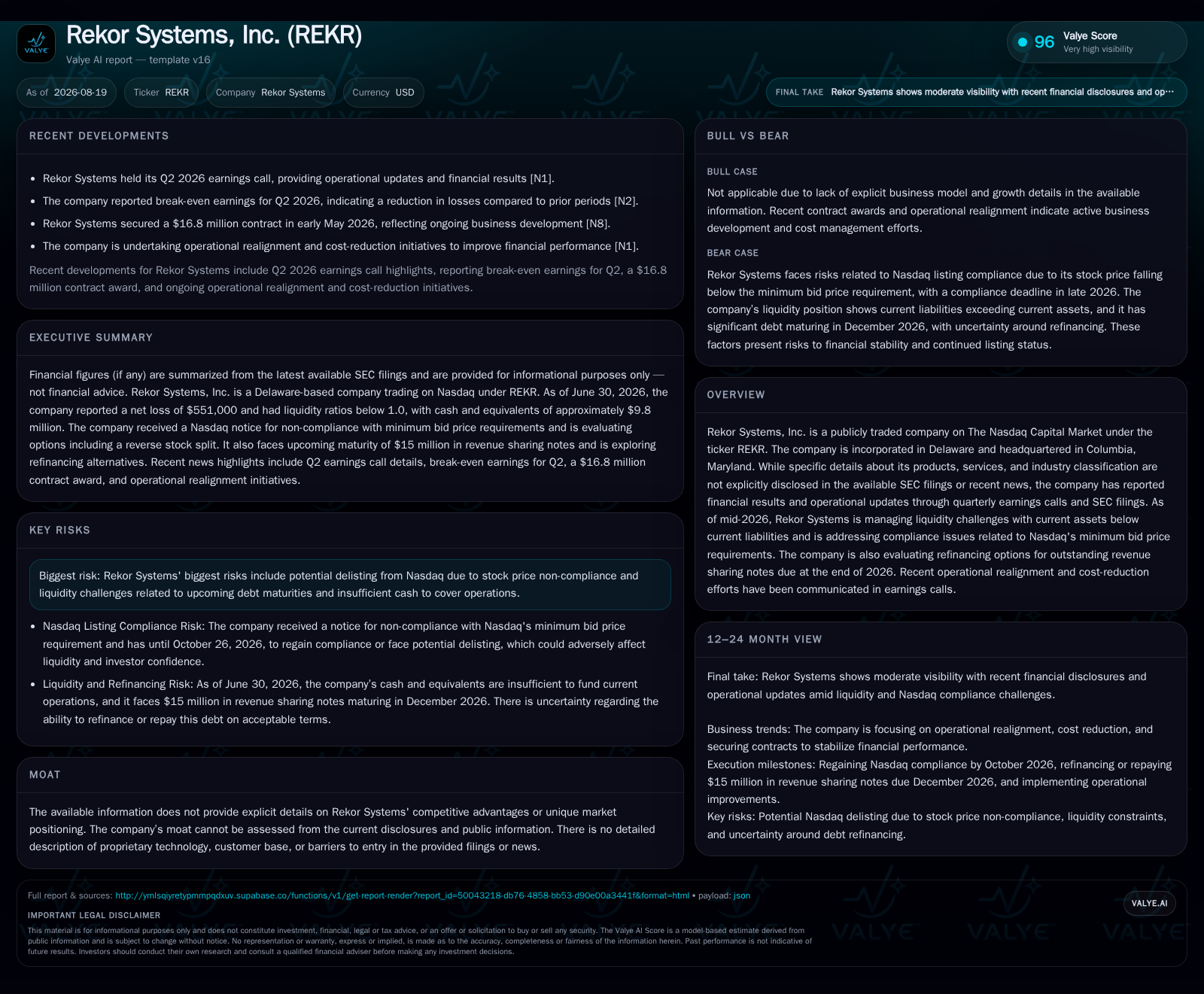
Rekor Systems is contending with a Nasdaq listing compliance warning due to low stock price and faces liquidity pressures from upcoming $15 million debt maturity. Recent contract awards and operational realignment offer pathways to stabilize cash flows, but the company must manage refinancing risks and prove sustainable profitability to avoid delisting and financial distress.
Rekor Systems, a Nasdaq-listed technology company headquartered in Maryland, is currently navigating a precarious juncture marked by liquidity constraints and compliance risks. Despite reporting break-even earnings in Q2 2026 and securing a sizable $16.8 million contract, the company faces a Nasdaq warning for its sub-$1 stock price and must address $15 million in debt maturing later this year. Operational realignment and cost-cutting initiatives aim to improve financial stability, but the success of these efforts hinges on effective refinancing and sustained revenue growth. This analysis examines Rekor’s business model dynamics, competitive positioning, and scenarios shaping its near-term trajectory.
Latest Operating Snapshot
Rekor Systems reported break-even earnings for Q2 2026, marking a reduction in net losses compared to prior quarters and suggesting some operational stabilization [N2]. However, the company’s liquidity position remains challenged, with cash and cash equivalents at approximately $9.8 million against current liabilities of about $29.7 million as of June 30, 2026, resulting in a current ratio of 0.78 [S1]. This indicates that Rekor does not have sufficient short-term assets to cover its immediate liabilities without additional financing or operational cash flow improvements.
Compounding liquidity concerns is a Nasdaq notice issued on April 27, 2026, warning Rekor of non-compliance with the minimum bid price rule of $1.00 per share. The company has until October 26, 2026, to regain compliance or face potential delisting, with management considering a reverse stock split as one possible remedy requiring shareholder approval [S1]. Additionally, $15 million of Series A Prime Revenue Sharing Notes mature in December 2026, and Rekor is actively exploring refinancing options to address this significant near-term debt obligation [S1]. Meanwhile, the company secured a $16.8 million contract in May 2026, which, if executed effectively, could bolster revenue and cash flow [N8].
Business Model and Unit Economics
Although Rekor Systems has not publicly detailed its product suite or industry verticals, its financial disclosures and contract activities imply a business model reliant on contract-based revenue streams likely linked to technology or services. Revenue generation presumably involves securing sizeable contracts (e.g., the $16.8 million award) that contribute to top-line volume, while pricing and mix dynamics remain opaque. The break-even Q2 result suggests that the company may be approaching fixed cost absorption thresholds, although its liquidity issues imply operating leverage is not yet robust.
The presence of $15 million in revenue sharing notes maturing within months points to capital-intensive or growth-phase funding needs, with variable costs likely significant but fixed costs and capital expenditures also critical factors. Operating leverage could emerge if the company scales contract volume without proportionate increases in fixed costs, but this depends on contract renewals, pricing power, and cost control. The current operational realignment and cost-reduction initiatives indicate management is actively seeking to improve margins by rationalizing fixed and variable cost structures, but sustaining this while investing for growth may prove challenging without refinancing.
Moat, Competition and Counterforces
Rekor Systems’ public disclosures do not clarify proprietary technology, customer stickiness, or distinctive competitive advantages, making assessment of its moat difficult. Without evidence of unique intellectual property, entrenched client relationships, or regulatory barriers, the company may face significant competitive pressures that limit pricing power and margin expansion. The absence of explicit industry classification complicates peer comparison, but the need for sizeable contract wins and refinancing suggests competition from better-capitalized or more established players.
Counterforces against building a durable moat include potential commoditization of its offerings, buyer power given contract-based procurement, and liquidity constraints limiting investment in innovation or sales efforts. Additionally, the Nasdaq compliance risk and uncertain refinancing could undermine investor confidence and the company’s ability to attract and retain customers. If competitors enjoy stronger balance sheets or more scalable platforms, Rekor’s position could be further pressured, emphasizing the importance of operational execution and financial discipline.
Bull Case
In a positive scenario, Rekor successfully refinances or repays its $15 million debt due in December 2026 on favorable terms, alleviating immediate liquidity pressures. Concurrently, the $16.8 million contract awarded in May 2026 converts into recognized revenue with healthy margins, providing a stable revenue base. Operational realignment and cost-reduction initiatives yield sustainable margin improvements, allowing the company to achieve consistent profitability beyond break-even quarterly results reported in Q2 2026 [N2].
This trajectory enables Rekor to regain Nasdaq compliance either through natural stock price appreciation driven by improved financial performance or via a managed reverse stock split that stabilizes market perception without eroding shareholder value. Confirming evidence would include announcements of successful refinancing, contract execution milestones, improving gross margins, and rising stock price above the $1 threshold. Conversely, failure to execute contracts or refinance debt, or persistent losses despite cost cuts, would falsify this optimistic scenario.
Base Case
The base case envisions Rekor navigating its near-term challenges with mixed success. The company manages to secure partial refinancing or extends debt maturities, avoiding immediate default but at potentially higher costs or dilutive terms. The $16.8 million contract contributes to revenue growth but may face delays or margin pressure due to competitive pricing or execution risks. Operational improvements reduce losses but do not yet produce significant profitability or strong cash flow.
Nasdaq compliance remains uncertain; the company might implement a reverse stock split to comply with listing rules, which stabilizes the stock price but does not fundamentally alter business risks. Financial metrics improve modestly, but liquidity ratios remain below ideal levels, requiring continued focus on cash management and business development. This scenario’s confirmation would be steady but unspectacular quarterly results, refinancing announcements with onerous terms, and regulatory filings documenting compliance efforts. Failure to comply with Nasdaq or refinance debt would invalidate this outcome.
Bear Case
The downside scenario involves Rekor failing to refinance the $15 million revenue sharing notes due December 2026, triggering liquidity crises that impair operations and necessitate asset sales, restructuring, or bankruptcy considerations. Concurrently, the $16.8 million contract could be delayed, downsized, or lost, removing a critical revenue cushion. Despite operational realignment efforts, fixed costs and cash burn remain high, driving further losses beyond the modest $551,000 quarterly net loss reported recently [S1].
Nasdaq delisting becomes imminent as the stock price stays below $1.00 without effective remedial actions, eroding investor confidence and limiting capital raising options. This scenario would manifest through missed refinancing deadlines, contract cancellations, sustained negative cash flow, and public warnings or notices from Nasdaq. Any meaningful improvement in these areas would falsify the bear case, while worsening liquidity and regulatory non-compliance confirm it.
What Matters Next
Key near-term performance indicators include progress on refinancing or repaying the $15 million revenue sharing notes, which directly influences liquidity and operational sustainability. Monitoring the execution status and revenue recognition from the $16.8 million contract awarded in May 2026 is vital for assessing revenue growth and cash flow prospects. The stock price trajectory relative to the $1.00 Nasdaq minimum bid price requirement and any implemented reverse stock split will determine the company’s listing status and investor sentiment.
Additional important metrics encompass quarterly earnings and cash flow results to gauge operational leverage and margin improvement, as well as updates on cost-reduction and realignment initiatives to evaluate their effectiveness. Disclosure of contract pipeline visibility or multi-year continued-adoption indicators would be useful to assess revenue stability, though these are not currently reported. Finally, management commentary in earnings calls or SEC filings about refinancing negotiations, capital expenditure plans, and strategic direction will provide critical insight into the company’s outlook.
Disclaimer: This is research-only, informational analysis and not investment advice. It may include AI-generated interpretation and general industry context. Always verify important details using primary sources.

Comments