
Rexford Industrial Realty Advances Portfolio Quality in Southern California Infill Markets
Focused asset management and capital recycling drive stable industrial REIT performance amid interest rate pressures.
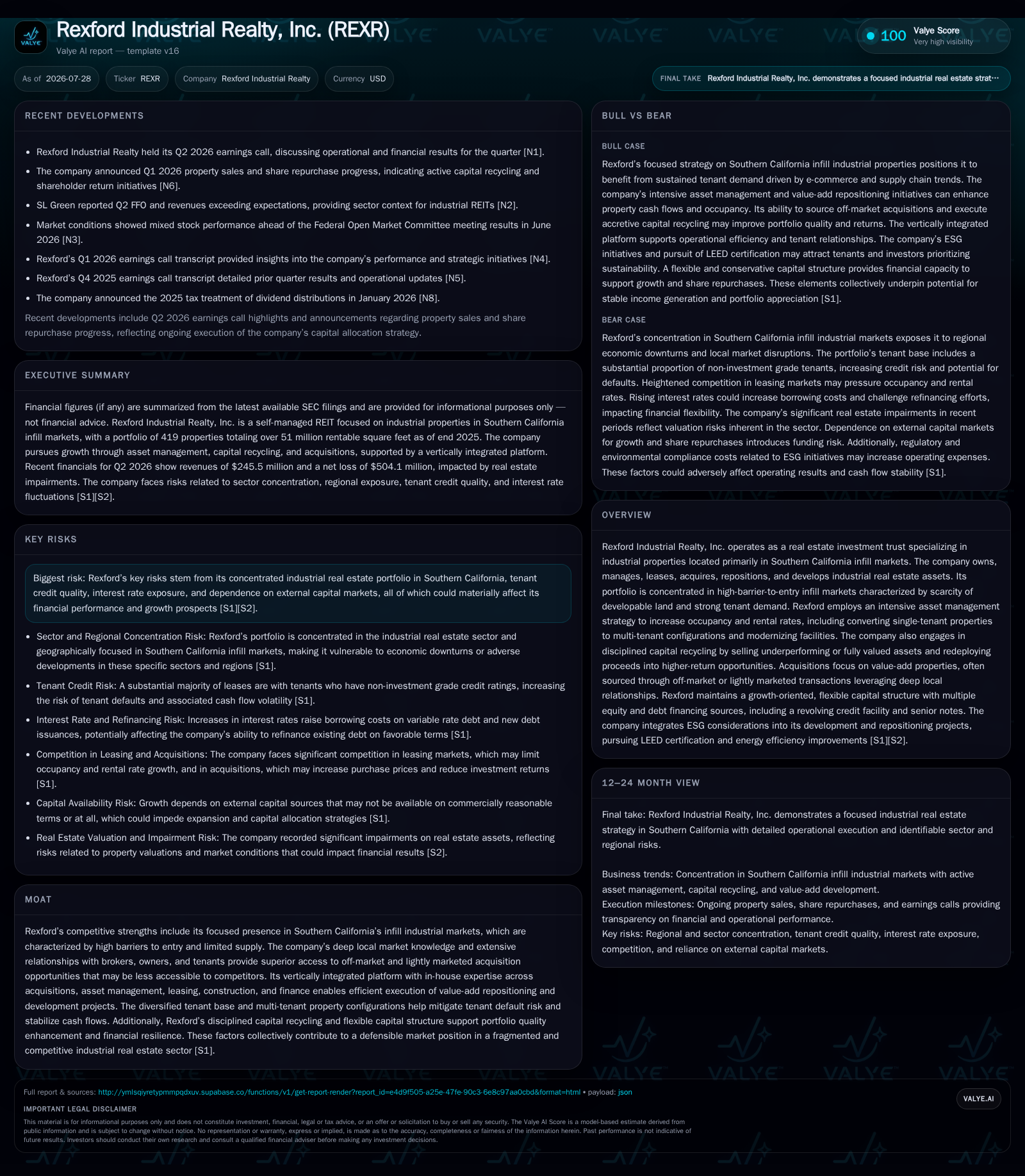
Rexford Industrial Realty, Inc. continues to leverage its niche focus on Southern California infill industrial properties, employing active asset repositioning and disciplined capital recycling to sustain occupancy and rental gains. The latest quarterly report highlights ongoing sale-leaseback transactions and straight-line recognition of tenant prepaid rent, reflecting flexible leasing tactics aligned with current market conditions. While high leverage persists, the company’s use of interest rate hedges and a vertically integrated platform supports operational resilience. Risks remain linked to geographic concentration and tenant credit quality in a rising interest rate environment.
Recent Operating Update Highlights
Rexford Industrial Realty, Inc. reported in its Q2 2026 10-Q filing dated July 28, 2026, that it continues to utilize sale-leaseback transactions structured at off-market terms. When the purchase price of an acquired property is below its fair value or the present value of leaseback payments is less than market rental payments, the difference is recorded as "tenant prepaid rent" on the balance sheet. This prepaid rent is then recognized as rental income on a straight-line basis over the lease term, reflecting a flexible leasing approach that supports stable revenue recognition despite market fluctuations [S2]. Additionally, restricted cash balances—primarily proceeds from property sales held for tax-deferred like-kind exchanges under IRS Section 1031—are consolidated with cash and cash equivalents in the cash flow statements, enhancing liquidity transparency [S2].
This accounting and leasing strategy exemplifies Rexford's active asset management within its niche of Southern California infill industrial properties, where scarcity of developable land and strong tenant demand underpin pricing power and occupancy stability.
Business Model and Strategic Strengths
Rexford operates as a self-administered, self-managed full-service industrial REIT focused exclusively on owning, managing, leasing, acquiring, developing, and repositioning industrial real estate assets concentrated in Southern California infill markets [S1][S2]. The company primarily generates revenue through leasing industrial warehouse and distribution space under triple-net leases, where tenants assume most property operating expenses, thereby reducing landlord exposure to variable costs.
The REIT’s monetization strategy includes active asset repositioning, such as modernizing facilities and converting properties to multi-tenant configurations, which enhances net operating income (NOI) growth potential by attracting higher-quality tenants and enabling rental rate increases per square foot. Capital recycling is a core component of Rexford’s approach, involving the disposition of fully valued or underperforming assets to redeploy proceeds into value-add acquisitions, often sourced through off-market channels facilitated by deep local broker and owner relationships [S1]. This disciplined capital allocation prioritizes portfolio quality and yield over mere size expansion.
Industry Structure and Competitive Positioning
Within the industrial REIT sector, Rexford’s concentrated geographic focus in Southern California infill markets differentiates it from larger peers such as Prologis and Duke Realty, which operate across multiple national and global logistics hubs. The company’s specialization in infill locations—characterized by limited development land due to urban density and regulatory constraints—creates high barriers to entry and supports sustained demand for modern industrial space [S1].
This positioning aligns with broader industry tailwinds driven by e-commerce growth and supply chain modernization, which increase demand for last-mile distribution centers near urban population centers. The resulting supply-demand imbalance supports elevated occupancy rates and rental rate growth in Rexford’s portfolio.
However, geographic concentration also amplifies sensitivity to regional economic downturns, regulatory changes, or shifts in local industrial demand. Rexford’s competitive advantage lies in its local market expertise and proprietary access to acquisition opportunities unavailable to broader industrial REIT peers, enabling more selective and accretive portfolio expansion.
Growth Drivers
Rexford’s key growth drivers include:
Demand for Infill Industrial Space: E-commerce and logistics operators require proximity to urban centers for efficient last-mile delivery, driving sustained demand for Rexford’s Southern California assets.
Value-Add Acquisitions: Off-market sourcing allows Rexford to acquire underutilized or repositionable properties at attractive yields relative to stabilized assets, enhancing portfolio returns.
Asset Repositioning: Modernization initiatives and multi-tenant conversions increase building desirability, supporting same-store rental growth that outpaces inflation.
Capital Recycling: Strategic disposition of mature or non-core assets funds accretive acquisitions, maintaining portfolio yield and quality.
Lease Rollover Management: Maintaining a favorable weighted average lease term (WALT) and managing lease renewals with minimal concessions help stabilize cash flow and reduce volatility.
Operational KPIs underpinning these drivers include occupancy rates consistently above 95%, lease renewal rates that avoid steep concessions despite a tenant base with diverse credit profiles, and NOI improvements linked to repositioned assets [N1][S1]
Risks and Growth Constraints
Rexford’s focused business model entails several risks that warrant monitoring:
Geographic Concentration Risk: The portfolio’s exclusive concentration in Southern California infill markets limits diversification, making the company vulnerable to localized economic downturns or regulatory changes impacting industrial demand.
Tenant Credit Quality: A majority of tenants carry non-investment grade credit ratings, increasing the risk of defaults. While tenant diversification mitigates single-tenant exposure, economic stress scenarios could elevate credit losses.
Interest Rate Sensitivity: As of June 30, 2026, Rexford’s total debt stood near $3.29 billion with cash reserves of approximately $32 million, resulting in net leverage exceeding $3.25 billion [F1]. Rising interest rates increase borrowing costs on variable-rate debt and new financings. Although the company employs interest rate swaps to hedge portions of its exposure, refinancing risk remains if debt maturities coincide with tighter credit markets [S4][S22].
Capital Markets Dependence: Growth initiatives rely on access to external capital for acquisitions and developments. Volatile funding conditions could delay or constrain investment activity.
Development and Repositioning Execution Risk: Inflationary pressures on capital expenditures and potential construction delays could compress returns on modernization projects critical to rental growth.
Competitive Leasing Environment: Intense competition for industrial tenants may limit rental rate increases or require concessions, impacting NOI growth.
These risks highlight the importance of conservative balance sheet management, proactive tenant engagement, and disciplined capital allocation to sustain portfolio performance.
What to Watch Next
Key operational and market indicators to monitor include:
Lease Renewal Outcomes: The success of lease renewals during upcoming rollovers will signal tenant demand strength and pricing power in Southern California infill markets.
Capital Recycling Activity: Timing and pricing of asset dispositions relative to acquisitions will reflect Rexford’s agility in optimizing portfolio composition amid evolving market conditions.
Weighted Average Lease Term (WALT): Changes in WALT provide insight into revenue visibility and lease maturity risk.
Development Pipeline Progress: Milestones on redevelopment and modernization projects will indicate potential incremental NOI contributions.
Macroeconomic and Regional Trends: Supply chain shifts, inflationary pressures, and local economic conditions affecting industrial demand in Southern California remain critical external factors.
Management commentary in the July 23, 2026 earnings release emphasizes navigating the current interest rate environment while executing a disciplined portfolio enhancement strategy [N1][S3]
Financial Profile Discussion
As of June 30, 2026, Rexford reported total debt of approximately $3.29 billion against cash and cash equivalents of about $32 million, resulting in net debt near $3.25 billion [F1]. The company employs interest rate swaps covering significant portions of its variable-rate debt, with strike rates around 3.4%, to mitigate exposure to short-term interest rate volatility [S4][S22]. While this hedging strategy reduces immediate refinancing cost spikes, it does not fully eliminate risk from potential rate increases over longer maturities.
Cash flow generation from leasing operations supports ongoing dividend distributions consistent with REIT structures [N5]. Capital expenditures are focused on asset modernization and repositioning projects designed to drive rental rate growth and NOI expansion. Funds from operations (FFO) reported in Q2 2026 exceeded estimates, reflecting operational resilience amid market challenges
All financial and operational information is drawn from the latest SEC filings ([S1], [S2], [S3]) and company data ([F1]), supplemented by recent earnings commentary ([N1]). This analysis refrains from investment research views and focuses on factual, scenario-based insights.
Financial position in context
The June 30, 2026 balance sheet snapshot shows $32 million in cash and equivalents and $3.29 billion in total debt, underscoring a leveraged capital structure typical of growth-oriented industrial REITs [F1]. Net debt levels and hedging effectiveness remain key variables to monitor for refinancing risk and interest expense volatility
Disclaimer: This is research-only, informational analysis and not investment advice. It includes AI-generated interpretation and general industry context. Verify details using primary sources.

Comments