
Herc Holdings Scales Fleet with H&E Acquisition Amid Cyclical Market Pressures
Herc Holdings reports Q2 2026 results reflecting integration progress of H&E Equipment Services while managing cyclical demand and supply chain challenges.
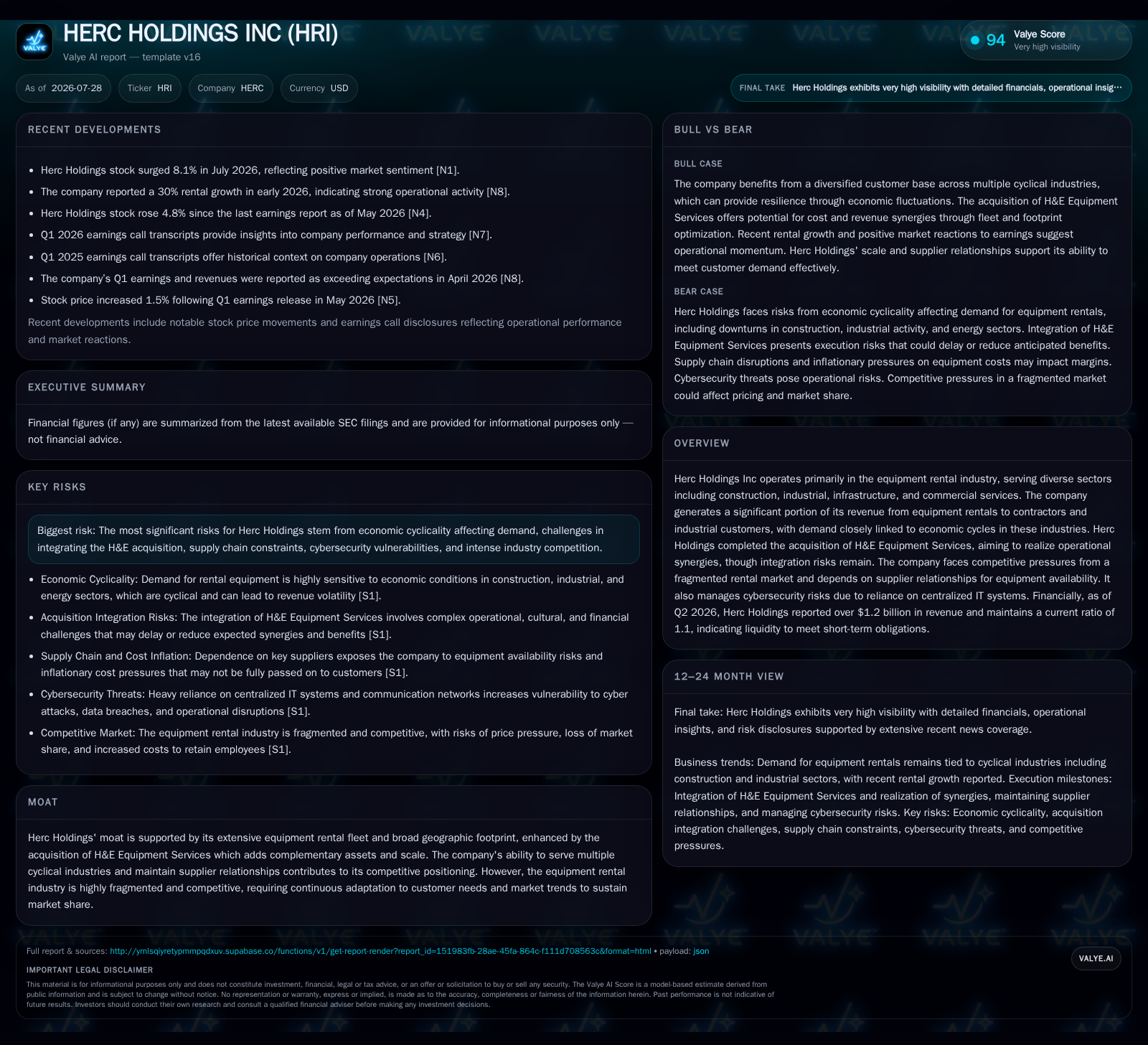
In its latest quarterly filing, Herc Holdings Inc highlights continued efforts to integrate the H&E Equipment Services acquisition, seeking operational synergies that are crucial amid a cyclical industry environment. The company’s revenue exceeded $4.3 billion as of year-end 2025, with liquidity supported by a current ratio of 1.1 as of mid-2026. Herc operates in a fragmented equipment rental market characterized by intense price competition and supply chain constraints, which it navigates using scale from the recent acquisition and supplier relationships. Key risks include economic cyclicality affecting end-market demand, integration execution, and debt servicing costs due to floating interest rates.
Recent Operating Update
Herc Holdings' July 28, 2026 10-Q filing underscores ongoing focus on integrating its major acquisition of H&E Equipment Services completed in mid-2025 [S2]. This acquisition expanded Herc's rental fleet scale and geographic reach, allowing access to complementary assets in key regional markets [S29]. However, the filing cautions that realizing full operational synergies remains complex and may take longer than initially expected while integration-related costs could be material [S29]. Such transitional risks are typical in large capital-intensive acquisitions, where systems consolidation and branch network optimization often cause short-term disruption before long-term benefit.
From a financial perspective, as of June 30, 2026, current assets stood at $960 million against current liabilities of $871 million, yielding a current ratio of approximately 1.1 [F1], a liquidity measure suggesting Herc maintains just enough short-term asset coverage to meet obligations but without abundant cushion. Cash and equivalents were $43 million at quarter-end [F1]. The company's fleet investment remains capital intensive; sustaining an extensive rental fleet necessitates continuous capital expenditures (CapEx) for renewal during maintenance cost pressures.
Business Model Analysis
Herc Holdings operates primarily as an equipment rental intermediary serving contractors in residential and commercial construction, general industrial sectors including refineries and petrochemical operations, infrastructure projects, and various commercial customers such as retail services and entertainment production [N3][S1]. Revenue is predominantly generated by renting out a diverse fleet comprising heavy machinery, aerial lifts, earthmoving equipment, generators, and more. Customers pay rental fees typically calibrated on duration (daily or hourly), equipment type, and utilization intensity.
The model relies heavily on equipment utilization rates—percentage of fleet actively rented—as well as rental revenue per day metrics to optimize revenue generation against fixed costs like depreciation and financing expenses. A critical operating challenge lies in balancing fleet size (fleet turnover) with demand variability driven by economic cycles affecting end markets. Maintenance and repair costs also materially impact gross margins; aging fleets or delays in CapEx renewal elevate upkeep expenses.
Additionally, Herc derives incremental revenue through equipment sales (off-lease units), maintenance services offered to customers, and logistical support facilitating on-time delivery. Customer segmentation encompasses broad contractor categories but is weighted toward non-residential construction and industrial clients whose capital investment levels dictate rental appetite.
Industry Structure and Competitive Position
The equipment rental services industry is highly fragmented with numerous national players like United Rentals (industry benchmark) and Sunbelt Rentals alongside many regional operators. Price competition remains intense; market transparency enabled by digital platforms allows cost-conscious customers to swiftly compare rates across suppliers. Competitors with larger fleets or better capital access can exert downward pricing pressure.
Herc’s competitive moat is anchored by its extensive fleet scale boosted via H&E acquisition resulting in greater geographic coverage density [S29]. This enhances fleet availability—a critical customer buying consideration given project time sensitivity. Supplier relationships underpin procurement efficacy since Herc depends on original equipment manufacturers for new units; any supplier disruptions or allocation decisions can constrain fleet growth.
Beyond scale advantages, Herc competes by tailoring localized equipment assortments aligned with customer needs, trying to reduce downtime risk through effective maintenance scheduling. Success hinges on recruiting key sales talent versed in diverse market demands to uphold customer retention rates amidst volatile conditions.
Growth Drivers
Growth prospects stem from multiple structural trends: increasing infrastructure spending fueled by government initiatives boosts contractor capital demands; a shift from equipment ownership toward rental reduces upfront customer CapEx commitments enhancing fleet utilization; expansion into previously underpenetrated regional markets via acquisitions improves market share; moreover, technological investments aimed at improving fleet management efficiency aid in driving higher utilization rates [S29]
The entry of the H&E Equipment Services business further unlocks cross-selling opportunities where combined branch networks can offer customers more extensive fleets closer to project sites—which reduces transport bottlenecks—while anticipated operational cost synergies are expected to improve profitability over time [S29]. Industry recovery from pandemic-related shutdowns also underpins rising industrial activity levels positively influencing rental volumes.
Risks and Watchpoints
Economic cyclicality is paramount: downturns in construction or industrial activity directly reduce equipment rental demand volumes while intensifying competitive pricing pressures — an effect compounded if oil & gas prices stay depressed potentially curbing upstream capital projects [S1]. Supply chain constraints impacting timely receipt of new equipment create capacity mismatches risking unmet demand or forcing reliance on older high-maintenance assets worsening margins [S18].
Integration risks remain material: the melding of IT systems, branch operations, workforce cultures along with aligning internal controls introduces complexity; failure to achieve targeted cost savings or revenue synergies within forecast timelines could weigh on near-term earnings [S29]
Further strain arises from Herc's significant indebtedness—a legacy amplified by recent large-scale acquisitions—with floating-rate debt exposing it to interest rate increases which could escalate debt servicing costs squeezing free cash flow available for reinvestment [S5][F1]. Any limitation on refinancing flexibility may curtail strategic agility.
Cybersecurity is another critical watchpoint due to reliance on centralized IT infrastructure for booking systems and inventory management—any breach potentially disrupts operations or damages customer trust though no specific incidents have been disclosed [S1]. Lastly, evolving government regulations pertaining to equipment standards or environmental compliance could add operational costs or constrain certain usage patterns.
What To Watch Next
Market participants should monitor several milestones signaling Herc’s trajectory: quarterly updates offering insight into synergy realization progress post-H&E acquisition relative to original integration plans; trends in rental utilization rates which reveal underlying demand strength; CapEx spend pacing indicative of fleet renewal aggressiveness; developments on debt refinancing or amendments reflecting financing flexibility; as well as margin trends revealing capacity to absorb maintenance inflation amid competitive price dynamics.
Given the industry's cyclical nature, indicators such as construction starts data or industrial capital investment statistics serve as external proxies for potential top-line growth. Any notable shifts in supply chain normalization would ease capacity constraints providing margin relief opportunities.
Financial Profile Discussion
As of June 30, 2026, Herc’s financial snapshot reveals $960 million in current assets versus $871 million current liabilities yielding a current ratio around 1.1—a modest liquidity posture consistent with an asset-heavy operation requiring careful working capital management [F1]. Cash reserves were $43 million indicating limited buffer against unforeseen short-term shocks.
Total debt remains elevated (last confirmed approximately $2.94 billion as of December 31, 2022), underscoring ongoing leverage risk given operating cash flow dependence for interest coverage [F1]. Interest expense sensitivity stemming from floating rate components warrants attention especially if interest rates climb further given prevailing macroeconomic tightening.
Capital expenditure needs remain substantial due to constant investment requisite for fleet modernization which directly influences operating efficiency through reduced maintenance costs and higher utilization potential. Free cash flow generation capacity will be pivotal in balancing growth aspirations against debt obligations without resorting excessively to dilution or onerous credit terms.
Overall liquidity metrics suggest adequate near-term resilience although tighter economic conditions would stress this balance especially if integration disruptions delay cash flow improvements.
This analysis integrates the latest quarterly disclosures anchoring the operational narrative within the broader context of industry dynamics characterized by fragmentation, economic cyclicality, supply chain volatility, and competitive pricing pressures typical for large national equipment rental companies like Herc Holdings Inc.[S2][S1][F1]. Continuing execution on integration synergies from its recent acquisition alongside prudent financial stewardship remains essential for sustaining its competitive position amid complex market headwinds.
This report does not offer investment advice but aims to provide an informed analytical overview based on currently available SEC filings and industry frameworks.
Financial position in context
As of 2026-06-30, companyfacts shows $43mm in cash and equivalents [F1]. Current assets of $960mm and current liabilities of $871mm imply a current ratio near 1.1x for 2026-06-30 [F1].
Disclaimer: This is research-only, informational analysis and not investment advice. It may include AI-generated interpretation and general industry context. Always verify important details using primary sources.

Comments