
Navitas Semiconductor Advances in GaN Power Chips Amid Litigation Risks
Q2 2026 results show revenue strength in GaN power semiconductors for AI infrastructure despite mounting intellectual property litigation challenges.
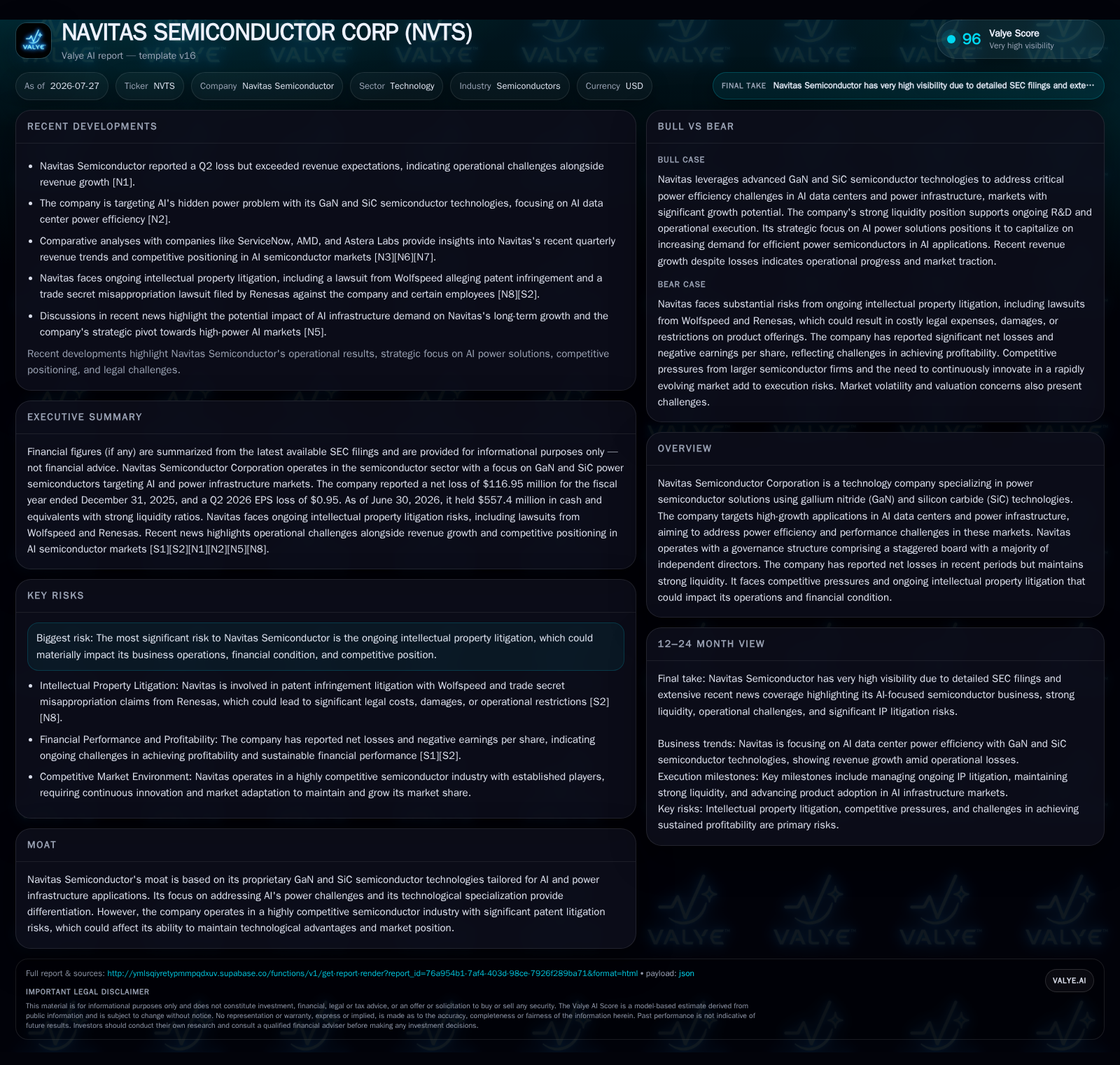
Navitas Semiconductor reported a Q2 revenue beat driven by growing demand for its gallium nitride (GaN) power semiconductor chips targeting AI data centers and power infrastructure OEMs, validating its fabless design model focused on high-performance power efficiency. However, ongoing patent litigation initiated by Wolfspeed and trade-secret claims from Renesas pose significant operational and financial risks, reflecting the patent-intense semiconductor industry environment. The company’s robust liquidity and zero debt position provide a foundation to sustain R&D investments amid continued net losses, while upcoming design wins and licensing milestones will be critical to monitor for growth validation.
Q2 2026 Revenue Execution Highlights Amid Litigation Challenges
Navitas Semiconductor Corporation reported second-quarter 2026 revenue that exceeded analyst expectations, driven primarily by strong sales of gallium nitride (GaN) power semiconductor chips tailored for the AI data center segment, a market characterized by escalating power efficiency demands due to intensive computational workloads [S2][N1]. This revenue strength reflects successful penetration into a niche where power conversion efficiency is critical for managing the thermal and energy constraints of AI server infrastructure. Key operating metrics such as design wins and unit shipments, while not explicitly disclosed in detail, underpin this growth narrative and indicate increasing customer adoption within AI infrastructure OEMs [S1][N6]. However, this positive momentum is counterbalanced by significant intellectual property (IP) litigation risks that could materially impact Navitas’s operational and financial outlook.
Fabless Business Model Leveraging Advanced GaN and SiC Chip Design
Navitas operates as a fabless semiconductor company, focusing on proprietary chip design while outsourcing wafer fabrication and assembly/testing to third-party foundries [S1]. This model reduces capital expenditure intensity compared to integrated device manufacturers (IDMs) and allows the company to concentrate resources on rapid innovation cycles in GaN and silicon carbide (SiC) power semiconductor technologies. These wide-bandgap materials enable higher switching frequencies and improved power efficiency, attributes highly valued in AI data centers and power infrastructure applications [S1][N6].
Revenue generation primarily derives from direct sales of GaN power chips to OEM customers who integrate these components into AI servers and power systems, as well as from technology licensing agreements that monetize Navitas’s IP portfolio [S1]. Critical operating variables include the number of design wins secured, average selling price (ASP) per unit, and manufacturing yield rates achieved through foundry partnerships. The high switching costs associated with integrating power semiconductors into complex systems underscore the importance of design wins as a durable revenue driver. Navitas’s ability to maintain premium ASPs is linked to the differentiated power efficiency and thermal performance of its GaN-based solutions, which address the growing energy demands of AI workloads [N6][N7].
Competitive Landscape and Intellectual Property Risks in a Patent-Intensive Market
The power semiconductor sector is highly competitive and patent-intensive, with companies vigorously defending their IP portfolios. Navitas faces a notable patent infringement lawsuit filed by Wolfspeed, a competitor specializing in SiC and GaN technologies, alleging infringement of multiple patents related to GaN and SiC power devices incorporated in Navitas’s product lineup [S4][S10][N9]. This litigation poses risks including potential injunctions that could restrict sales, costly licensing fees, or the need for redesigning affected products, which could delay time-to-market and increase R&D expenses.
Additionally, Navitas is embroiled in a trade secret misappropriation lawsuit initiated by Renesas, implicating former employees including Navitas’s CEO [S16]. This legal dispute adds operational and reputational risks, potentially diverting management attention and increasing legal costs. The combined impact of these IP disputes could compress gross margins and impair competitive positioning if Navitas is forced to alter its technology roadmap or pay substantial damages.
Growth Drivers: AI Data Center Power Efficiency and Expanding Electrification
Navitas’s growth is anchored in secular trends driving demand for high-performance power semiconductors. The rapid expansion of AI workloads globally necessitates power solutions that can handle elevated voltages and currents with minimal thermal losses, directly benefiting GaN and SiC technologies [S1][N7][N10]. The adoption of 800V power systems in AI infrastructure exemplifies this, enabling data center operators to scale compute capacity while reducing energy consumption and cooling costs.
Beyond AI, Navitas targets power infrastructure markets including electric vehicle (EV) charging stations and renewable energy systems, where GaN and SiC semiconductors offer superior efficiency and durability under harsh operating conditions. These end markets provide additional design win opportunities and support premium pricing due to the performance advantages of wide-bandgap semiconductors. The company’s focused R&D efforts aim to accelerate time-to-market for new products, a critical factor given the rapid pace of technological innovation and competitive pressures in the sector.
Risks and Constraints: Litigation, Technology Development, and Customer Concentration
Despite favorable market dynamics, Navitas faces several constraints. The ongoing patent litigation with Wolfspeed could lead to injunctions or costly licensing agreements that disrupt product sales and delay revenue recognition [S4][S10]. The technical complexity and expense of redesigning semiconductor products to circumvent patented technologies could extend development cycles and increase capital requirements.
Technology risk is inherent given the evolving nature of GaN and SiC semiconductor research; failure to maintain technological leadership could erode market share against competitors with larger R&D budgets and more extensive IP portfolios, such as Wolfspeed and Infineon Technologies. Customer concentration risk also exists, as Navitas relies on a limited number of OEM design wins in specialized AI and power infrastructure markets, heightening vulnerability to shifts in customer demand or procurement strategies.
Near-Term Catalysts: Design Wins, Licensing Agreements, and Litigation Outcomes
Key upcoming catalysts to monitor include announcements of new design wins in AI and power infrastructure segments, which serve as leading indicators of future revenue growth and market acceptance [S3][N6]. Progress in licensing negotiations or settlements related to the Wolfspeed and Renesas litigations will materially influence Navitas’s margin profile and cash flow generation potential.
Judicial rulings or settlements resolving these disputes will be pivotal. A favorable outcome or commercially reasonable licensing agreements could mitigate uncertainty and enable uninterrupted product commercialization. Conversely, adverse judgments may necessitate strategic adjustments, including potential product portfolio realignment or increased R&D investment to develop non-infringing technologies.
Financial Position Supports Continued R&D Investment Amid Operating Losses
As of June 30, 2026, Navitas held approximately $557 million in cash and cash equivalents, with current assets totaling $602 million against current liabilities of $27.6 million, yielding a robust current ratio of approximately 21.79x that underscores strong short-term liquidity [F1]. The company carries no debt, providing financial flexibility to sustain its capital-intensive R&D programs essential for maintaining competitive differentiation in GaN and SiC technologies [F1][S2].
Despite this liquidity strength, Navitas continues to operate at a net loss, reflecting the heavy upfront investment in technology development and scale-up typical of fabless semiconductor firms at this growth stage. Operating income remains negative, driven primarily by R&D expenses aimed at accelerating product innovation and expanding design win pipelines [F1]. Maintaining this liquidity cushion will be critical to absorb potential legal costs and support capacity expansion aligned with increasing AI infrastructure demand.
Disclaimer: This analysis is based on publicly available SEC filings and industry context for informational purposes only and does not constitute investment advice or research views.
Financial Snapshot as of June 30, 2026
- Cash and equivalents: $557 million [F1]
- Current assets: $602 million [F1]
- Current liabilities: $27.6 million [F1]
- Current ratio: ~21.79x [F1]
- Total debt: $0 [F1]
This strong liquidity position supports Navitas’s ongoing investment in R&D and capacity expansion despite continued net losses, reflecting the capital-intensive nature of semiconductor innovation and market development.
Disclaimer: This is research-only, informational analysis and not investment advice. Verify details using primary sources.

Comments