
Cincinnati Financial Strengthens Underwriting and Investment Performance in Q2 2026
Q2 results reveal robust net income supported by disciplined underwriting and stable investment income amid competitive market dynamics.
Cincinnati Financial Corporation reported solid second-quarter 2026 earnings driven by strong underwriting discipline and effective catastrophe risk management, despite industry-wide pricing pressures. The company's established relationships with independent agents support stable premium flows, while its sizable cash reserves and prudent capital management underpin financial resilience. Key risks remain from regulatory changes and evolving claims environments, but the firm's consistent dividend record and conservative reserving reflect prudent stewardship. Monitoring combined ratio trends and catastrophe losses will be critical to assessing near-term profitability.
Recent Operating Update: Q2 2026 Highlights
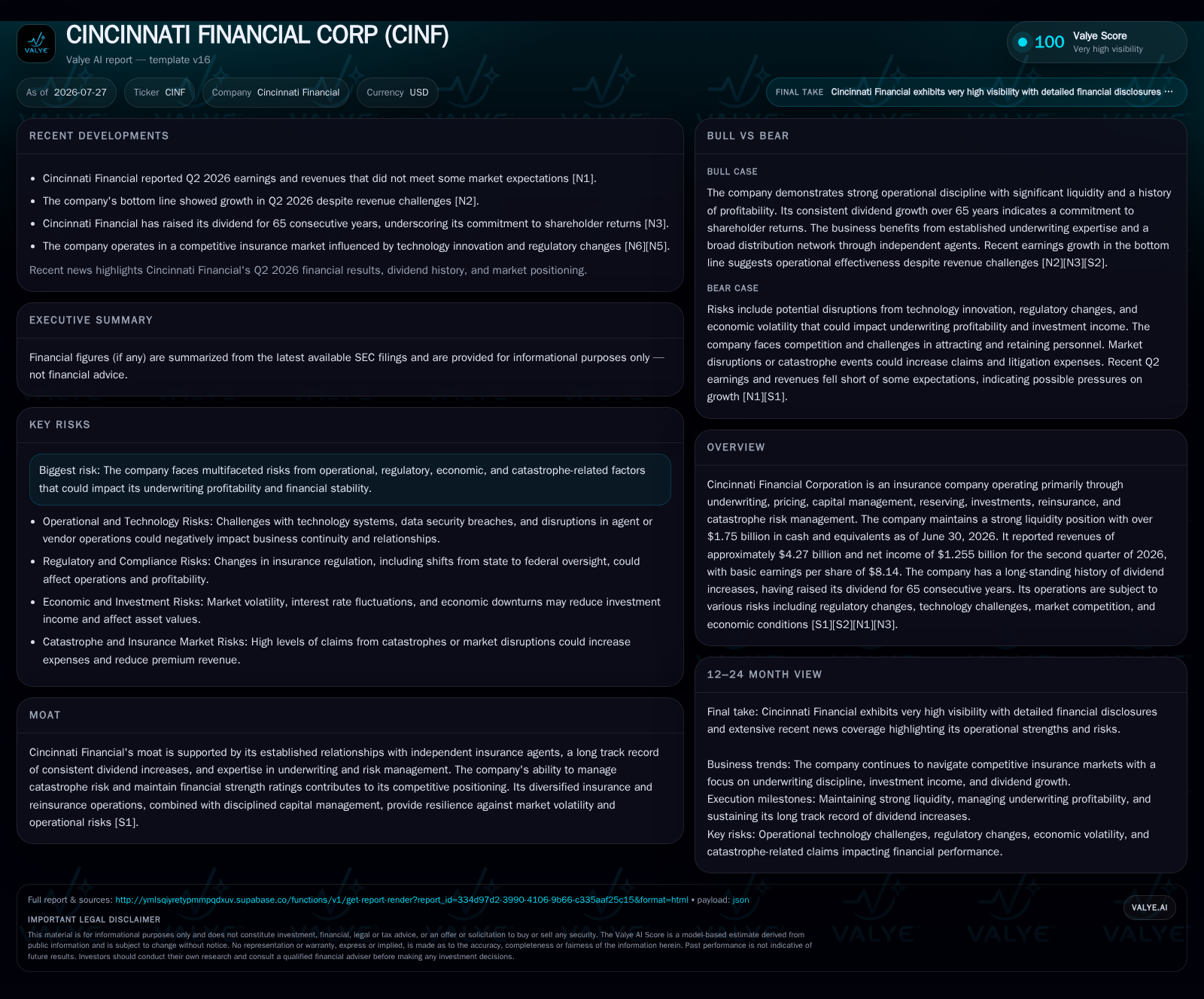
Cincinnati Financial Corporation reported robust operating results for the second quarter of 2026, with net income of approximately $1.255 billion and basic earnings per share of $8.14 [S2][S3]. This performance reflects disciplined underwriting combined with stable investment income contributions amid a competitive pricing environment.
This quarterly update aligns with Cincinnati's longer-term strategy emphasizing prudent underwriting, conservative reserving practices, catastrophe risk management through reinsurance strategies, and effective float investing — pillars critical to navigating property & casualty insurance market volatility [S1][N1]. The firm continues to operate primarily through established independent insurance agents who serve as essential intermediaries driving new premiums and renewals.
Business Model: Underwriting Discipline Meets Capital Management
Cincinnati Financial operates within the U.S. property and casualty insurance industry as a diversified insurer offering coverage across personal lines (e.g., homeowners, auto), commercial property and casualty lines, and selected specialty products [S1]. Revenue is predominantly earned from net premiums after ceded reinsurance costs; these premiums are priced based on actuarial assessments of risk exposure, historical loss experience, market conditions, and competitive dynamics.
The company's underwriting function directly impacts profitability via loss ratios (claims cost relative to earned premiums) and expense ratios (operating costs related to premium generation). Combined ratio — the sum of loss plus expense ratios — serves as a primary KPI indicating underwriting profitability when under 100%. Cincinnati emphasizes maintaining combined ratio discipline through selective pricing increases combined with focused claims management efforts.
Investment activities constitute another key revenue component—investment income derives from the "float," which is the pool of premiums held before claims are paid out [S1]. Effective asset allocation targeting fixed-income securities balances yield capture against credit risk in an environment marked by interest-rate fluctuations. As such, Cincinnati’s investment strategy contributes earnings stability that complements the more variable underwriting results
Capital management further supports this model by providing reinsurance to mitigate exposure to catastrophic losses (e.g., hurricanes, severe weather events) which can cause significant volatility in claim payouts. Maintaining strong risk-based capital ratios positions Cincinnati to absorb adverse developments without compromising policyholder stability or regulatory compliance.
Industry Context and Competitive Position
Property & casualty insurance is characterized by cyclical underwriting profit cycles influenced by catastrophe frequency/severity, social inflation impacting claim severity, regulatory regimes affecting pricing freedom, and investment market conditions shaping float returns. Key peers serving as general benchmarks include Travelers Companies Inc., Chubb Limited, and Progressive Corporation — each known for varying mixes of personal versus commercial lines focus with mature agent/broker networks supporting distribution.
Compared to peers, Cincinnati Financial differentiates itself through long-standing strong relationships with independent agents enabling tailored risk assessments at localized levels—critical for maintaining policy retention amidst competitive pressures. Additionally, the firm’s track record for consistent dividend increases aligns with a financial strength perception that bolsters agent loyalty and customer trust.
Continued execution of disciplined underwriting has historically resulted in favorable combined ratios relative to some peers who have struggled with adverse reserve development or aggressive pricing discounting. However, all face common headwinds including amplified social inflation effects raising claims costs beyond historical patterns; this demands ongoing vigilance in reserve adequacy monitoring.
Growth Drivers
Structural demand growth benefits from underlying economic expansion driving accumulation of insurable assets along with heightened regulatory emphasis on risk mitigation encouraging broader insurance penetration. Additionally, increasing asset values elevate renewal premium bases over time.
Product innovation aimed at niche coverage extensions or modular policy designs tailored through improved data analytics empowers competitive differentiation at agent distribution points. Enhanced underwriting technology adoption also facilitates better segmentation allowing more precise price setting aligned with evolving risk profiles.
Pricing momentum remains important; Cincinnati has leveraged favorable rate increases in recent periods to offset inflationary expense trends while avoiding aggressive volume growth pursuit that could jeopardize margin integrity [N1]. Commercial lines expansion notably offers incremental scale leveraging existing agency partnerships.
Investment income growth potential is linked primarily to managing duration exposures prudently amid rising interest rates that can boost yields but heighten mark-to-market volatility—strategic asset mix adjustments will be pivotal here going forward.
Risks and Growth Constraints
Key risks include adverse reserve development if incurred claims exceed prior estimates due to unforeseen factors like changing legal liability frameworks or emergent risk patterns such as cyber exposures. Catastrophe losses remain uncertain despite reinsurance protections; unexpectedly severe natural or man-made events can quickly erode quarterly earnings stability.
Market competition might constrain pricing power especially if major carriers intensify discounting or seek rapid premium growth foregoing underwriting discipline temporarily. Regulatory interventions restricting rate-setting freedoms or imposing stricter capital requirements could adversely impact operating flexibility.
Social inflation elevates claims severity through factors including increased litigation frequency or heightened jury awards; this trend challenges reserving adequacy assumptions requiring cautious ongoing evaluation [S16][S21]. Technology disruptions also pose operational risks affecting customer service platforms or internal controls if not proactively managed.
Economic downturns could dampen business volumes resulting from reduced insurance buying or policy cancellations; however, Cincinnati’s emphasis on diversified product mix mitigates concentration risks somewhat.
What to Watch Next
Stakeholders should closely monitor upcoming quarterly disclosures for indications of sustained combined ratio improvement particularly regarding loss ratio trends tied to catastrophe impact reporting. Reserve development updates will be critical signals about whether prior loss estimates require adjustment given evolving claims experience.
Pricing actions announced in future rate filings alongside commentary around agent retention metrics offer insights into revenue traction under current market conditions. Investment yield progression amid fluctuating interest rates is another lever influencing earnings volatility needing close observation.
Dividend policy changes remain a barometer of confidence in cash flow sustainability given the firm's legacy of uninterrupted increases stretching back 65 years [N4][S1]. Lastly, any regulatory developments impacting underwriting guidelines or capital frameworks could materially reshape operational levers going forward.
Financial Profile Discussion
As of June 30, 2026, Cincinnati Financial held $1.75 billion in cash and equivalents against $859 million in total debt liabilities, resulting in a net cash position of approximately $891 million—reflecting a conservative leverage posture supportive of absorbing claims shocks or funding strategic initiatives [F1]. This liquidity buffer underpins financial strength ratings indispensable for agent network confidence ensuring continued access to reinsurance markets on favorable terms [S1].
Capital allocation appears aligned with sustaining underwriting capacity while cautiously pursuing expansion opportunities principally via organic agent-driven premium increases rather than larger-scale acquisitions that might introduce integration risks or destabilize loss experience tightness currently maintained [S1]
© 2026 Valye News. This report is for informational purposes only; it does not constitute investment advice or research views.
Disclaimer: This is research-only, informational analysis and not investment advice. It may include AI-generated interpretation and general industry context. Always verify important details using primary sources.

Comments